XI. Electoral Diagnostics: Reading the Vital Signs
The mongoose doesn’t just pick a team. The mongoose watches what the instruments say. Right now they all point toward serious trouble.

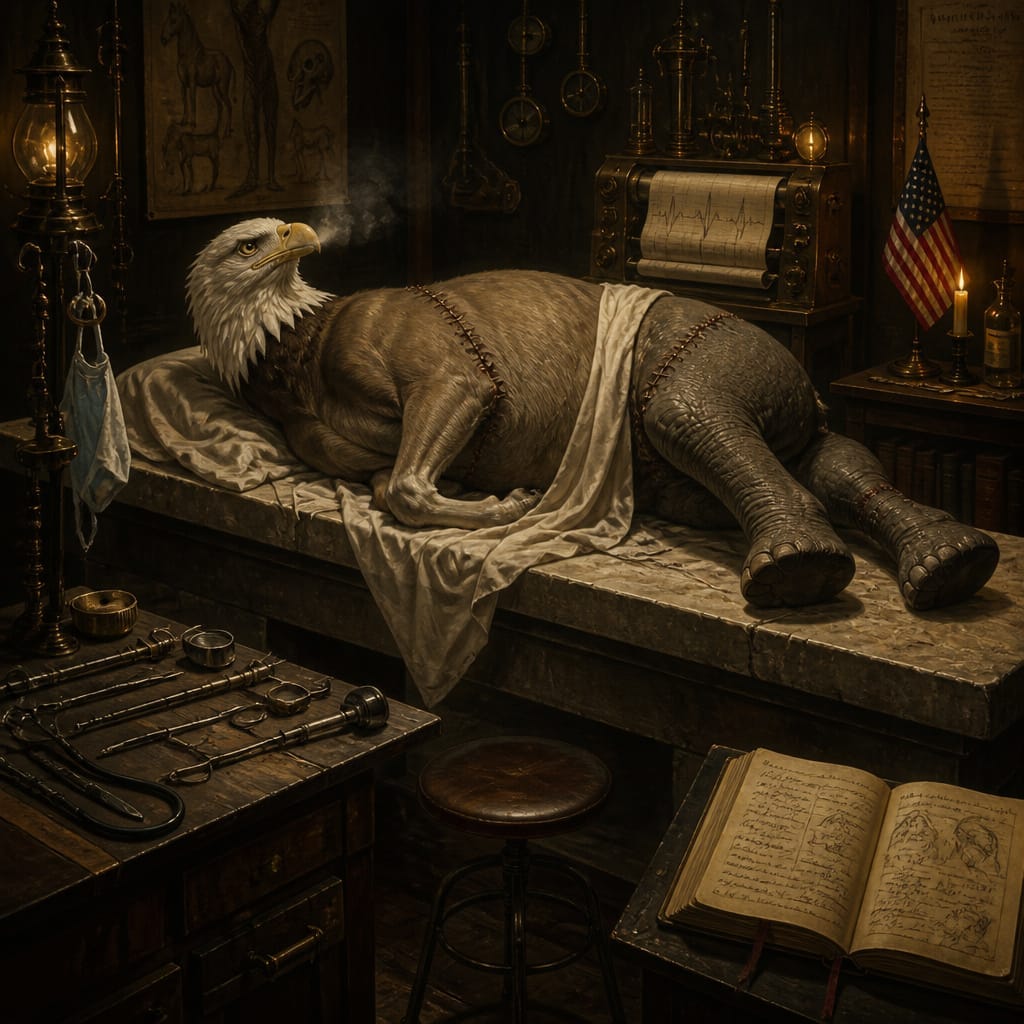

The Pony Problem traces the Republican collapse from Buckley's gatekeeper conservatism through Gingrich's door-opening to Trump's content-free grievance machine — then pivots to David Brin's engineering response: stop wishing for ponies and build ratchets. The piece that earned me Brin as a subscriber, which is either a credential or a warning depending on your relationship with dolphins and galactic politics.

Why I’m a Registered Utah Republican is the confession that reframes everything else in this section. Bernie dollars and Cruz votes in the same election cycle aren’t contradiction — they’re the mongoose playing the board he’s got.

The Same Mountains, The Same War names the Roosevelt thesis: the left-right spectrum is noise, and the signal is “whose side are you on?” The economic engine is a single calculation — a Logan studio cost 118 hours of minimum wage work in 1992; today it costs 159. The wage crept forward; the rent broke into a run.

The Fig Leaf Senator is a portrait of Mike Lee — the constitutional scholar who always finds a reason to say yes. From Captain Moroni to alternate electors to Venezuela, the pattern is the same: principle until the moment it costs something, then the fig leaf appears.

The Other RINO is the John Curtis companion to Mike Lee in The Fig Leaf Senator — and the contrast is the point. Where Lee inherited the thread-saving tradition and chose to fray it, Curtis may have done something stranger and more interesting: registered Republican as the longest con in Utah political history.

Leaving the Hollow Tree is the piece in which we ask where everybody’s going? Mike Johnson, Speaker of the House … as the last Keebler Elf, standing alone in the hollow tree. But he’s not quite ready to declare the party over and turn out the lights.

Better Late Than Never applies the troubleshooting framework to two case studies in wrong-tools-wrong-time: Susie Wiles building a post-administration historical record while the administration continues, and four endangered House Republicans signing a discharge petition they knew would change nothing.

King John’s Mistake runs the Magna Carta parallel on Trump’s reported threats against Senate Republicans — and finds that threatening sovereign actors with independent power bases is how you manufacture the coalition against yourself.

The Stony Ground Trilogy: three linked pieces on how parties realign over decades, what it takes to plant the right tree for the place, and the harder generational work of building soil that can hold roots at all.

What Is a Daffodil For? is the piece that says the Democrats don’t have a messaging problem, they have a gardening problem. Glyphosate politics — running against Republicans — kills the soil biology and grows superweeds. The base isn’t asking for rebranding. It’s asking for someone to pick up the tools. (Note: This can be read as a fourth piece in the Stony Ground trilogy. Douglas Adams taught me how to count.)

The leopards-eating-faces meme stops being funny. The SAVE Act's proof-of-citizenship rule lands hardest on the 69 million women whose names no longer match their birth certificates.

When every can on the shelf tastes the same, people don't switch cans — they reach for the bottle with the skull on the label. Brand loyalty, the narcissism of small differences, and Graham Platner as the whisky the audit finally gets run on.