At Least It’s Real
On brand loyalty, the narcissism of small differences, and what a starved electorate will drink.


Sixty percent of Americans quit a brand they were loyal to this year. The average breaking point, they say, was a price hike of about sixteen percent. Groceries went first, then the personal-care and household aisles, and the winners were Aldi and the dollar stores and the warehouse clubs — the places that never pretended to be anything but cheap. And Accenture now reports that more than a third of people using AI shopping tools will let the machine pick a different brand for them, so long as it offers a reason.
The headlines call this a reprogramming and hand the blame to the algorithm. That story is too clean, and it lets the guilty party slip out the back.
Loyalty was a shortcut long before it was ever a feeling. You bought the same coffee every week because checking whether the other coffee was better cost you something — a second stop, a gamble on a can you’d never opened, thirty seconds of arithmetic in an aisle. The comparison carried a price, and most of what we flattered as brand loyalty was the interest compounding on nobody wanting to pay it. The internet filed that price down. The machine in your pocket took it to zero. Loyalty stopped being a habit you carried from home and became a verdict you re-render at every purchase, out loud, with the alternatives fanned in front of you.
If that were the whole story, though, the Cola Wars could never have happened.
Coke and Pepsi spent a century and untold billions at war over a difference a blindfolded tongue can’t reliably find. The Pepsi Challenge ran on exactly that joke — people who would defend their can to the grave couldn’t pick it out of two paper cups. The loyalty attached to the flag; the liquid was incidental. Marketing existed to manufacture a difference the senses couldn’t supply on their own.
Freud got there before the ad agencies. He called it the narcissism of small differences — the observation that the communities most alike reserve their sharpest hostility for one another, that the narrower the real gap, the louder the identity you must build across it. (Civilization and Its Discontents, 1930) And that is not a bug in a two-party system. It’s the engine room.
Consider Susan Collins and Chuck Schumer. Collins sells concern — the furrowed brow, the statement that she is troubled, deeply, by whatever her party is about to do, and then, when the count is close, the vote that lands where her party needed it. Schumer sells fight — the floor speech, the vow that Republicans will own the damage, the line in the sand, and then the health-care subsidies lapse anyway and the government reopens on terms his own senators call a surrender. One can sells the sensation of restraint, the other the sensation of resistance, and to the shopper at the back of the sign they taste more and more like the same syrup, because the outcome rhymes whichever can she grabs: the machine grinds on, on schedule.
The careful version matters here, because the lazy one is a trap. Collins and Schumer are not the same politician. Real differences separate them, and on the day one of those differences reaches a particular family it can matter enormously. The frame is about the shopper, not the shelf — the voter who has stopped reading labels. She doesn’t run your policy comparison. She flips a coin, and more and more she flips it into the trash.
Which is what the grocery numbers were telling us all along. When people quit a brand, they seldom cross to the rival. They go to the store label — the generic, the thing standing outside the war that never pretended to be a flag. A cola dies the day the shopper decides the whole aisle isn’t worth the bother and reaches past both cans for the plain white one.
In politics that plain white can has a face this year, and in Maine it has a name. Graham Platner — oyster farmer, Marine, three combat tours — walked into the Democratic primary against Janet Mills, the sitting governor, the establishment’s pick, the very can Chuck Schumer had reached for, and beat her by better than fifty points before she folded her campaign and stepped aside. Bernie behind him, Warren behind him, the unions behind him. He talks, as they say, pretty, and he looks like he was carved from a dock piling. The base stampeded toward him the moment someone poured them something that tasted like it had been made by a human being instead of reconstituted from powder.
End the essay there and it’s a hymn — and you’d be right not to trust it.
Because Platner did not win despite the rough edges. He may have won because of them, and that includes the edges no one wants on a candidate. Deleted posts that flirted with political violence and waved off concerns about sexual assault in the military; slurs he has since apologized for; a tattoo later identified as a Nazi symbol, which he says he never understood and had covered more than a year ago.
Michelle Goldberg wrote a column titled I Thought Graham Platner Was Finished. What I Saw in Maine Changed My Mind. Plattner shrugged the pile off and won going away.
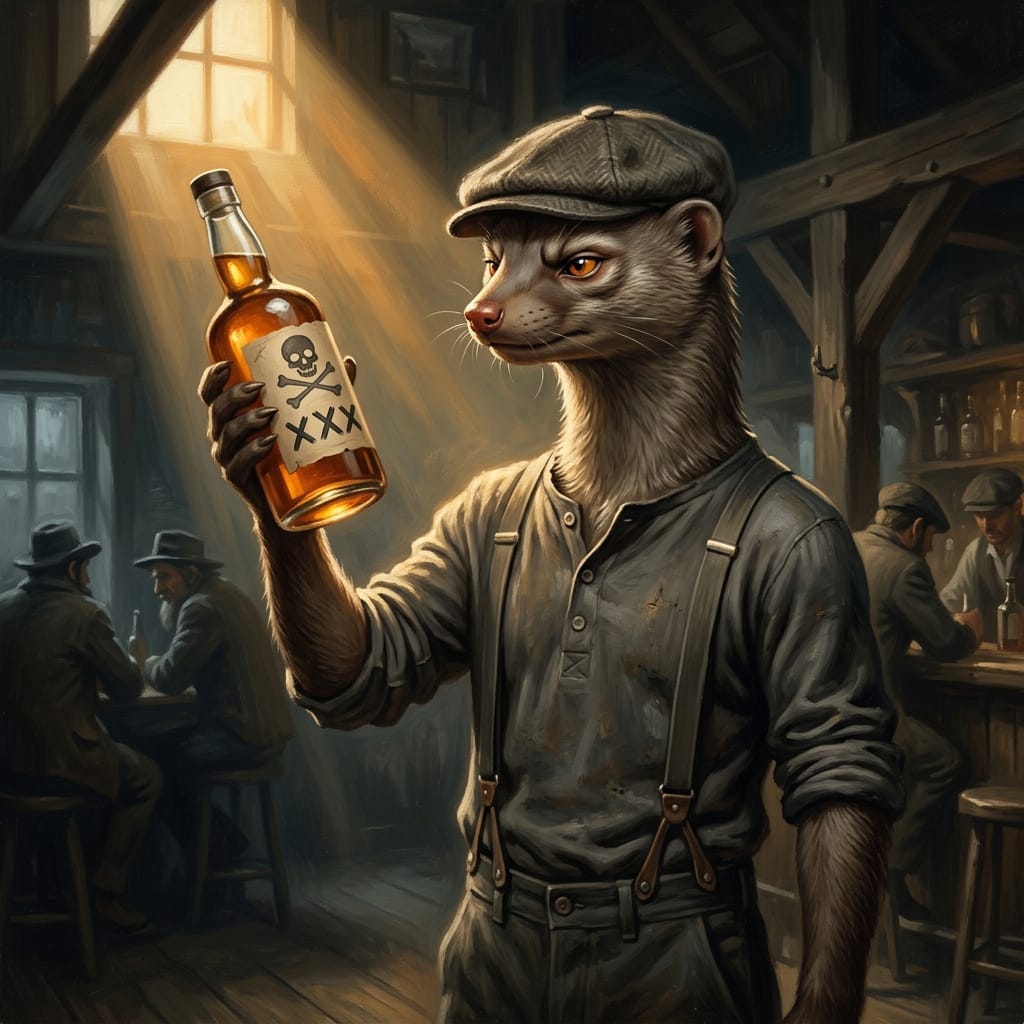
That is the hinge of the whole piece. A focus-grouped candidate doesn’t have a Nazi-tattoo problem; the manufacturing sands that off along with everything else that might have been interesting. So in a landscape flooded with Kool-Aid, the sediment at the bottom of the glass reads as proof that this, at last, is real whisky. The mess becomes the credential. “He’s obviously not a product” turns out to be the exact reasoning that lets a burn go down that you might otherwise hold in your mouth and question. The same thirst that makes him thrilling is the thirst that makes the tattoo survivable. A thing can be unmistakably real and still be bad for you; whisky is the proof, and its appeal and its danger are the same fact.
None of which settles whether Platner is the real thing, and the stump speech can’t settle it either, because the stump speech is the ad — the most polished pour a campaign owns. You can’t taste the barrel from the label. “At least it’s honest” is what thirst says; an audit says something slower. The base in Maine forgave the past for reasons that are genuinely American and not to be sneered at — combat and the wreckage it leaves, youth, the good old creed that a person can change. That creed is real. It is also, conveniently, precisely what you would say if you were a very good pour with nothing underneath.
So the machine runs its audit, aisle by aisle and race by race, an instant and merciless check on whether the thing we were loyal to was ever worth the loyalty. Most of what we called brand fails it, because most of it was friction wearing a logo. Most of what we called opposition fails it too, for the same reason: a flag stretched across a gap that kept pouring out the same result. And into that gap walks the store brand, the whisky, the man in the parking lot, offering the one thing the audit cannot strip away — the taste of something made by a person, sediment and all.
That should thrill you and scare you in the same swallow. But if it frightens the people who spent a generation selling nothing but powder, they have forfeited their standing to be shocked. Hand a shopper the same syrup in a Democrat can and a Republican can, year after year, let her watch the identical outcome pour from both, and eventually she reaches for the bottle with the skull on the label — precisely because the skull is the only mark on the shelf that looks like it might mean something. The establishment brewed that thirst itself, can by identical can. 🦡
Consider sharing this with someone standing in front of the same shelf, wondering why every can tastes the same.
yep, yep, yep... exactly why some of us have hated usually only having the choice of the Dem brand or the Republican brand - when both gave us candidates who served the powerful and not the middle or working class (and yes, the Republicans then went from there to complete la la land)....
I hope the Dem insurgency scares the crap out of the DNC - maybe the Dems will wake up and start fighting for everyday Americans (and showing that fight - "deliverism" may be valid, but it is a hard sell right now).
Similar take from Fanone, this one building up towards the argument from some in-the-news examples. https://michaelfanone.substack.com/p/the-new-rule-of-american-politics