The Second Door
Or, Whichcraft: A Parable of Inquiry


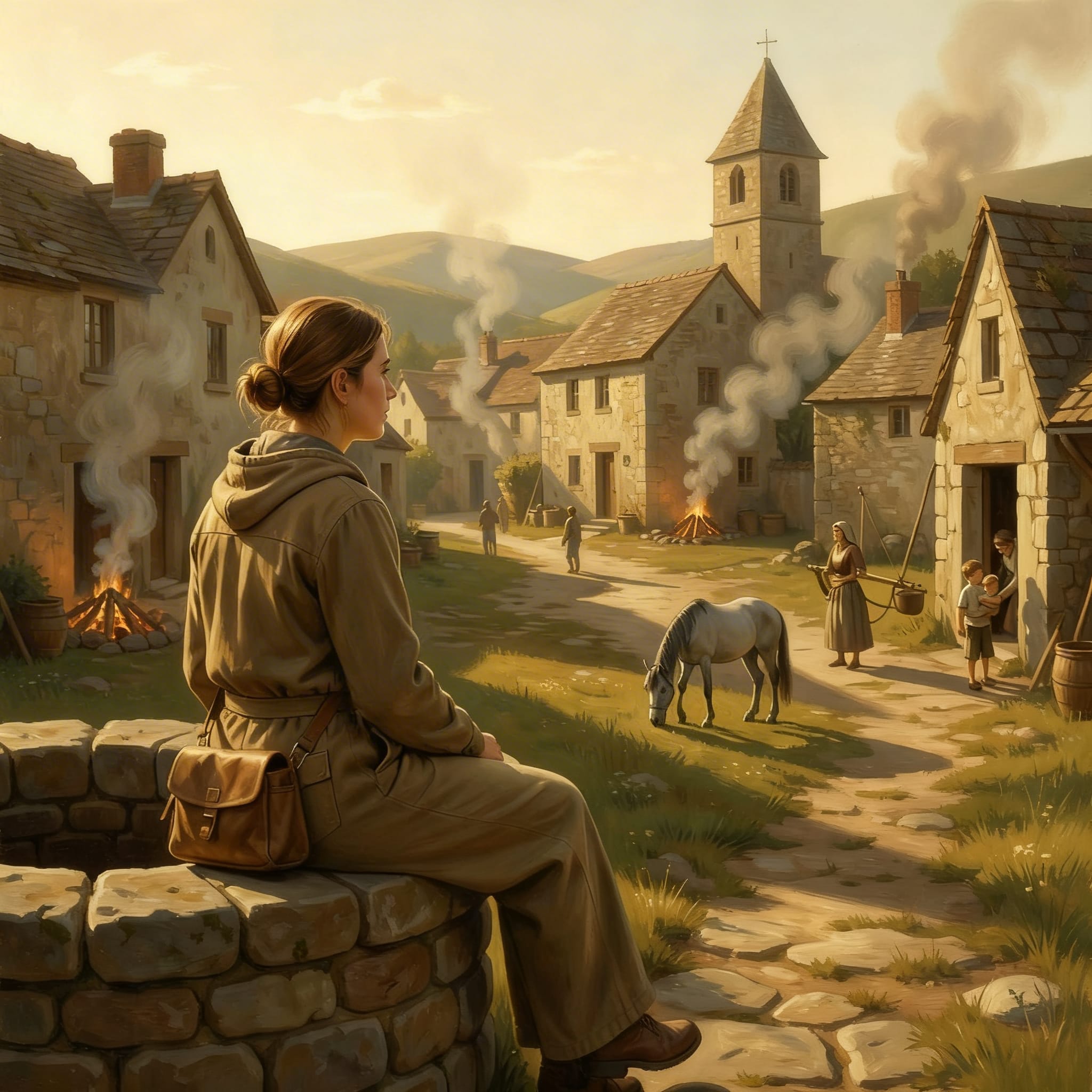
And now, for something completely different! This started as a pun about w(h)ichcraft, which soon became a cosmology about the seven (eight?) interrogatives, which became an idea for a short-short story, which is now this thing, here for your entertainment. The mongoose, as ever, went looking for the logically-correct but intentionally-wrong answer, and found an open door.
The examiner was named Calleth, and she had been watching apprentices fail this sort of problem for seventeen years — once for every year of Eilidh’s life, which was the sort of symmetry Calleth often noticed and never mentioned.
“This is the village,” she said. “Three days’ walk from the College, in the folded country where the limestone comes up through the grass. Forty-six households. For the last eleven months, one child in five has taken sick between the first frost and the thaw. Not dying, mostly. But not growing well, either. The village reeve sent to the College in autumn and again at midwinter. The College sent me. I have sent you.”
Eilidh waited. She had been at the College long enough to know that examiners were not finished simply because they had stopped talking.
“The reeve believes the well has gone bad,” Calleth said. “He has asked for an aitiomancer. What he has gotten is a half-trained apprentice on a grey pony. Find the cause. You have until sundown tomorrow. I will be at the inn.”
And she had gone to the inn, which was the part Eilidh had not expected.
The well was a good well. Eilidh knew this within an hour of arriving, because she had been trained by a woman who could taste a water source the way a vintner tastes a barrel, and the water in the village well was clean, cold, and older than the village. Aitiomancy on the well itself returned nothing — no poisoning, no seepage, no dead thing in the dark at the bottom. The causes ran out before they got started.
She sat on the well’s stone lip for a long time, with the grey pony cropping grass behind her and the afternoon going gold at the edges, and she thought about what a heuromancer was supposed to do when the discipline the problem called for gave her nothing.
The answer, she had been taught, was to try a neighboring discipline. If aitiomancy failed, reach for topomancy — perhaps the cause was not in the well but in the ground around it. If topomancy failed, reach for chronomancy — perhaps the cause was not in the place but in the season. The disciplines were fingers on a hand; a competent heuromancer learned to let the problem close around whichever finger fit.
Eilidh did not reach for topomancy. She sat on the well and watched the village instead.
She watched a woman draw water and carry it home on a yoke. She watched two boys chase a dog that did not want to be chased. She watched an old man mend a fence with the slow, careful motions of someone whose hands had outlived his eyes. She watched the smoke from the cooking fires and the way it leaned east, and she watched the shadow of the church tower move across the common, and she watched a girl of perhaps six years carry a smaller child on her hip toward a doorway and disappear inside.
And she thought: the reeve asked for an aitiomancer.
Not I need a heuromancer. Not I need someone from the College. The reeve had asked for a specific discipline, by name, and the College had sent one, and the one they sent had found nothing, and so they had sent another, and now they had sent her. Three requests. Three aitiomancers. The reeve was very certain what kind of answer he wanted.
Eilidh got off the well and went to find the reeve.
He was a broad man with grey in his beard and the particular tiredness of someone who has been carrying a thing alone for too long. She asked him, not about the well, but about the children. Which children. Whose. He told her. She asked him how the sick children were distributed across the village, and he told her that too, and as he spoke she watched his face, and she understood.
The sick children were not distributed across the village. They were distributed across six households. The same six households, every winter, for eleven months and also — she pressed him — for the winter before that, and the winter before that, though in those years it had been fewer children and no one had counted.
“And these six households,” Eilidh said carefully, “share something. Don’t they.”
The reeve did not answer at first. He looked past her, at the doorway, at the yard beyond it, at nothing. His hand went to his beard and stayed there. Somewhere outside a dog barked once and stopped. When he brought his eyes back to her face, they had the quality of a man setting down a weight he had hoped to die still carrying.
“They share a grandfather,” he said.
Eilidh rode back to the inn in the dark. Calleth was at a table by the fire with a bowl of something and a cup of something else, and she looked up when Eilidh came in and did not say anything, only raised an eyebrow.
“The well is fine,” Eilidh said. “The cause isn’t in the well. It isn’t in the ground or the season either. It’s in a bloodline, and the reeve knows it’s in a bloodline, and he asked for an aitiomancer because he wanted the College to tell him it was the well so that he would not have to tell six households that their grandfather had given them something they cannot give back.”
Calleth set down her cup.
“He didn’t want an answer,” Eilidh said. “He wanted the right answer. He wanted me to find a cause he could fix. And the discipline he asked for was the one that would have let me give him one, if there had been one to give.”
“And what did you tell him?”
“I told him the well was fine. I told him I would ask the College to send a healer who knows the blood-sicknesses. I told him the sick children could be helped, even if they could not be cured, and that the help would come. And then I asked him what he was going to tell the six households, because that was his problem and not mine, and he was going to have to solve it whether I had come or not.”
Calleth was quiet for a long time. The fire moved in the grate. Somewhere in the inn, someone was singing in another room, badly and cheerfully.
Then she did the thing Eilidh had seen her do exactly once before, on the day Eilidh had been admitted to the College: she smiled, slowly, with the particular quality of someone who has been waiting a long time to smile at this specific person about this specific thing.
“Child,” Calleth said. “Do you know what discipline you just used?”
Eilidh opened her mouth to say aitiomancy, I suppose, in the end — and stopped. Because it had not been aitiomancy. The magic of tracing causes had failed at the well. What she had done afterward, watching the village, watching the reeve’s face, asking not what is wrong but what does this man want me to find — that had not been any of the seven disciplines. It did not have a name in any book she had studied.
“No,” she said.
“Good,” said Calleth. “Neither do I. That’s why we’re still looking for it.”
She pushed the second cup across the table.
“Drink, child. You passed. Not the examination — the examination was the well, and the well was a trick, and half the apprentices I bring here solve the well and go home proud and never become anything. You passed the other thing.”
“What’s it called?” Eilidh asked.
Calleth laughed — not unkindly.
“It’s called noticing,” she said. “And now that you’ve done it once, the hard part begins, which is doing it reliably on a morning when you are tired and the question seems simple and the expected answer is right there in your hand. Drink your drink, Eilidh. Tomorrow we ride back to the College.”
Eilidh drank.
Outside, the wind moved in the folded country, and the limestone held its old water, and in a village three days’ walk away a reeve sat up late by his own fire, working out what he was going to say in the morning to six households about a grandfather and a winter and a thing that could not be given back.
Consider sharing with someone who needs to find the second door today.
Oh I like that. This is very much Granny Wearherwax's headology from Pratchett
** She watched an old man mend a fence with the slow, careful motions of someone whose hands had outlived his eyes. ** I enjoyed the read, the attention to the quiet "notices" that surround us.