Stony Ground Part THREE: The Soil of Men's Hearts
Or, How We Build Soil That Lets Our Grandchildren Grow

I got a fundraising text from Beto O’Rourke this morning while I was drinking my coffee. There he was on my phone screen, looking earnest and road-worn, telling me he’s traveling across Texas to register unregistered Democrats. Good for him. I mean that sincerely. But it sent my brain down a diagnostic path, and now we’re here, so pull up a chair.
I have a gun safe full of boomsticks.
I should probably clarify that statement, because there’s a whole spectrum between “I own firearms” and whatever the ammosexual guys are doing with their tactical Christmas card photos. I was never that guy. I’m the guy who took a lot of deer when I was a younger man, who respects a rifle as a tool, and who keeps his hardware locked up properly because that’s what responsible people do. Guns don’t scare me. Crazy angry people scare me. If you own guns and that sentence doesn’t resonate with you, we’re probably not in the same conversation.
I bring this up because of the moment Beto O’Rourke lost Texas.
It wasn’t the night he lost to Ted Cruz by 2.6 points in 2018. That night was actually a triumph — he came closer to flipping a Texas Senate seat than anyone had managed in a generation, and the energy he generated downballot was transformational. Twelve insurgent Democrats defeated twelve incumbent Republicans in the Texas state house that year. The soil was ready and Beto was the right tree, perfectly shaped for that particular season.
No. He lost Texas during a 2020 presidential primary debate, when he said, “Hell yes, we’re going to take your AR-15, your AK-47.” The crowd roared. Twitter exploded. And every pragmatic gun owner in Texas who’d been willing to consider voting for this charismatic young border Democrat quietly, permanently, closed the door.
Here’s what kills me: Beto and I want the same thing. We want guns out of the hands of dangerous people. We want our kids safe in schools. We want the crazy angry people to not have easy access to the tools of mass murder. I’d shake his hand and buy him a beer and we’d agree on ninety percent of it. But the moment he adopted the language of people who’ve never held a rifle — the confiscation framing, the specific weapon names deployed as talismans of fear rather than as tools that millions of people own responsibly — he wasn’t talking to the ammosexuals. They were already lost. He was losing me. The guy with the gun safe and the common sense and the willingness to find middle ground.
That’s the Right Tree, Right Place problem distilled to a single sentence. Beto didn’t fail because his values were wrong for Texas. He failed because his language was wrong for Texas. He grafted coastal affect onto a Texas trunk, and the graft took — permanently. By 2022, private polling showed him underperforming a generic Democrat in a statewide general election. When your personal brand polls worse than a nameless placeholder, you’ve become the issue instead of the messenger.
Stony Ground Part TWO: Right Tree, Right Place

There’s a big box hardware store near me with a nursery out front. They sell trees, shrubs, flowers, ornamental grasses — whatever corporate decides to ship in from wherever corporate is. It’s a fine nursery. The prices are reasonable. The staff are helpful enough.
A Texas Democrat who says “I grew up hunting, I own guns, and I think we can do better about keeping them out of dangerous hands” is saying exactly what Beto meant. But in a language the soil understands. That’s not triangulation. That’s fluency.
Which brings me to Caroline Gleich, and to Utah, and to a harder problem.
Gleich ran for Senate here in 2024 against John Curtis. She lost by thirty points. In Utah, that’s not exactly a shock — the D next to your name carries a penalty that starts at about twenty points before you open your mouth. But thirty is still a signal worth reading.
And here’s the thing: I liked her. A lot. She has this Mary Lou Retton energy — cute, blonde, genuinely thoughtful, radiating the earnest approachability of everybody’s kid sister. She’s a world-class ski mountaineer who’s skied the hardest lines in the Wasatch, a serious athlete and a serious person. In a state shaped by LDS community culture, where relational trust is the entry credential for everything, her likability wasn’t a trivial asset. It was the right asset.
Her platform made sense for Utah, too, at least on paper. Clean air — and if you’ve ever watched the winter inversion settle into the Salt Lake Valley like a gray lid of poison, you know this isn’t an abstract coastal concern. Protected public lands, in a state whose entire identity is built on its landscape. Climate action that speaks directly to the ski industry, the outdoor recreation economy, the thing that makes Utah Utah.
So why thirty points?
Part of it is just the math. Utah is Utah. The structural disadvantage for Democrats here is real and deep and not going away soon.
But there’s something else, and it’s the part nobody wants to say out loud.
Utah has a patriarchy problem. Not the loud, angry kind you see at MAGA rallies. The quiet kind. The kind that’s woven into the institutional fabric — into who holds the priesthood, who speaks with authority in the ward, who gets deferred to in community decisions. It’s the kind where the people practicing it would be genuinely hurt if you named it, because in their framework they’re honoring women. They’re protecting women. Pedestals are still cages, but the ones here are decorated real nice.
So Caroline Gleich walks in with every qualification you could ask for, and before she says a word about policy, a meaningful portion of the electorate has already filed her in a category that doesn’t include “senator.” Not consciously, most of them. They’d never say it. But the thumb is on the scale before the weighing starts.
There’s a very real strain of thought in this state — and I wish I were exaggerating — that would restrict the franchise to those with a particular set of chromosomes. God help us. It’s not the majority. But it doesn’t have to be the majority to shape the soil that every candidate has to try to grow in.
The soil of men’s hearts is stony ground.
I can’t remember where I read that. It might be buried somewhere in the fifteen hundred books of my literary archaeology, or it might be something I heard once and composted into my own thinking so thoroughly that I can’t find the seam anymore. Doesn’t matter. It’s doing its work either way.
It’s riffing on the Parable of the Sower, obviously — stony ground where the seed can’t root because there’s no depth of earth. But the specificity matters. Men’s hearts. Not humanity’s in general. Men’s. And the crucial insight is that the stone isn’t natural to us. It was laid there. Layer by layer, generation by generation. Don’t feel that. Don’t need anyone. Don’t bend. Don’t cry. Be the provider, the protector, the authority — perform a role you never auditioned for, and accept punishment when you can’t sustain it.
And here’s the part that most people can’t hold in their head at the same time: the patriarchy doesn’t produce happy men. The young guys drowning right now — the ones falling into Tate and Peterson and the whole manosphere pipeline — they’re not thriving under the current arrangement. They’re suffocating under expectations designed for an economy and a social structure that no longer exist. Be the breadwinner. Of what? There’s no factory job that buys a house at twenty-three anymore. Be stoic. About what? About the loneliness epidemic, the deaths of despair, the fact that nobody taught you to say “I’m struggling” because the same system that elevated you also forbade you from being fully human?
The women carry the other half of the same false coin. Be everything the feminist revolution promised you could be, but also perform femininity, but also don’t threaten anyone, but also be strong but also be likable. Caroline Gleich can ski lines that would kill most men on the mountain and she still walks into rooms where a significant percentage of voters have pre-decided where she belongs. And it isn’t in the Senate.
My partner Lady T and I just finished rewatching Orphan Black, and this is what that show understands so perfectly: it’s not a story about women being better. It’s about women being whole. Being allowed the full range of themselves. And the clone metaphor cuts deep because the system keeps trying to reduce each of them to a function — the mother, the scientist, the survivor, the wild one — and they keep insisting on being people. I support the Sestras. The future is female — not because women should rule and men should follow, but because a society that fronts the needs of our sisters, mothers, and daughters will be better for all of us. Including the young men who are quietly breaking under the weight of a role that was never designed for their actual human hearts.
These are two sides of the same true coin. And any politics that can’t hold both sides at once isn’t serious.
We call our place The Leaf House. Two-thirds of an acre of semi-rural horse property in northern Utah, backing onto a paved rail trail. When we moved here, the soil was what you’d expect from high-desert land that had been compacted and neglected — thin, alkaline, grudging. The kind of ground where you could barely dig a hole and you hit hardpan six inches down.
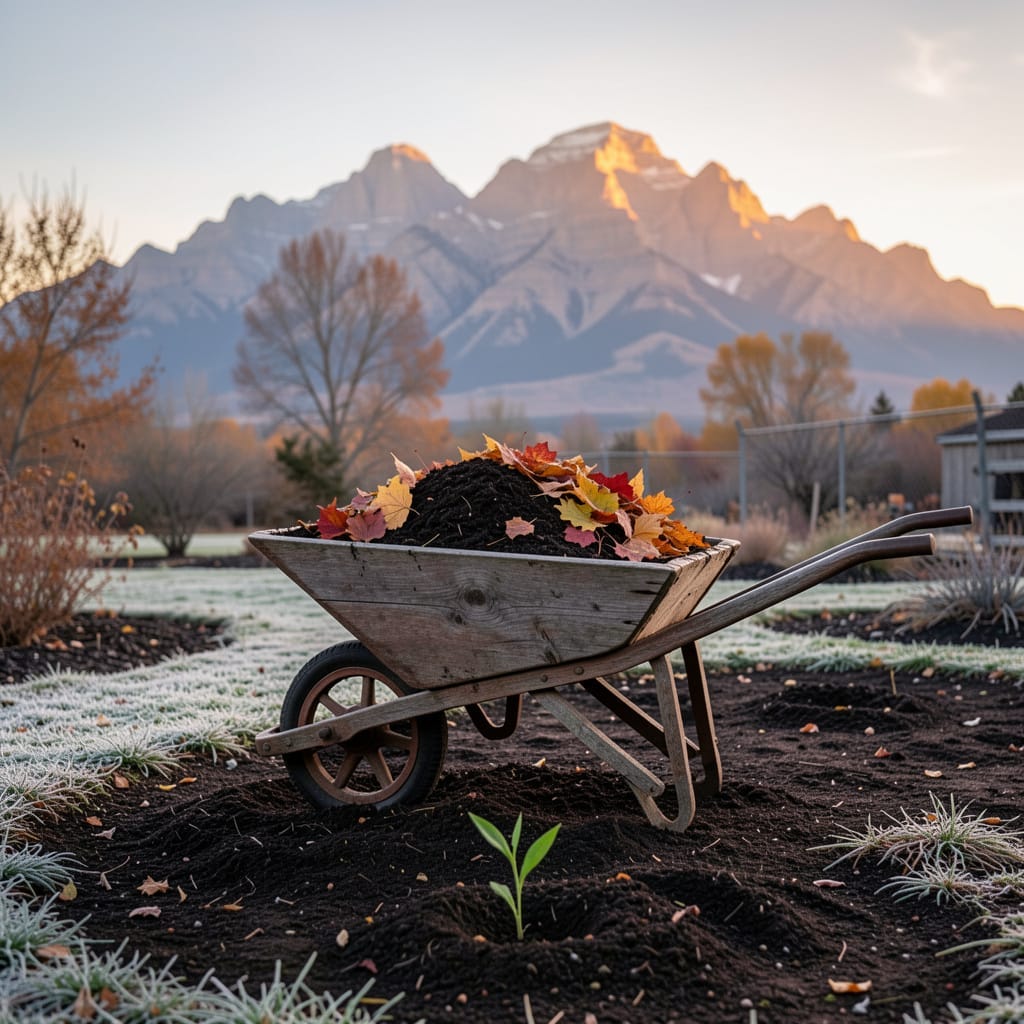
Every year, we add leaves. Sawdust. Bunny poo. We layer organic material the way you’re supposed to — not tilling it in aggressively, not trying to force a transformation in one season, but laying it down and letting the freeze-thaw cycles do their work, letting the mycelium find the cracks, letting the worms slowly, invisibly, build structure where there was none. It is a generational project. We will not see the end of it. The grandchildren might.
And this, I think, is the actual theory of political change that honest people have to reckon with.
Beto O’Rourke was one season’s layer. He didn’t fail — he layered in some compost. Those twelve flipped Texas state house seats, the voter registrations, the kid at Texas Woman’s University who registered for the first time because a guy with a smile and free pizza made it feel possible — that’s organic material being laid down on stony ground. Caroline Gleich was one season’s layer. Thirty points is a loss, but every conversation she had about clean air in the valley, every young woman who saw a ski mountaineer stand up and say “I’m running,” that’s leaves and sawdust on alkaline soil. And here’s the thing — she’s not done. In November 2025, she won a seat on her local Summit County board, running as a nonpartisan. She didn’t quit and she didn’t keep banging on the same door. She went down the ladder, planted in soil she could actually grow in, and started building root structure from the ground up. That’s not retreat. That’s composting.
You don’t fix compacted electoral ground by running the perfect candidate in one cycle, any more than you fix hardpan by dumping a single load of compost and expecting tomatoes in June. You layer. You’re patient. You accept that the mycelium does work you can’t see and the freeze-thaw opens cracks you didn’t plan. And one spring, something grows where nothing could grow before, and you can’t point to the single thing that made it possible because it was all of it.
Our neighbors in what we call the Commune — about a dozen households practicing mutual aid across ideological lines, sharing tools, solving problems, arguing about politics over borrowed hedge trimmers — they are the proof of concept. Not the proof that we’ve won. The proof that the method works. That you can lay down organic material on stony ground, season after season, and the soil changes. Slowly. Grudgingly. But it changes.
The soil of men’s hearts is stony ground. So is the soil of any state, any electorate, any community that’s been compacted by generations of hardpan ideology. The question isn’t whether you can grow something beautiful in it tomorrow. The question is whether you’re willing to keep adding leaves.
I am. We are. Pass me the wheelbarrow.
Consider sharing with someone who needs a little patience today.
🐸🦝 The Frog and Mongoose: where we compost our failures into future soil.
Stony Ground Part ONE: The Thirty-Year View

Most of my mongoose thoughts start with an interesting question. For example: How long has California been a Democratic Party stronghold? And when did it first become such?
Or, for the FOURTH part of the Stony Ground trilogy, you can look at the piece that says the Democrats don’t have a messaging problem, they have a gardening problem. Glyphosate politics — running against Republicans — kills the soil biology and grows superweeds. The base isn’t asking for rebranding. It’s asking for someone to pick up the tools.

And then transplant a Filbert tree. 💕