Stony Ground Part TWO: Right Tree, Right Place
(Or, How do we Plant what will Grow?)

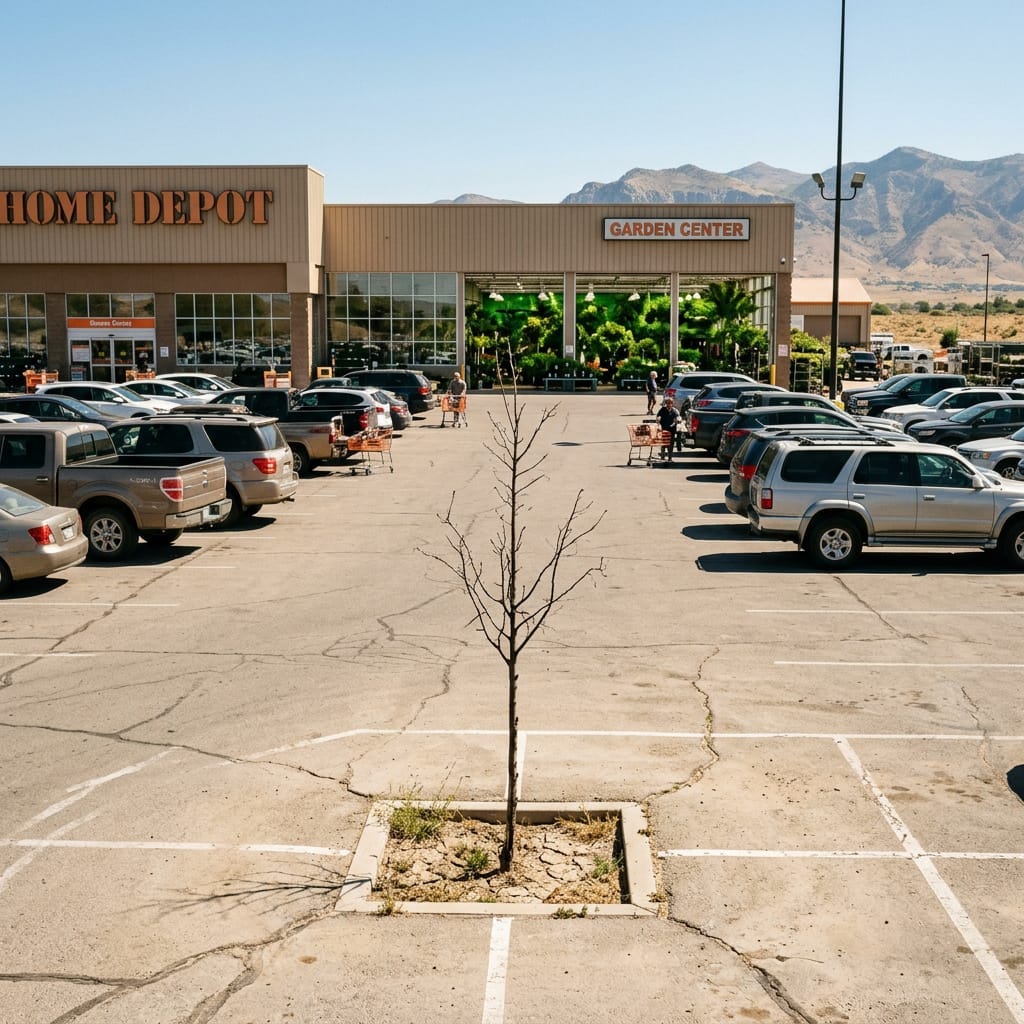
There’s a big box hardware store near me with a nursery out front. They sell trees, shrubs, flowers, ornamental grasses — whatever corporate decides to ship in from wherever corporate is. It’s a fine nursery. The prices are reasonable. The staff are helpful enough.
The parking lot, though, is full of dead trees.
Norway maples, mostly. Beautiful trees in the right conditions — fast-growing, dense canopy, reliable fall color. The USDA hardiness zone map says they should be perfectly happy here. Zone 6, maybe 7. Textbook Norway maple territory. And yet three years after planting, what you’ve got isn’t a tree. It’s a dead stick with failed ambitions. Turns out the zone map doesn’t capture a dry Utah summer. Doesn’t capture alkaline soil. Doesn’t capture the particular cruelty of a Rocky Mountain high desert climate that will smile at a tree all spring and then murder it in August without a second thought.
Right tree. Wrong place.
I’ve been thinking about that parking lot a lot lately, watching Democrats try to figure out how to win elections.
Last time, we ran the diagnostic on California’s transformation from Reagan country to permanent blue — Pete Wilson’s Prop 187, the seventy-five percent of Latino voters who decided in 1994 that they would not forget. The mechanism is documented; the thirty-year clock is running on the Southwest now too. Different decade, different state, same mechanism: tell a community they don’t belong, they remember, they register, they vote. Their grandkids vote.
Stony Ground Part ONE: The Thirty-Year View

Most of my mongoose thoughts start with an interesting question. For example: How long has California been a Democratic Party stronghold? And when did it first become such?
But that piece ended with the harder question. A people who’ve been told they don’t belong isn’t the same as soil ready to grow what we want to plant in it. Telling people they are welcome after all is the precondition. It is not the harvest.
The harvest depends on whether you can plant the right tree for the place.
We’re about to find out.
Texas Republicans spent the summer of 2025 redrawing their congressional districts. They looked at Donald Trump’s 2024 gains with Latino voters — real gains, driven by economic frustration and inflation and Biden fatigue — and concluded that this was permanent. Structural. A new baseline. They drew maps that require Latino Republican crossover votes to hold five gerrymandered seats. Trump personally called Texas legislators to push it through.
Then Trump launched Operation Metro Surge.
Masked federal agents raiding schools. A five-year-old named Liam Ramos detained as bait to draw in his father. American citizens executed in the streets by federal agents. Churches raided. Every Rodriguez and Trujillo and Cortez watching their neighbors kettled in residential neighborhoods. The most visible anti-Latino enforcement campaign in modern American history — aimed directly at the communities those maps needed to deliver Republican margins.
That’s not reading the room wrong. That’s building your entire structural plan around a specific set of conditions, and then deliberately creating the opposite conditions, and seeming genuinely puzzled when the trees die.
The dummy-mander. A gerrymander so badly calibrated to actual political reality that it becomes a gift to the other side.
California, 1994. Texas, 2026. Different decade, different state, same mechanism. You tell a community they don’t belong, they remember. They register. They vote. Their kids vote. Their grandkids vote. And thirty years later, some political consultant is standing in the parking lot wondering why all the Norway maples are dead sticks.
Tonight, Texas Democrats voted in their Senate primary. James Talarico, a state representative from Austin, went up against Congresswoman Jasmine Crockett in one of the most closely watched Democratic contests in years. As returns came in, the margin was razor thin — and honestly, the closeness of the vote is the least interesting thing about this race. At time of writing, Talarico appears to be pulling ahead, but the returns show no clear winner yet. What matters more than the margin is what the contest itself revealed.
Both candidates are talented. Both are progressive on policy. The disagreement between them isn’t really about what they believe — it’s a diagnostic argument about why Texas Democrats keep losing, and what it would actually take to win.
Crockett argues the path to a blue Texas runs through massive Democratic base turnout — fire up the people who are already yours, drive disengaged Democrats to the polls with the promise of partisan warfare. Talarico argues you have to do that and build a bigger tent, running a populist faith-based message that can speak to voters the Democratic Party doesn’t usually reach.
Talarico is a Presbyterian seminarian. He quotes scripture. He talks about a “politics of love” as a direct counter to the politics of division and fear. He calls his healthcare plan “Medicare for Y’all” — the same policy as Medicare for All, presented in a way that doesn’t sound imported.
He’s not changing the tree. He’s choosing a variety that can survive the soil.
Watch what he does with Catholic Latino voters who pulled the lever for Trump in 2024 out of economic exhaustion and are now watching ICE raid their parishes. He’s not asking them to become progressive. He’s asking them to notice who’s actually picking their pocket. That’s the Prop 187 mechanism running in reverse — instead of a Republican telling a community they don’t belong, a Democrat is saying you absolutely belong here, and I know what’s being done to you, and I’ll fight it.
Whether that’s enough to flip a Senate seat Texas hasn’t sent a Democrat to since 1988 remains to be seen. But the margin bears watching. The California realignment wasn’t visible in 1994 either.
Post-game note: By early Wednesday morning, Talarico had won it cleanly — 53% to Crockett's 46%, clearing the 50% threshold to avoid a runoff. The right tree, apparently, had roots. He now waits to find out whether he faces Cornyn or Paxton in November — that runoff is May 26, and it matters enormously for how the general plays out.
Here’s the thing I keep coming back to, as a secular progressive living in a very red corner of a very red state.
I want Democrats to win. I want them to win everywhere they can possibly win. And I’ve spent a long time watching the party lose unlosable races because they insisted on sending Norway maples to Utah.
Alexandria Ocasio-Cortez is extraordinary. Brilliant, fearless, effective, built exactly right for a dense urban district in New York with a young, diverse, politically engaged electorate. She thrives there. She’s supposed to thrive there. She’s the right tree in the right place.
She is not the template.
The persistent mistake is mistaking virality for universality. AOC has forty million followers and universal name recognition, and so the instinct is to replicate her everywhere. But what she represents is a specific local adaptation that went national. Trying to grow that tree in northern Utah is how you end up with dead sticks and a lost election and a confused postmortem about why progressive ideas don’t work — when the actual problem was the planting decision.
What does the right tree look like in a conservative rural district? Probably someone who hunts. Probably someone with genuine ties to a faith community, or at least genuine respect for one. Someone who can talk about fiscal responsibility without flinching, who supports a safety net without calling it socialism, who meets people where they actually are rather than where we’d like them to be. Someone the neighbors recognize as belonging — not imported, not performing, not translating headquarters talking points into local dialect, but actually from the soil they’re standing in.
And here’s the thing about that candidate: they don’t have to pass a purity test to stand with us. They just have to show up.
I’ve thought for a long time that we’ve been running the coalition wrong. We’ve been the ones with the purity tests at the door — the right positions on the right issues, the right language, the right cultural signals. Meanwhile the other side has been running a much simpler operation: you hate what we hate, you’re in. They absorbed libertarians and evangelical Christians and working-class Catholics and chunks of the Latino community because tribal solidarity travels further than policy alignment.
What if we let them be the purity test party? What if our operating principle was: anyone who isn’t actively against us is welcome to stand up with us?
That’s not asking progressives to abandon their values. It’s removing the bouncer from the door. You want a living wage? Come in. You want your kids to have healthcare? Come in. You’re tired of billionaires running everything? Come in. You don’t have to call yourself a Democrat. You don’t have to agree with me about everything. You just have to decide that what’s being done to this country is wrong, and you’d like it to stop.
The other side can have their monoculture. We’ll take the forest.
A forest survives hard winters. A monoculture doesn’t. Ask any forester. Ask any gardener. Ask anyone who’s watched a parking lot full of Norway maples turn into dead sticks because somebody trusted the zone map without understanding the actual ground.
Right tree. Right place. That’s where the game begins. But it’s not the whole game.
The right tree for the place isn’t enough. You can pick the perfect candidate — the right faith, the right history, the right local instincts — and still lose because of one wrong sentence, one imported phrase, one moment when the candidate forgot which soil they were standing in.
And underneath even that mistake is a deeper question still: even when the language is right, even when the candidate is from the soil, what do you do when the soil itself is stony ground?
That’s the question for next time.
🦝 The mongoose reads the soil. 🐸 The frog watches with tactical frivolity. 🦄 The unicorn exists defiantly. The badger picks the hill. 🦡 And the Shoggoth is, improbably, on your side. 🐙
Consider sharing this with someone who needs to think about what grows where they live today.
Stony Ground Part THREE: The Soil of Men's Hearts

I got a fundraising text from Beto O’Rourke this morning while I was drinking my coffee. There he was on my phone screen, looking earnest and road-worn, telling me he’s traveling across Texas to register unregistered Democrats. Good for him. I mean that sincerely. But it sent my brain down a diagnostic path, and now we’re here, so pull up a chair.