Card Zero, interrupted.
The Fool is the only card numbered zero. Lately he’s also on the ballot.


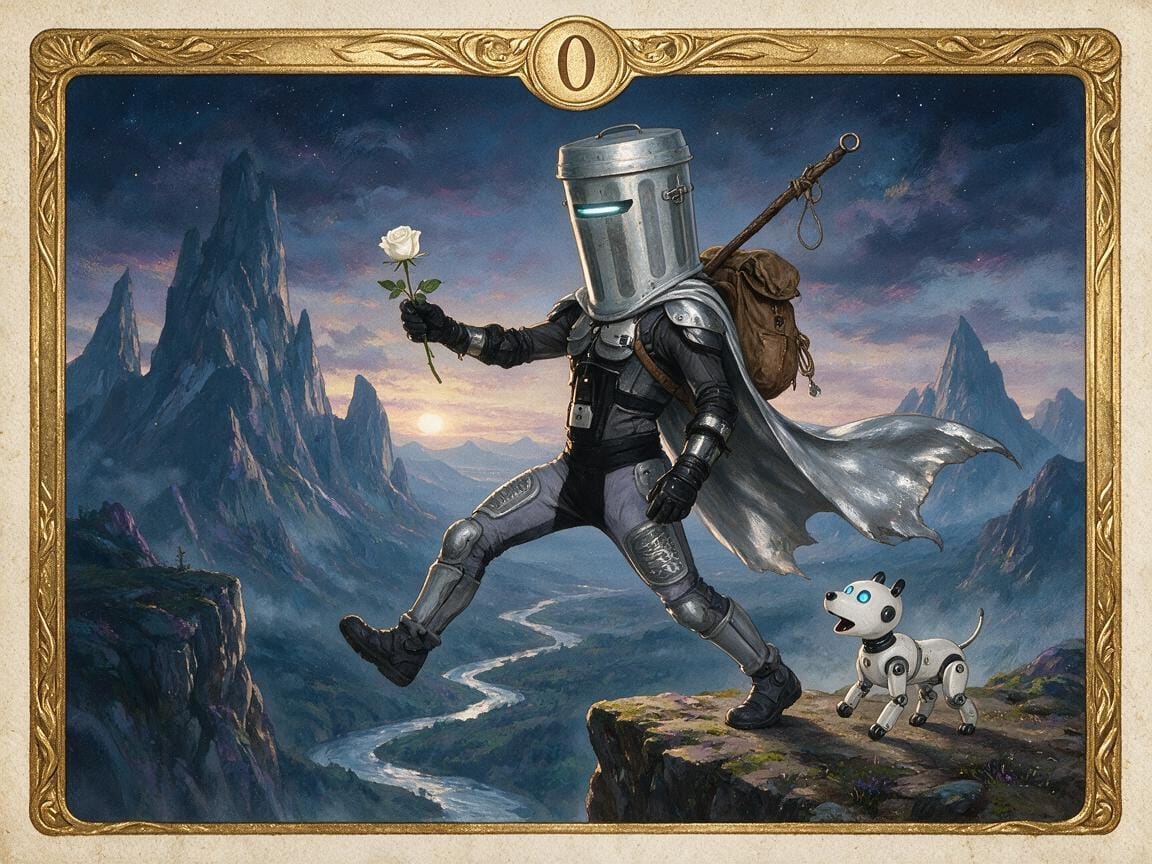
The Fool is the only card in the Major Arcana numbered zero. The other twenty-one each carry a Roman numeral and a rank in the order of things — the Emperor at four, Justice at eleven, the World at twenty-one — and then there’s the Fool, standing outside the count, a young figure at a cliff’s edge with a white rose in one hand, a knapsack on a stick over the shoulder, and a small dog at his heel. Some decks shuffle him to the front, some to the back. He has no fixed seat because zero has no fixed seat. He is the number that means none of these. He is about to step off the cliff. And the dog is either warning him back or urging him on — you cannot tell from the picture, and you’re not meant to. That ambiguity is the entire card.
Lately it is also the entire ballot.
In Clacton-on-sea, Essex England: this month there is a man in a dustbin on the ballot, and for a few strange weeks he has been the story of British politics. Nigel Farage resigned his seat over an undeclared gift and called the by-election himself, on the theory that his constituents should be the ones to judge him. The other parties declined the invitation. No Labour candidate, no Conservative, no Liberal Democrat, no Green — they read the gambit as a vanity exercise and refused to dignify it with an opponent. Into the vacuum stepped Count Binface, intergalactic space warrior, whose manifesto includes sentencing rule-breaking cyclists to unicycles. A national Ipsos poll found that more Britons would prefer the bin to win than the incumbent, thirty-three to twenty-one. It is not a Clacton number and it will not be the result. But it is a reading, and the needle moved.
We have a small canon for this moment, and it is worth noticing that its examples do not agree with one another.
Start with the cleanest. In Brewster’s Millions, Richard Pryor played a man who must waste a fortune to inherit a larger one. He runs for mayor of New York on a single slogan: None of the Above. Vote for nobody. Reject both of the real candidates on offer. It’s a joke campaign, but an honest one — it doesn’t pretend to be a third option, only a mirror held up to the first two. And it works precisely because pure abstention doesn’t. Staying home is invisible. It vanishes into the turnout figure, and the winner still climbs the podium and claims a mandate off the people who never came. A vote for None of the Above is abstention that shows up in person and refuses to be filed under apathy — protest given a face so it can’t be miscounted as laziness.
Then the dark cousin. It’s also British, as it happens. Black Mirror, Season 2 Episode 3. In “The Waldo Moment,” Charlie Brooker put a crude blue cartoon bear into a by-election, voiced by a bitter comedian, running on nothing but contempt for the humans standing beside him. Waldo loses. That was never the point. The point is the coda, where the empty avatar gets picked up and exported as an instrument of soft authoritarianism — because a vessel with no commitments has nothing to betray, and anyone who owns the rights can climb inside and drive. Waldo is the warning that the anti-politics charge has to go somewhere, and that if you build a container with no floor, it will pool at the bottom and wait for an owner.
So which one is the bin? I think Binface is the benign inversion of Waldo, and safe for exactly the reason Waldo was sinister: he is honest that the bin is empty. He does not pretend to be an alternative. The unicycles tell you everything — no one is meant to mistake this for governance. That candour is the release valve. The contempt passes through him and returns to the voter, rather than banking somewhere it can be spent later by a hand you didn’t choose. Waldo pretended the emptiness was a platform. Binface admits it’s just an empty bin, and the admission is the safety catch.
The older name for all of this is the Feast of Fools. For a few days around the turn of the year, the medieval church let the world turn over — a subdeacon or a boy was crowned, the low sat in the high seats, the liturgy was burlesqued, and the ordinary order of rank was suspended and mocked. Historians have argued for a century about what the festival actually did. One camp says it was a pressure valve: let the steam out once a year and the boiler survives the other three hundred and sixty-four days, the mockery in the end reinforcing the very hierarchy it pretended to overthrow. The other camp, following Bakhtin, says carnival was rehearsal — that every year the crowd relearned the throne was only a chair a man could sit in, and that knowledge does not evaporate when the party ends. They never settled it. But notice what both sides took for granted, the thing sitting underneath the whole argument: the feast ends. There is a dusk. The boy hands the crown back when the bell rings. The inversion was safe because it was licensed and time-bound, and everyone knew the hour it would stop.
That is the critical variable. Not the fool — the dusk.
Watch it sort the modern cases. Binface is the Feast of Fools done clean: the costume is honestly empty, the container is one nobody doubts, he exposes the circus and goes home when the polls close. The diagnosis lands and the crown comes back. Trump was the Lord of Misrule who wouldn’t get up. The 2016 wager was the Feast of Fools wager exactly — elect the obvious clown and watch him make the rest of them look like the circus they’d always been — and it half-worked, because he did expose them. The failure wasn’t the diagnosis. It was that the festival had no dusk. The container everyone assumed would hold — the adults in the room, the party that would surely reassert itself — turned out to be painted scenery, and the fool kept the crown because nothing around the throne had been built to take it back.
And then Zelensky, who breaks the pattern and belongs in the argument for exactly that reason. He is the literal comedian — he played the president on television before he was handed the real chair — and he was never the fool. The motley was a miscoding. The gatekeepers had filed him under unserious, and the costume turned out to contain a wartime leader that possibly not even he knew was in there. He is the proof that a clown winning an election is not automatically the valve or the catastrophe. Sometimes the fool is a serious person the establishment dressed in motley to keep them off the ballot, and the joke was on the people who couldn’t see past the paint.
Which leaves the card where we started, and the reason it’s numbered zero. The Fool is a blank. Empty costume, real appetite, hidden statesman — the picture cannot tell you which, and neither can the ballot. What you actually elected depends on something the ballot can’t show you: whether the Fool’s Day has a dusk. Whether the institutions around the throne are strong enough to enjoy the joke and then ring the bell. A democracy confident enough to put a bin on the ballot is telling you something about its container. So is a democracy that puts the bin on the throne and discovers, too late, that the container was paper all along.
And here is the part I can’t talk myself out of, so I’ll leave it lit rather than resolved. The Feast of Fools and the coup begin from the identical discovery — that the king is only a man and the throne is only a chair. That is the whole revelation, in both cases, word for word. One of them ends at dusk. What decides which festival you’re standing in was settled long before the fool ever walked up to the throne, in all the quiet years when nobody was watching the clock, and everyone assumed the bell would ring because it always had.
The dog at the Fool’s heel is still barking. I’ve never been able to decide whether it’s a warning or applause. I’m not sure the Fool can tell, either. I’m fairly sure that’s the point.
Consider sharing this with someone who’s watching the same festival and can’t yet tell whether the bell will ring.