With Friends Like These, Part One:
A hundred years after Violet Gibson, the trains still don’t run on time.

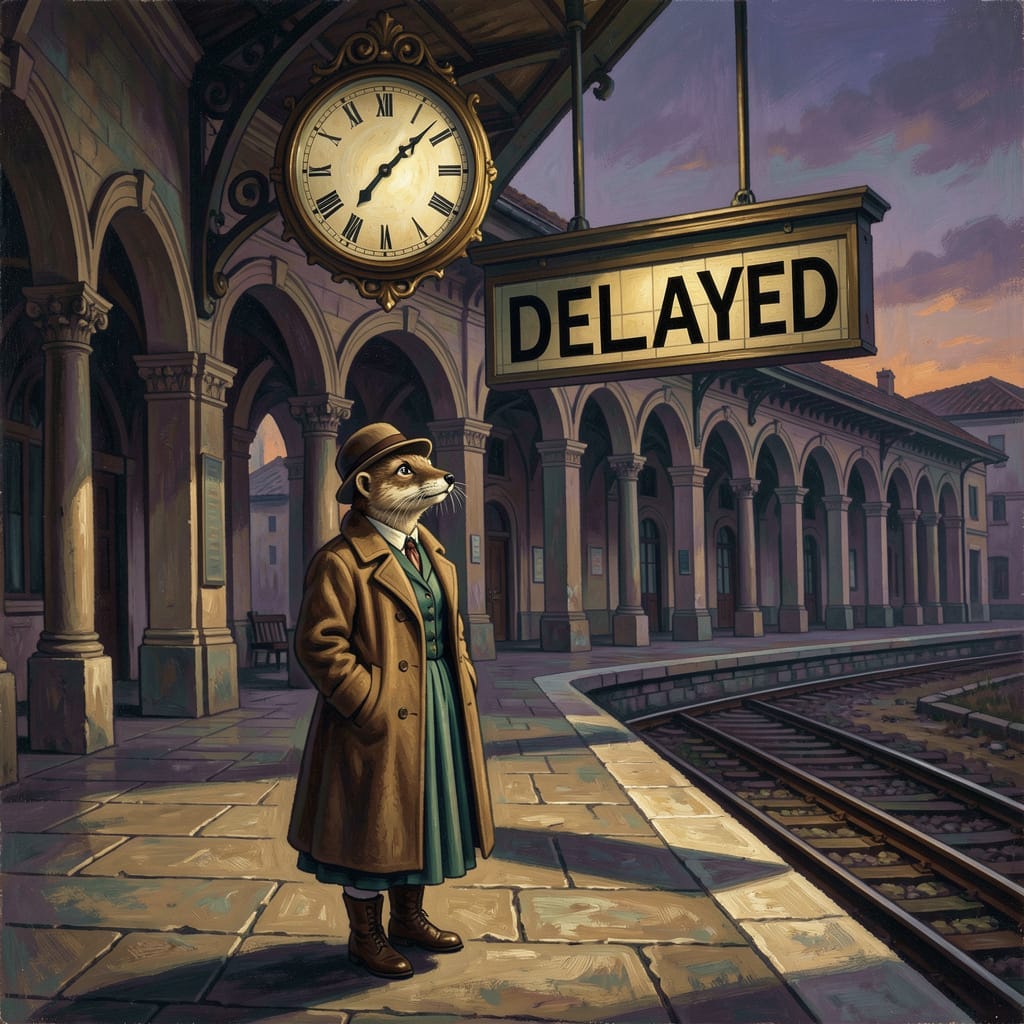
A hundred years ago today, an Irishwoman named Violet Gibson walked up to Benito Mussolini in the Piazza del Campidoglio and shot him in the face. The bullet grazed his nose. She tried to fire a second time and the gun jammed, and the crowd nearly killed her on the spot. The Italian state declined to try her, declared her insane, and shipped her back to England, where she spent the next thirty years in an asylum in Northampton and died forgotten. The experiment she tried to end ran for another nineteen years and killed tens of millions of people across Europe.
The thing the world remembers about Mussolini, other than how it ended, is that he supposedly made the trains run on time. He did not. The Italian rail system under fascism was no more punctual than it had been under the liberal governments that preceded it. Most of the modernization Mussolini took credit for — the electrification programs, the new rolling stock, the showpiece improvements on the Milan-to-Rome corridor — had been planned and partially executed by the governments of the 1910s, and the regime simply cut the ribbon on projects that were already moving. Local service stayed as chaotic as it had ever been. The myth was assembled in real time out of fascist self-promotion and credulous Anglo-American travelogues, and it survived because it was useful as a thought-terminating cliché. Say what you want about Mussolini, but — that’s a sentence whose only function is to give the speaker permission to stop thinking.
I was thinking about that sentence this morning, in the small windowless room where I work. The news from Washington was the kind of news that makes everyone in the room a little quieter than usual, a little more deliberate about saying good morning. We watched our boards. We made each other coffee. Nobody talked about the eight-o’clock deadline or the Truth Social post or the threat to annihilate a civilization, and everybody was thinking about all of it. That’s how it goes in a place where you’re not supposed to discuss politics and where the politics have arrived anyway, riding in on the screens. But you take care of your people. You take care of yourselves. Some mornings that’s the entire program.
Five thousand miles from my console, the Vice President of the United States landed in Budapest this morning to shore up another man’s election.
The lab predates the franchise
Viktor Orbán has been the prime minister of Hungary since 2010, which is to say he has been the prime minister of Hungary for six years longer than Donald Trump has been a serious presence in American politics. This sequence matters. Hungary is not a country that took its cues from MAGA; MAGA is a movement that took its cues from Hungary. The captured courts came first in Budapest. The captured media came first in Budapest. The captured universities came first in Budapest. The “illiberal democracy” branding, the procreation-and-replacement framing, the Brussels-as-occupier rhetoric, the CPAC pilgrimages, the Tucker Carlson location shoots — all of it was running as a live experiment in Central Europe while the American right was still figuring out which decade it wanted to live in. The lab predates the franchise.
This coming Sunday is Hungary’s parliamentary election. Five days from today. And for the first time in sixteen years, Orbán is losing.
His opponent is a forty-five-year-old former Fidesz insider named Péter Magyar, a center-right defector who broke with the party two years ago and started his own movement, the Tisza Party. Magyar is no wide-eyed European liberal. He’s a conservative running on three things: corruption, the deterioration of public services, and the question of why ordinary Hungarians’ lives keep getting harder while the people around the prime minister get spectacularly richer. His campaign is, at bottom, a kitchen-table audit of sixteen years of Orbánism. The audit is coming back markedly unfavorable, and the polls have been showing it for months.
The Tank Test
Here is the number that does the work.
As of the most recent weekly data from the European Commission’s oil bulletin, a liter of Euro 95 petrol in Hungary costs €1.538. That’s roughly $5.82 per US gallon, which sounds bad to an American ear. But compared to the rest of the European Union, Hungary actually looks good — fourth-cheapest of the twenty-seven member states, fourteen percent below the EU average for petrol and nineteen percent below for diesel. The Druzhba pipeline and the cozy relationship with Moscow are doing some real work at the pump. Orbán can stand on a stage in Kaposvár and say we have cheaper gas than the Europeans, and the sentence is technically true.
Now do the math the rest of the way.
The average net wage in Hungary is €1,015 per month. A full fifty-liter tank of petrol costs €76.90. That’s seven and a half percent of the average Hungarian’s monthly take-home pay, every single time they fill up the car. Twelve hours of work for one tank of gas.
Compare that to the American driver currently complaining about gas a bit over four dollars a gallon: a thirteen-gallon fill-up runs about fifty-five dollars, against a US median monthly net wage somewhere north of forty-five hundred. That’s a hair over one percent of monthly income. Roughly ninety minutes of work. The Hungarian, with the supposedly cheap Russian gas, is paying eight times as much of their life as the American is to fill the same tank.
Cheap is a ratio, not a sticker. And that ratio is brutal.
This is the trains not running on time, a century later. The fascist bargain has always been the same: you give us the courts and the media and the universities, and we’ll give you something material in return — order, identity, full employment, cheap fuel, secure borders, a country that runs. You hand over the institutions and you get the trains.
But Mussolini’s trains weren’t punctual. And Orbán’s tank costs twelve hours.
The material payoff that was supposed to justify the political ugliness turns out, every time, to be a story rather than a reality. The reason it turns out that way is structural. The materialist bargain was never the actual transaction. The actual transaction was always that a small number of regime-adjacent people get spectacularly rich while the institutions that could hold them accountable get systematically dismantled. The trains and the gas are the marketing copy. The corruption is the actual product.
The texture of the product
You can see the product clearly in the texture of this election.
Two weeks ago, the Washington Post reported that Russia’s Foreign Intelligence Service had drafted an internal proposal to stage a false-flag assassination attempt on Orbán in order to improve his electoral odds — a document obtained and authenticated by a European intelligence service. Yesterday, on April 6, Serbian police found four kilograms of explosives at the TurkStream gas pipeline, and Orbán and his foreign minister immediately blamed Ukraine for trying to cut Russian energy supplies to Hungary. Magyar called it a false flag designed to delay the election. Earlier in the campaign there was a Druzhba pipeline crisis, also blamed on Ukrainian foot-dragging. Throughout the spring there has been AI-generated propaganda, fake social media profiles, conspiracy narratives about Brussels and Kyiv, and credible reporting on the importation of Russian propaganda expertise into Fidesz operations. State media has refused to give Magyar even a token television appearance.
Orbán himself has hinted at deploying domestic security forces on election day to “guard against alleged Ukrainian interference” — a sentence that should make the hair on the back of your neck stand up, because it is precisely the same posture Steve Bannon described recently when he promised that ICE would patrol American polling stations in November. About seven months ahead of us on the electoral calendar, Hungary is running the dress rehearsal.
Orbán is not the cautionary tale MAGA needs to study. He is the receipt MAGA refuses to read.
The co-investor
That’s why JD Vance is in Budapest today.
Marco Rubio made the same trip in February. Trump endorsed Orbán on Truth Social late last month, calling him a strong leader with a phenomenal track record. The Vice President’s presence on the literal day his boss is posting civilizational threats from a different continent is the act of a co-investor flying in to talk the original buyer out of returning the questionable merchandise. If Hungary returns it — if Magyar wins on Sunday — the warranty claim becomes very public, and the showroom in Washington loses its anchor display. The whole American import scheme depends on the source country still believing in the product.
The geographic absence is its own message, too. The Vice President is the constitutional mechanism by which an incapacitated commander-in-chief can be restrained, and on the day the commander-in-chief is posting threats to wipe out a civilization of eighty-nine million people before sundown, the Vice President has made sure to be on a different continent shaking hands with another illiberal strongman. Whatever else that picture is, it isn’t an accident.
The harder lesson
Here is the one the American reader actually needs.
Even if Orbán loses on Sunday, he may not be removed from power. The Carnegie Endowment published a piece last week with the bleak title Win or Lose, Orbán Has Broken Hungary’s Democracy, and the argument is the one nobody wants to hear. Sixteen years of Fidesz rule have not just produced an unpopular government; they have produced a captured state. The judiciary is stacked with long-term Fidesz appointments. The regulatory agencies are stacked with long-term Fidesz appointments. The state-owned media is staffed top to bottom with loyalists. The constitutional court is captured. The electoral commission is captured. Whoever wins the election on Sunday inherits a government in which the actual machinery — the parts that touch ordinary life, the parts that decide whether a court ruling is enforced or a regulation is applied or a contract is honored — answers to the people who put it there over the previous decade and a half. Carnegie’s conclusion is that the only path to a real transfer of power is a Tisza supermajority large enough to amend the constitution. Anything less, and the apparatus just keeps running, regardless of whose name is on the door.
Read that paragraph again with American eyes. Remember when Trump told us, vote for me now and you’ll never have to vote again? This is what he meant.
This is the lesson Hungary is about to teach the rest of us: that institutional capture is much, much easier to do than to undo, and that elections — the thing democratic citizens are taught to treat as the master mechanism for course correction — become an increasingly thin instrument the further the capture has progressed. Hungary is going to vote on Sunday, and it is going to discover, win or lose, what the limits of voting are once the walls have been moved. We are going to get to watch this in real time. We are going to be tempted to file it under Eastern European political curiosity and move on. We should not. The American reader who watches the Hungarian results on Monday morning and feels even a flicker of well, that couldn’t happen here should immediately ask which of the institutions they’re imagining as protective have not already been hollowed in the past fifteen months. The Department of Justice. The inspectors general. The federal courts at every level. The regulatory state. The civil service protections. The intelligence community’s independence. The military’s chain of command. Go down the list honestly. The walls have been moving here too.
The dress rehearsal is in Budapest. The big show is coming soon, and opening night is here, in November.
A hundred years
A hundred years ago today, an Irishwoman with a small revolver tried to end an experiment before it consumed a continent. She failed, and the experiment ran. Seventy years after the experiment ended, a Hungarian prime minister picked up the playbook, sanded off the worst of the language, and started running it again as a model for Western admirers. Sixteen years into that revival production, the Hungarians who have lived under it the longest are looking at their pay stubs and their gas pumps and their hollowed public services and beginning to come to a conclusion. The Vice President of the United States flew across the Atlantic this week to try to talk them out of it.
With friends like these.
Take care of your people. Take care of yourselves. Watch what happens in Budapest on Sunday — not as foreign news, but as a letter mailed seven months ahead of time, addressed to us, from a country that ran the experiment first and is now trying, in the only way a democratic country can try, to take it back.
Consider sharing with someone who needs a clearer map today.
🐸 🦝 🦄
Frank Zappa could see. May I have some cream cheese on my cake? Thank you for blowing through some of the smoke and mirrors (I'm recalling your post of Lady T and kiddos in The Fun House) and yes, take care of those we can.
The wheel of time keeps spinning, eh? It's a shame we have to learn these lessons again.