What the Swans Mean
You can't spell TRUTH without PRAVDA.


You can’t spell TRUTH without PRAVDA.
But reality always bats last. And today, or tomorrow, or next week — or yesterday — that front-page obituary is being written.
The Soviet state had a tell. When something at the very top broke — a death, a coup, a rupture the official channel could not bring itself to say out loud — the screen filled with swans. Tchaikovsky played over a void. The citizen learned to read it the way you read a stopped clock, where the thing on the face matters less than the thing it stands in for. Beauty on a loop meant the people who decided what you were allowed to know had, for the moment, decided nothing — because the thing that needed saying could not be said. The clearest instance is the August 1991 coup, when the plotters took the airwaves and handed the country Swan Lake while the tanks moved in Moscow. The long funerals of the gerontocracy got the same treatment, or so the lore runs. Either way the grammar held. When the broadcast goes lovely and content-free, look for the body.
Here is what makes it almost too good. They reached for Swan Lake because it was safe — nationally beloved, ideologically blank, the most innocent beautiful object in the cabinet. They could not have grabbed anything more loaded.
Start with the text itself. The Swan Lake the world loves is not the one Tchaikovsky wrote. The 1877 premiere flopped. The version that became immortal was staged in 1895 by Petipa and Lev Ivanov — about a year after Tchaikovsky was dead. He never saw the swans that made his name deathless. The canonical work is posthumous, reconstructed, assembled by other hands over a score whose author can no longer tell you what he meant. A true thing wearing a shape its maker neither confirmed nor denied.
Then the ending, which different regimes have fought over like disputed border territory. Tchaikovsky’s score reaches for transcendence through death: the lovers drown, the spell breaks, apotheosis. The Soviet stage could not abide despair, and for years ran a triumphant finale instead — the hero kills the sorcerer, the lovers live. Same notes, opposite metaphysics. A ballet whose ending the state kept rewriting, played on a loop by a state that could not admit its own ending was at hand.
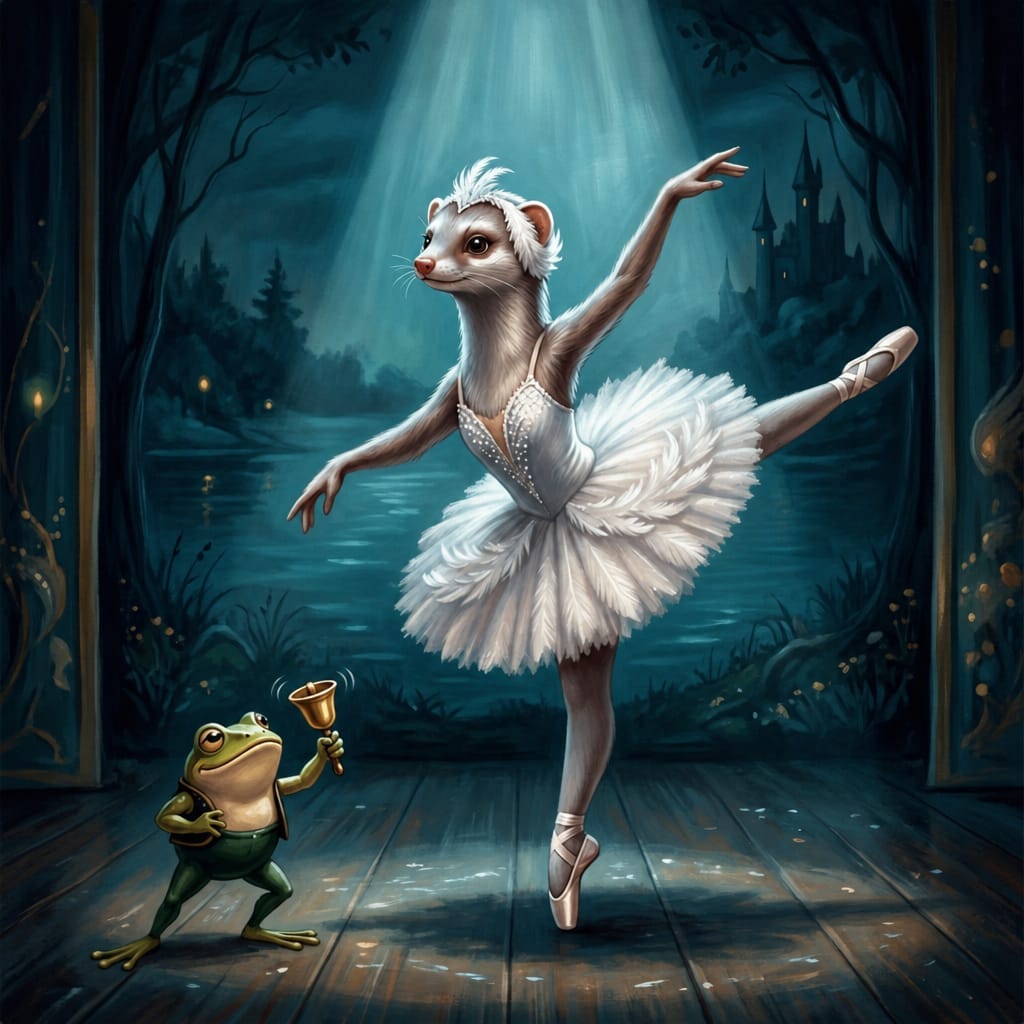
And underneath the ballet, older than Petipa, older than Russia, the thing the swan really is. Across the Indo-European world the swan is a human being under enchantment — true on the inside, false on the outside, waiting. In the Irish telling the children of Lir spend nine hundred years as swans, fully themselves the whole time, their voices intact, and the spell holds until a bell rings. That is the whole machine in one image. The swan is a suppressed human truth in a beautiful false body, and the suppression breaks the instant the bell sounds.
So look at what the Soviet broadcast actually did, without meaning to. It put enchanted creatures on the screen — suppressed truth in lovely false form — to cover a suppressed truth at the top. The fairy tale and the cover story were the same story. The citizen watching the swans was watching a metaphor for the exact act of watching the swans.
I am not going to tell you the third thing this essay is about. You already know which inning it is, or you don’t, and the swans won’t say.
But notice the tense. The citizen at the screen never knows whether the death already happened and the channel is simply slow, or whether it is happening as they watch, or whether the broadcast is the only thing still standing between the country and the news. Today, tomorrow, next week — yesterday. The obituary is set in type before the announcement is read; somewhere a front page is being made up right now with the headline space left open, and blankness is not the same as nothing. The bell is the obituary. When it rings the swans become children again and the suppressed thing gets its name back.
Hamlet knew the shape of this before there was a Pravda to spell. Waiting on the duel he suspects will kill him, he tells Horatio: if it be now, ‘tis not to come; if it be not to come, it will be now; if it be not now, yet it will come. The readiness is all. Hamlet, Prince of Denmark is doing the citizen’s arithmetic four hundred years early — running every inning and concluding it does not matter which one we are in. The bell tolls when it tolls. (Ask not.)
The Prince walks into the duel anyway, and it kills him, and he was right about the readiness the whole time. That is not the soft version of this ending. It is the only one. The front page called Truth was the machine for not printing it. The optimistic finale blares over the actual collapse. Reality does not argue and it does not broadcast; it waits in the bottom of the ninth, and then it bats.
And the ready among us square our shoulders and walk in.
The readiness is all.
Consider sharing with someone who needs to know what the swans mean today. And keep your bells ready.
And Trump has not appeared in public for a week.