Part One: WE’VE BEEN HERE BEFORE
(Or: The Muckrakers Always Rise)


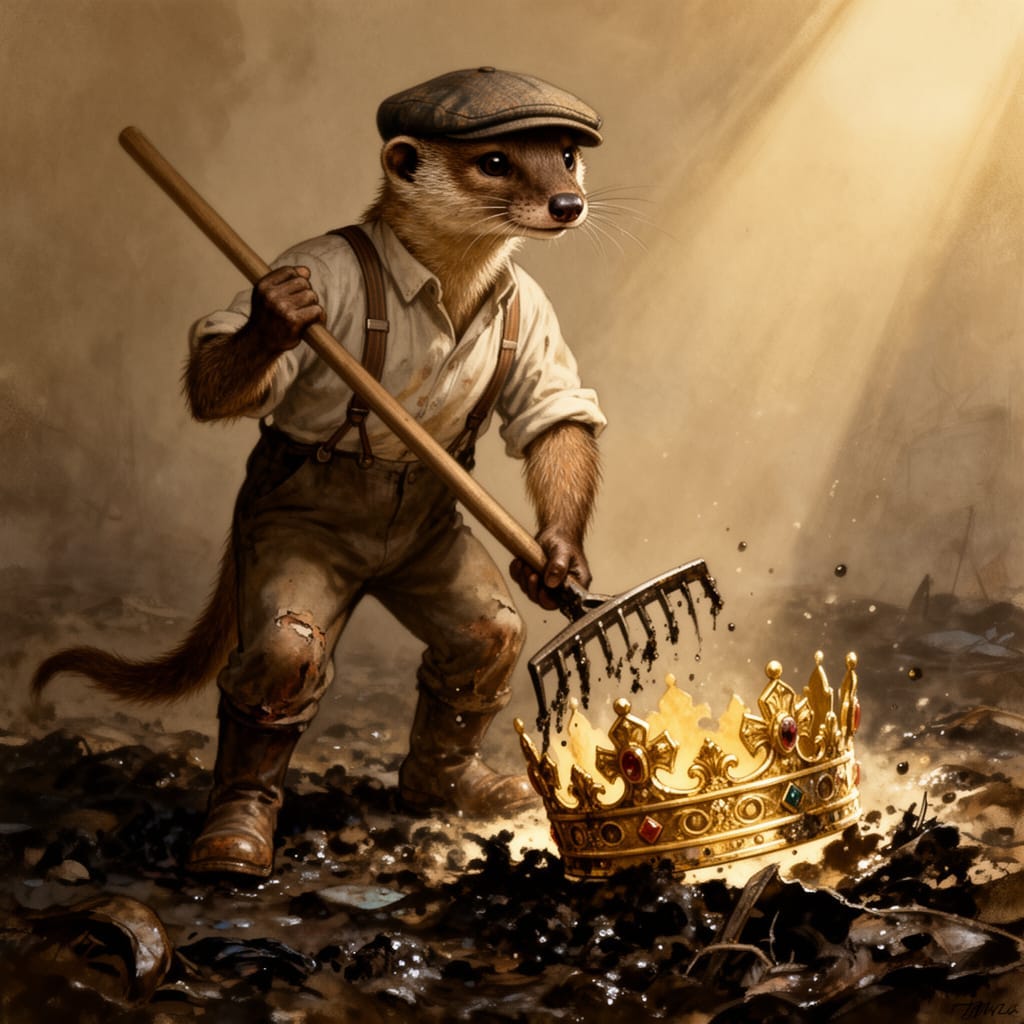
Teddy Roosevelt gave us the word as an insult.
It was 1906.
The Progressive Era was gaining steam, and journalists were publishing exposé after exposé - corporate corruption, political machines, food safety nightmares, brutal conditions in factories and slums. Roosevelt, who agreed with many of their goals, thought they’d gone too far. Muckrakers. They were just too negative. Too focused on the filth.
He compared them to a character in Pilgrim’s Progress: the man with the muckrake, so busy raking the filth at his feet that he couldn’t see the celestial crown offered from above.
“Muckraker.” It was meant to sting.
The journalists shrugged and kept raking.
Yeah, we rake the muck. Someone has to show people what’s hidden IN the muck. You’re welcome.
They had plenty of reason to rake.
The Gilded Age had left America shining on the surface and rotting underneath. The robber barons owned the railroads, the oil, the steel, the banks. They owned the legislatures and the courts. And - crucially - they owned the newspapers.
The public knew what Hearst and Pulitzer decided they should know. The gatekeepers controlled the gates.
Then the technology shifted.
Cheaper printing presses. New magazine formats. Distribution networks the old money didn’t control. Suddenly you didn’t need a newspaper baron’s permission to reach an audience.
And the muckrakers rose.
Ida Tarbell spent years documenting how Standard Oil crushed its competition, creating the template for modern investigative journalism. Her series ran in McClure’s Magazine - not a Rockefeller paper.
Upton Sinclair wrote The Jungle and showed America what was really in the sausage. The public revolted. The Pure Food and Drug Act passed within months.
Lincoln Steffens exposed the corruption strangling American cities, one political machine at a time.
Jacob Riis photographed the tenements, using flash powder and silver bromide plates, to create images that made poverty impossible to ignore.
They were muckrakers. They didn’t ask permission. They didn’t go through channels. They just told the truth, over and over, until the truth couldn’t be unseen.
Roosevelt came around.
The trust-buster, the Bull Moose, the man who took on the monopolies - he eventually realized the muckrakers were his allies. They were doing the work that made reform possible. You can’t fix a problem people don’t know exists. You can’t mobilize a public that’s been kept blind.
The muckrakers gave him the political air cover to fight.
And together - the reformers in office and the truth-tellers outside it - they broke the stranglehold. Not completely. Not permanently. But enough. Enough to breathe. Enough to build the Progressive Era on the wreckage of the Gilded Age.
History doesn’t repeat, but it rhymes.
Lin-Manuel Miranda proved that literally.
A young Peurto-Rican playwright picked up Ron Chernow’s biography of Alexander Hamilton and thought: this is a hip-hop story. Everyone said he was crazy. A rap musical about the first Treasury Secretary? On Broadway?
It became the most significant piece of American history education in a generation. Kids who’d never cracked a textbook were suddenly debating the Federalist Papers. Hamilton versus Jefferson. The compromises that built the republic and the sins that stained it. The immigrant who got the work done, the flawed genius, the man who wrote his way out - who wrote the nation into existence, one anonymous essay at a time.
Miranda didn’t ask the gatekeepers for permission to make history exciting. He just did it. And millions of people who thought they didn’t care about the Founding Fathers discovered that they did - they just needed someone to tell the story in a language they could feel.
That’s always how it works. The story doesn’t change. The telling does.
And right now? The rhyme is deafening.
We’re in another Gilded Age.
The wealth concentration is worse than it was in 1906. The oligarchs own the platforms now instead of the printing presses, but the game is the same: control the information, control the narrative, control the public.
And just like before, the technology has shifted.
The gatekeepers are losing control of the gates.
A retired history professor named Heather Cox Richardson started writing letters in 2019, soon becoming one of the most successful individual writers on Substack. No editor. No publisher. No corporate owner deciding what she could say. Just a woman who knows the history, writing it down every night, reaching millions of readers who never asked permission to learn.
Belle of the Ranch. A retired Air Force Nurse and political observer in Florida posts three videos a day, seven days a week - unless hurricanes are hitting, because she also does disaster relief. She has a unique way of delivering quiet devastation with three facts and a raised eyebrow. No studio. No network. Just truth, delivered steady.
An Oregon-based permaculture YouTuber shifted her focus to include political matters; she regularly talks about resistance tactics proliferating like healthy ecosystems - distributed, resilient, impossible to stamp out from the center.
A long time Republican political activist and commentator on a podcast drops one perfect line about Chuck Schumer being "Mitch McConnell without the smoldering sensuality," and suddenly serious political critique travels faster than any think piece could.
A guy in Utah sits in a windowless bunker on the night shift, watches the gauges, writes down what he sees happening in the world around, and wheat-pastes the overflow onto the trail behind his house.
None of us asked permission.
We just started raking.
The New Muckrakers
The new muckrakers don’t all agree with each other. They don’t share a platform or a party or a strategy. Some are historians; some are lawyers; some are comedians; some are permaculture farmers with strong opinions about fascism.
What they share is this: they’re telling the truth without a gatekeeper’s approval, and they’re finding audiences hungry to hear it.
The robber barons of the Gilded Age thought they had it locked down. They owned the papers. They owned the politicians. They owned the courts.
They didn’t own Ida Tarbell’s typewriter.
The oligarchs of today think they have it locked down. They own the platforms. They own the algorithms. They’re trying to own the government outright now, which is at least more straightforward.
They may own Substack or YouTube, but they don’t own the writers. They don’t own the YouTubers. They don’t own the podcast feeds or the Mastodon servers. And they dam’ sure don’t own the hand-printed broadsheets wheat-pasted to suburban concrete walls at 9 PM by a couple of geriatric hippies who finally ran out of fricks to give.
We’ve Been Here Before
Here’s what Heather Cox Richardson wants us to remember:
We’ve been here before.
The late 19th century was a time of extreme division, staggering corruption, political violence, and a democracy that looked like it might not survive. The muckrakers were dismissed, mocked, told they were too negative, too focused on the muck.
They kept raking.
And the Progressive Era followed. Reform came. Not easily. Not quickly. Not completely. But it came.
It came because ordinary people got access to the truth. It came because writers and journalists and photographers refused to let the comfortable lies stand. It came because the public, once informed, demanded better.
The muckrakers made it possible.
So here we are
Here we are, still doing what we do. The muck is deep. The rakes are heavy. The gatekeepers are screaming that we’re too negative, too focused on the filth, can’t we see the celestial crown?
We see it fine.
We just know you have to clear the muck first.
Reaching For the Crown
Teddy Roosevelt was wrong in 1906, and then he was right. He learned. The muckrakers taught him.
The Bull Moose started as their critic and ended as their ally. Because in the end, they wanted the same thing: a country that lived up to its promises. An economy that worked for people, not just plutocrats. A democracy that meant something.
We’re still fighting for that. The fight never really ended; it just moved.
But the muckrakers always rise. The technology changes - printing press, magazine, radio, television, internet, Substack, YouTube, hip-hop Broadway musicals, whatever comes next - but the dynamic stays the same:
When the powerful control the narrative, the truth finds another way out.
It always does.
They called us muckrakers.
We said thank you.
🐸🦝📰
Consider sharing with someone who needs to know we’ve been here before - and we got through it.
Next time: The Founders who understood this first.
