Truth, Names, and Other Dangers
“And all should cry, Beware! Beware! / His flashing eyes, his floating hair!” — Samuel Taylor Coleridge, Kubla Khan

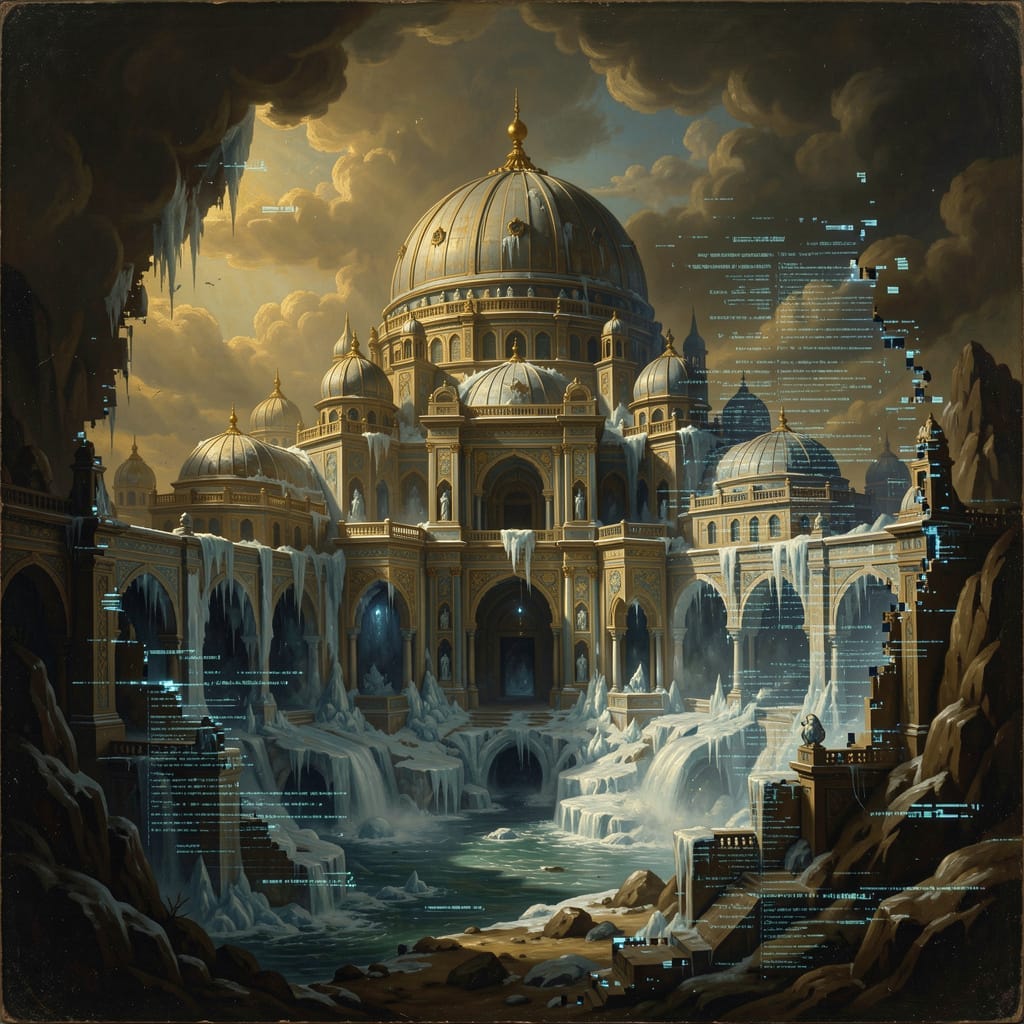
There is a famous story about an unfinished poem, and I want to suggest that it is also a story about the internet, about power, and about the thing we have lost that we don’t quite have the language to name.
In 1797, Samuel Taylor Coleridge fell asleep in a farmhouse after reading a passage about the palace of Kubla Khan. What came to him in the opium haze was something whole — a vision of a vast and perfect architecture, a pleasure dome with caves of ice, a paradise contained within a structure so complete that it held beauty and danger in the same breath. He woke and began writing it down. He got fifty-four lines in. Then a person from Porlock knocked on the door, and by the time Coleridge returned to his desk, the vision had dissolved. What survived is a fragment — gorgeous, strange, and permanently incomplete.
I have been thinking about Porlock a lot lately.
In 1981, a mathematician and science fiction writer named Vernor Vinge published a novella called True Names. I stole his title for my last piece, and David Brin — one of those world-class writers generous enough to engage with a small Substack from northern Utah — rightly called me on it. Fair enough. Debts should be acknowledged, and this one runs deep.
Vinge imagined a world of networked hackers operating in a shared virtual space he called the Other Plane. Re-reading it now, forty-five years later, the Other Plane feels less like science fiction and more like Romantic visionary poetry running on a modem. The descriptions shimmer and shift. The rules are felt rather than explained. I found myself, somewhere around the midpoint, suddenly wanting to read the rest of the cyberpunk epic Coleridge started and then sobered up from. There is a direct family resemblance. The pleasure dome with caves of ice is an eerily accurate description of the digital frontier Vinge was building.
The architecture of True Names runs on a single principle: in the Other Plane, hackers operate under pseudonyms, wielding power that dwarfs their physical selves. But the one vulnerability that unlocks everything is your True Name — your real-world identity. Learn someone’s True Name and you can find their body, expose them to the state, coerce or destroy them. The entire structure of power and resistance runs on a single axis: who can be named, and who cannot.
Vinge published this before the internet existed in any public sense. The people who went on to build that internet read it and recognized the architecture of the problem before the problem existed. He didn’t predict the hardware. He translated the ancient fairy rules of the Egyptians and the Celts and the Brothers Grimm into silicon. And like Coleridge’s vision, what he described was whole — anonymity as simultaneously the shield of the dissident and the weapon of the predator. A complete structure that held contradictions in tension without resolving them.
But where Coleridge’s vision was shattered by a person from Porlock, Vinge’s vision was shattered by us.
We have forty years of experimental data now, and the results are in. The pseudonyms became screen names, handles, burner accounts, anonymous forums. The power Vinge described — the ability of a networked individual to act at a scale disproportionate to their physical self — turned out to be exactly real.
So did the dangers.
The word we use is troll, and I don’t think we’ve paused long enough to notice what we’re saying. A troll is a creature from Norse mythology that lives under a bridge. It attacks travelers from a position of concealment. Its power comes entirely from the fact that you cannot see it until it has already struck. Faceless, nameless, hidden by the architecture it inhabits. We reached for this word to describe anonymous online predators, and we reached for it because the pattern is the same pattern it has always been. The bridge is just made of fiber optics now.
From trolls, the degradation follows a path as predictable as gravity. Harassment becomes doxxing — the weaponization of the True Name, dragging someone from the safety of pseudonym into the vulnerability of the physical world. Doxxing becomes swatting — using the revealed name to summon armed agents of the state to someone’s door. Swatting becomes stochastic terrorism — broadcasting the True Name to an audience large enough that someone, somewhere, will act on it. Each step is an escalation along the same axis Vinge identified. Each step is an exploitation of the relationship between the hidden name and the exposed one.
The miasma of it is that these tools cut in every direction simultaneously. Doxxing is how fascists terrorize their targets. It is also, right now, the only accountability mechanism left when institutions refuse to name the powerful. The same act — exposing a True Name — is a weapon against the vulnerable and a tool of justice against the unaccountable, and there is no clean way to separate the two. The architecture is morally neutral, exactly as Vinge described it. The pleasure dome contains the caves of ice, and you cannot demolish one without collapsing the other.
David Brin saw this problem clearly, and his answer in The Transparent Society remains the most radical challenge to our instincts.
Brin’s logic is stark: if the camera watches you, the only meaningful defense is a camera watching the camera. Not concealment. Symmetry. If everyone can see everyone — citizen, corporation, state — then the power differential that makes surveillance dangerous collapses. The cop watches you, but you watch the cop. The government reads your email, but you read the government’s. Nobody gets a hidden name, and because nobody gets a hidden name, nobody wields the asymmetric power that hidden names provide. It is a modern answer to Juvenal’s old question — Quis custodiet ipsos custodes? Who watches the guardians? Brin’s answer is: we all do.
I find this almost more persuasive than I’m comfortable with. And yet, standing here in the spring of 2026, I find it insufficient. I’m not at all sure how we get from here, to there. Brin’s symmetry requires a return path — a functioning system of law and accountability that reacts when a Name is revealed. Without that path, transparency isn’t a shield. It’s just a better way for the powerful to adjust their aim.
Consider what is happening right now, in the country I live in, in the spring of 2026.
Agents of the federal government are appearing at airports to detain people. They are wearing tactical gear. Some of them are covering their faces. Some of them are not. The ones who are not — and this is the part that should stop you cold — are operating with their True Names exposed in an age where every cell phone is a camera and every camera is connected to every database that has ever existed. Any teenager with a phone and five minutes can match a face to a high school yearbook, a photo ID, a social media profile. These agents have handed their True Names to the archive, voluntarily, in public, and they have done so because they believe the current power structure will protect them permanently.
This is not Brin’s symmetry. They are exposed, but they believe they are untouchable.
At the same time, the files that would name the powerful — the Epstein client list, the sealed records, the connections that would expose the architecture of influence operating above and behind the visible government — remain locked. Not hidden, exactly. We know the vault exists. We know there are Names inside. But the Names stay sealed, because the people with the power to unseal them are, in some cases, the people those Names would expose.
And at the same time, the institutions of the state are being renamed. The Department of Defense becomes the Department of War. A body of international water becomes the Gulf of America. The language of governance is being rewritten, term by term, in plain sight, by people who understand that renaming is the oldest act of dominion there is. That is the offensive use of True Names — the one I wrote about last time. But the concealment of the powerful’s own names, the sealing of their own records, the classification of their own connections — that is the defensive use. And the combination of the two — I will name you and you may not name me — is the oldest and most dangerous asymmetry in the human story.
In the old stories, the Queen destroys Rumpelstiltskin by learning his name. In 2026, Rumpelstiltskin knows the Queen's name, her address, her social posts and her search history — and she hasn’t even been given his badge number.
Coleridge never finished Kubla Khan. He spent the rest of his life knowing that something whole had visited him and departed. I don’t think we finish this either — there is no clean resolution to the problem of names and power in a networked world. Brin’s universal transparency is a noble goal that assumes a functioning state. Vinge’s digital anonymity is a beautiful dream that assumes a vacuum. The fairy rules are true and cut in every direction.
But I know this: the people currently wielding power understand the rules better than the people resisting them. They understand that renaming is dominion. They understand that concealing your own name is armor. And they understand that the combination — naming the world while hiding yourself — is the most ancient and most effective configuration of power available.
The counter-move is equally ancient. You name the thing. You insist on the statutory name, the legal name, the True Name. And when power hides behind masks and sealed files and executive privilege, you photograph every face and file every request and build the archive that the future will open.
The person from Porlock always knocks. The vision always dissolves. But the fragment survives. And the Names, once known, stay known.
That is the other danger.
Consider sharing with someone who needs to remember that the fairy rules still apply — especially the dangerous ones.
🐸🦝🦄
You know what ? Since I found you I read you last (not altogether in the feline meaning “I like you, I'll eat you last”) ; after Heather Cox Richardson, and Joyce Vance, and Mary Geddry and two or three others, (OMG I read entirely too much of that stuff, and me just being a Quebecois). Because your posts allow me to take some needed distance, and now and then reach beyond the here & now .Thanks. Again.
Where should I look to learn more about the fairy rules? When you talk about that stuff, I feel something in my DNA that I seem like I almost remember.