The Understory
What a bad fruit year teaches about the difference between what impresses you and what keeps you fed — and a note, while we’re here, about why it goes quiet around this place come summer.


There will be no apples this year. No plums, no apricots. I want to say that plainly at the start, the way you’d report a death in the family to someone who’ll wonder later why the usual cards stopped coming.
It was not a hard winter that did it. A hard winter the trees know how to survive; they’ve been surviving hard winters longer than my people have been in this valley. What undid them was a kindness — a long warm spell in early spring that felt, to a plum tree, exactly like permission. The apricots went first, as they always do, flinging out blossoms the way a young man flings out promises, certain the good weather is a settled thing and not a rumor. The plums followed. The apples, more cautious, were just beginning to open when the frost came down one clear night and took the lot. Not the trees. The trees are fine, leafed out and green and hale. All we lost was every flower they’d been fool enough to trust with the warm week, killed in a single quiet hour, and with the flowers the whole year’s crop of tree fruit.
I’ve watched this valley long enough to know it isn’t all that rare. An apricot in northern Utah is a gambler who plays the same hand every spring and loses as often as he wins, and we plant him anyway, for the two years in five he comes home flush. There’s nothing much better than a Chinese Apricot, sun warmed and dripping with golden juice, straight off the tree.
But there’s a particular cruelty to the warm-spring-then-frost pattern that a plain hard freeze doesn’t have. The tree didn’t fail. The tree did everything its nature told it to do. It read the signal the world was broadcasting, committed everything to it, and then the world changed the signal after the commitment was made. I can’t be angry at the trees. I’ve made the same mistake myself, in rather more expensive ways.
So I went looking, this cold green June, for what had held. And here is the thing worth writing down, the reason I’m bothering you with my orchard at all: something always has.
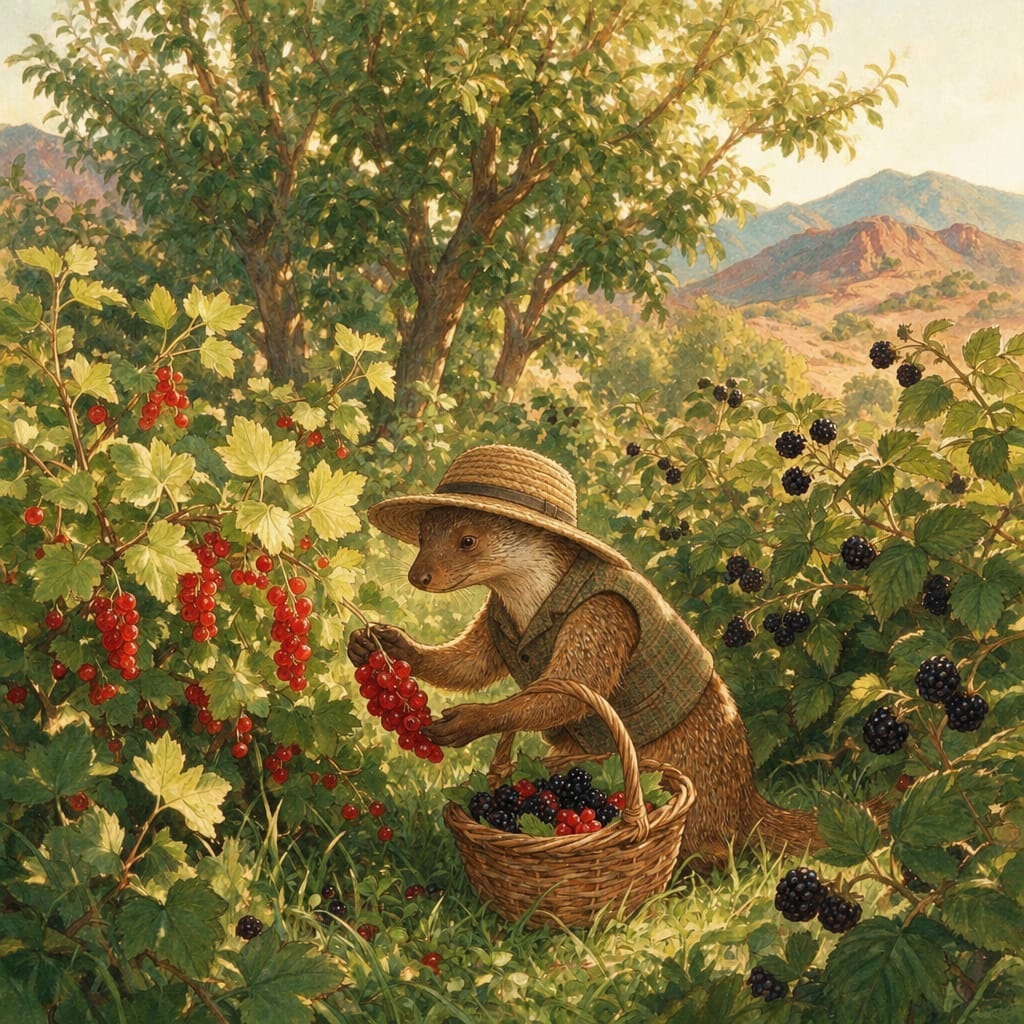
Low to the ground, under where the fruit should have been, the tough and unglamorous layer of the place had simply gone on with its business. The currants, which no child ever wished for on a birthday, but which make a breakfast scone that is as good as any scotsman ould ever hope for — made their hard little strings of red fruit as if nothing happened. The jostaberries — that graceless hybrid nobody’s grandmother grew — don’t seem to have noticed there was a frost. The raspberries and the blackberries, blooming late and long on canes that hadn’t yet stuck their necks out when the cold came, are coming on fine. The goji, a plant I mostly tolerate for its stubbornness, will flower right through the summer and cannot be persuaded to care about a bad April. Chokecherries, a mountain-west native, shrugged their shoulders and got to business a few weeks later. As usual.
And Lady T’s annuals, started warm in the sun room and set out after the danger passed, are doing what annuals do, which is refuse to plan far enough ahead to get their hearts broken.
The orchard is the part of this place that photographs well. It’s the part I’d show you first. It’s also, this year, the part that gave us precisely nothing. The understory is the part I never mention — the redundant, low, homely layer of small fierce things — and it is the reason we’ll still be putting up preserves in August. A dooryard planted only in fruit trees would have handed us a spring of blossom and a summer of fruitless leafy branches. The diversity that looks, to a tidy mind, like clutter is exactly the thing standing between a bad frost and an empty larder.
I could pretend I planned it this way from wisdom. Mostly I planted a great many different things because I am greedy and could not choose, and the greed turned out to be a strategy. That’s how it usually goes. Resilience is rarely a decision anyone makes on purpose; more often it’s what greed and stubbornness and a refusal to specialize look like in hindsight, after the year that punishes the specialists.
And I’ll tell you the part I’m gladdest of, which is the least romantic part: we are not yet living on what this ground alone provides. There’s a wage job that keeps the lights on and a full shelf at the grocery a few minutes away and a dozen households nearby who’d not let us go short, nor we them. The homestead purist would call that a failure of self-reliance. I call it the whole point. A place that has to feed you entirely, with no wider web behind it, is one hard frost from disaster — it’s a single crop pretending to be a farm. The graduated thing, the layered thing, the place that grows what it can and reaches for the rest without shame, is the thing that holds. Self-sufficiency as a proud absolute is just another monoculture. It fails the same way, and for the same reason.
Which brings me, by the roundabout route these stories always take, to a small confession for the people who read what I write here.
You’ll have noticed the essays come thick in the winter. There’s a reason, and it’s the same reason the apricots bloom in March: the season permits it. When the ground is asleep and the dark comes at five, there are hours for sitting and thinking and arguing with the world on a page. But the ground is awake now. Between the work that pays and the work this place demands from first light to last, the writing slows. It always has. It always will. This is not the Substack faltering; it’s the Substack keeping the same seasons as everything else on the property. I keep a winter’s pace in winter and a summer’s pace in summer, and I’ve decided, as we near the end of summer after that frost-bitten June, to stop apologizing for it and simply tell you so.
The apples will bloom again next spring, and gamble again, and some year soon they’ll win. The currants will hold the line in the meantime. And I’ll be back at the page in earnest when the leaves turn, with a winter’s worth of things I’ve been too busy weeding to say. Through the summer, if I can post two pieces a week, I feel pretty pleased with myself.
Until then: tend your own understory. It’s the low fierce things, not the tall proud ones, that carry us through the year that goes wrong.
Consider sharing this with someone who’s measuring their worth by a crop that didn’t come in this year. 🦡
I love the small fierce, obdurate things.
Great post which sent me off of on several disparate streams. I’ve been thinking about “community” and “empathy” a lot while reading Octavia Butler’s Xenogensis trilogy (a long way to go in it yet) and her point that a fundamental human weakness is the self-destructive aggressive hierarchical tendencies. Thanks for a great post. Happy hunting for your Autumn Bounty.