The Subsidiary Science
What a garden knows that a stock exchange has forgotten


By 1845 a great many people in Ireland ate one thing. The Lumper was a watery, unlovely potato that nobody grew for the taste of it, but it threw an enormous yield off poor, wet ground, and it kept a family alive on an acre and a half where nothing else would, and so it spread until it stood very nearly alone between millions of people and hunger. It was propagated by cutting rather than seed, which means every Lumper in the country was a clone of every other — one genetic individual smeared across an entire island. On paper it was the most efficient food system in Europe. Maximum calories, minimum land, one dependable variety, nothing wasted.
Then a water mould called Phytophthora infestans came off a boat, and the most efficient food system in Europe revealed itself as the most brittle. A monoculture has no second answer. The blight met a single crop with a single vulnerability and took the lot, three seasons running.
But the blight is only the ecological half of the catastrophe, and it is the smaller half. Through the worst of the dying, Ireland went on exporting food — grain, butter, livestock, cash crops moving out through the ports under guard while the people who raised them starved beside the road. The market did not break during the Great Hunger. The market worked perfectly. It did precisely what it was built to do, which is move food toward money, and it kept doing it while a million people died and a million more got on boats. The failure was not that the system stopped functioning. The failure was what it was designed to optimise for, running flawlessly, over a mass grave.
We should hold both halves of that together, because the whole argument lives in the seam between them. A fragile crop is an earth-care failure. Food flowing away from the hungry toward the solvent is a fair-share failure. And they happened in the same place, at the same time, to the same people, because the food system and the economy had been designed by two disciplines that don’t talk to each other — an agronomy that prized yield over resilience, and an economics that prized price over people. Permaculture is, before it is anything else, the attempt to make those two disciplines the same discipline.
The demotion
Here is the move that makes permaculture economics more than three warm words stapled to a business plan. It is not a new set of values bolted onto the front of the dismal science. It is a demotion of the dismal science itself.
Conventional economics runs as the master discipline: the frame inside which everything else — the soil, the watershed, the climate, the neighbours — gets priced as an input or booked as an externality. Permaculture inverts the nesting. The economy is a subsystem of the biosphere, a wholly owned subsidiary that cannot for one quarter outperform its parent company, because its parent company is the ground it stands on and the air it breathes. Herman Daly and the ecological economists made this argument in equations for fifty years and got shown the door for it. Permaculture makes the same argument in a garden bed, where it is harder to wave away, because you can watch what happens when you try to extract more than the system produces.
Demote economics to a subsidiary science and the three ethics stop being sentiment. They become what an engineer would call design constraints — the tolerances inside which the machine is allowed to run.
Earth care is a waste rule
The first constraint is the one the Lumper flunked. Produce no waste, the principle says, and the mongoose hears it as an accounting instruction rather than a moral one: in a healthy system, one element’s output is another’s input, and a thing with nowhere to go is a design error. Downstream of that single rule sits the whole difference between an economy built for efficiency and an economy built to still be standing next winter.
Efficiency and resilience are not the same virtue, and past a certain point they are enemies. The perfectly efficient supply chain is single-sourced, just-in-time, no slack, no redundancy — which is to say it is a monoculture, and it fails the way the Lumper failed, all at once and everywhere, the first time reality diverges from the plan. A resilient system carries redundancy the way a food forest carries species: not as inefficiency to be trimmed but as the insurance that keeps the whole thing alive when one layer dies. Run that thought to its conclusion and antitrust stops being a legal doctrine and becomes an ecological one. You break up the monopoly for the same reason you interplant the field — because the system that has narrowed itself to one answer has narrowed itself to one way to die.
People care is a feedback rule
The second constraint sounds like charity and is actually plumbing. Obtain a yield, the principle says — every element in the design has to give something back or it doesn’t earn its place. Turned on a society, that becomes the least sentimental possible argument for a floor under everyone: a person who gets no real yield from the system will, entirely rationally, stop maintaining it. You do not redistribute because it is kind. You redistribute because a component drawing no benefit is a component with no reason not to fail, and enough of those and the structure comes down. It is the maintenance budget, not the collection plate.
Braided into that is the principle permaculture calls self-regulate and accept feedback, which in a human system means the shortest possible loop between the person feeling the harm and the authority to fix it. Put the sensor where the pain is. That is subsidiarity wearing work clothes, and regular readers will recognise it as the same load the liquid-democracy essays were carrying: the correction has to live where the information lives, or the system sails blindly toward its own iceberg with every gauge in the engine room reading fine.
Fair share is a flow rule
The third ethic is the radical one, and it is radical precisely because it refuses to moralise. Le Guin got there first, on a fictional moon, in The Dispossessed: excess is excrement. Surplus retained in the body of a person or a firm past the point of use is not a triumph and not a sin — it is a blockage, and blockages make the organism sick. A pond with an inflow and no outflow does not become a richer pond. It stagnates, or it breaches the dam. Hoarded wealth is a stagnant pond that has convinced everyone downstream the drought is their own fault.
Fair share, read this way, is not a cap on ambition. It is a rule about flow — surplus above the level a system needs for its own resilience gets routed back out to build capacity somewhere else, because that is what surplus is for. This is the ethic that quietly reconciles two things that usually sit in different pamphlets: the Georgist claim that the unimproved value of land is common wealth and belongs in the common purse, and the gift economy’s insistence that abundance is meant to move. Same rule, two vocabularies. Keep what the system needs to stay healthy; let the rest flow, because a surplus that doesn’t flow isn’t wealth, it’s a clot.
The garden as an economic diagram
The three ethics set the tolerances. The design principles — the working half of permaculture that people forget exists — turn out to double as economic instructions almost without translation.
Zones and sectors is the cleanest. In a permaculture layout you place things by how often you need them: the herbs you cut daily sit by the kitchen door, the orchard you visit weekly sits further out, the woodland you manage seasonally sits at the boundary. Provision by frequency of need. Map that onto an economy and the exhausted fight between localism and global trade simply dissolves — it was a false binary the whole time. Daily bread comes from Zone 1, close and resilient and short-looped. The genuinely rare and complex things — the MRI machine, the vaccine platform, the lithography that etches a chip — come from wherever on Earth can make them, because you do not build a semiconductor fab in every village and you were never going to. It isn’t autarky and it isn’t a borderless single market. It’s graduated, the way a garden is graduated, by how near the need lives to the door.
Small and slow solutions takes an axe to growth-for-its-own-sake and blesses the patient kind of capital, the kind that plants a tree it won’t sit under. And use edges and value the marginal is the one I’d frame and hang over the door, because it says the most productive zone in any system is the ecotone — the messy margin where field meets forest, where two systems overlap. The informal economy, the barter network, the tools shared over a fence, the twelve households who move a freezer and a chainsaw and a casserole between them without an invoice changing hands: an orthodox economist files all of that under “not counted.” Permaculture files it under “most productive zone, do not pave.” Some of you know a network like that. Some of you are one.
Where I’d watch the gauges
I would be a poor mongoose if I handed you a design and no honest failure modes, so here are the ones I’d keep a hand on.
The scale problem is real, and permaculture writers wave it away too breezily. Small-and-slow cannot build an MRI machine. The zone model gives an answer — the rare and complex things live in the global zone, and the natural monopolies live in the public one — but that answer is doing heavy work, and anyone who tells you the whole economy can be run off raised beds and mutual aid is selling you the Lumper again: one beautiful answer, no backup plan.
The enforcement problem is harder. Fair-share flow needs either a state with the power to compel it or a community tight enough that hoarding gets you shamed at the equivalent of church. The second mechanism is real and it works — and it stops working somewhere north of Dunbar’s number, around the point where the people you’d be defecting against stop being faces and become statistics. Twelve households, the gift logic holds because everyone is visible to everyone. Twelve million, it doesn’t, and nobody has convincingly built the bridge from the one to the other. That gap is where most of the twentieth century’s worst experiments went to die, and pretending it isn’t there is how you end up repeating them.
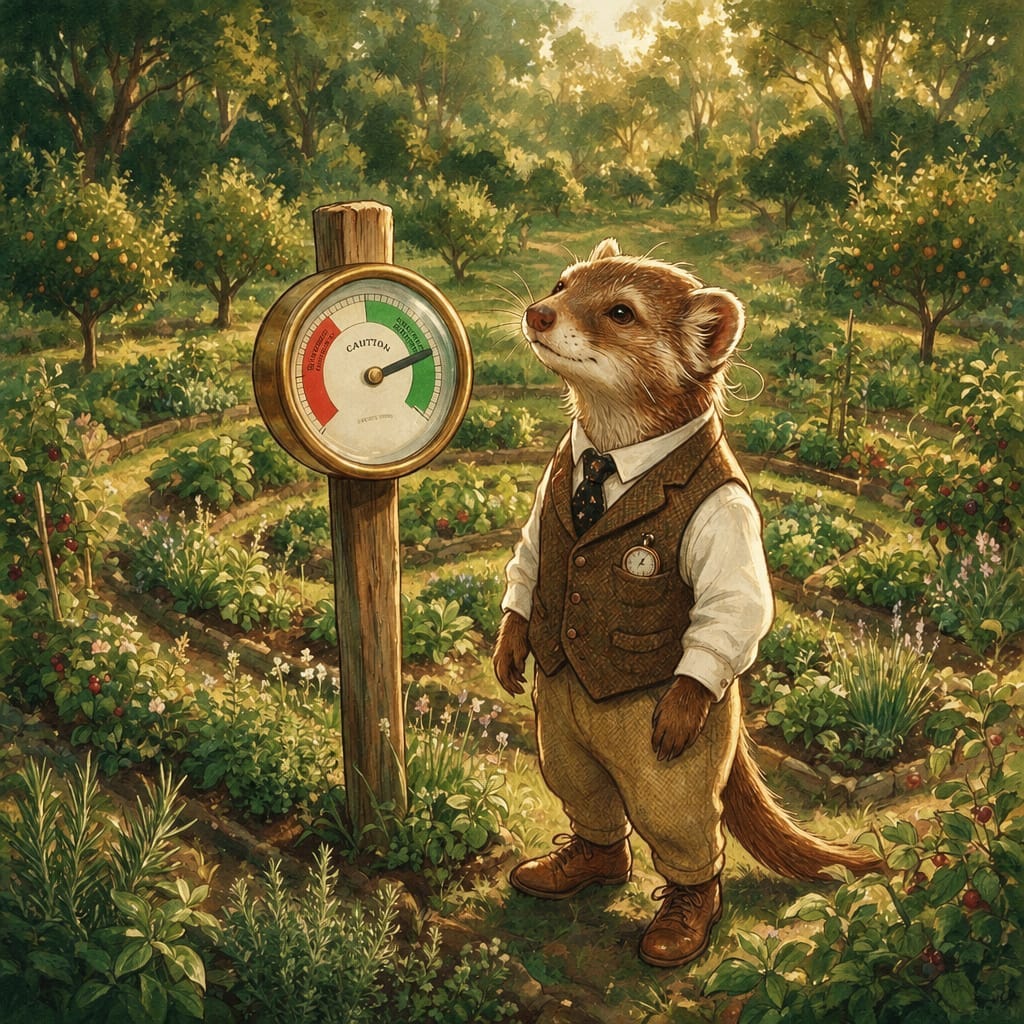
And the last one is a caution against my own side’s enthusiasm: keep the market. Not as the master, but as an instrument. For fast, local, legible signals about what people actually want and how scarce a thing actually is, a price is a superb sensor, and throwing the sensor out because you dislike the ideology that overbuilt it is exactly the closed-system reflex these essays keep warning about. You demote the market. You do not smash the gauge.
What it actually is
Strip the garden metaphors away and the honest name for all of this is older than permaculture. Karl Polanyi called it re-embedding: the work of taking the market back out of the disembedded, society-devouring mode it slipped into somewhere around the first industrial century, and setting it back down inside the ecology and the community it was always supposed to serve. Permaculture’s contribution is not the insight. It’s the diagram — a set of design rules concrete enough to build from on a Tuesday, on two-thirds of an acre, with your neighbours.
The live cousins, if you want to pull threads: Kate Raworth’s doughnut is the closest thing to a formal articulation, a floor of human need and a ceiling of planetary limit with the safe operating space between. Elinor Ostrom won a Nobel showing that commons don’t inevitably collapse — that communities govern shared resources sustainably all the time, when the rules are theirs. And most directly of all, the Transition Towns movement grew straight out of a permaculture classroom; Rob Hopkins was teaching the design principles before he ever thought to point them at a whole town’s economy. That lineage has already tried to walk some of this. It’s worth knowing how far they got before you assume it can’t be done.
The Great Hunger was two design failures wearing one coat — a crop that couldn’t fail safely and an economy that couldn’t see a starving man standing between it and a profit. We have spent a hundred and eighty years fixing the first failure and pretending the second one was a law of nature. It isn’t a law of nature. It’s a design choice, and the thing about a design choice is that it can be made again, differently, by anyone willing to read the actual gauges instead of the ones the model promised.
Build the food forest. Let the economists catch up.
Consider sharing this with someone who’s still waiting for the market to notice they’re hungry today. 🦝
Translated and shared.👍
Another absolutely brilliant article! Restacking now!