THE STEREOSCOPE
Or, seeing the world with depth

II. Building the Foundation: How the Mongoose Thinks
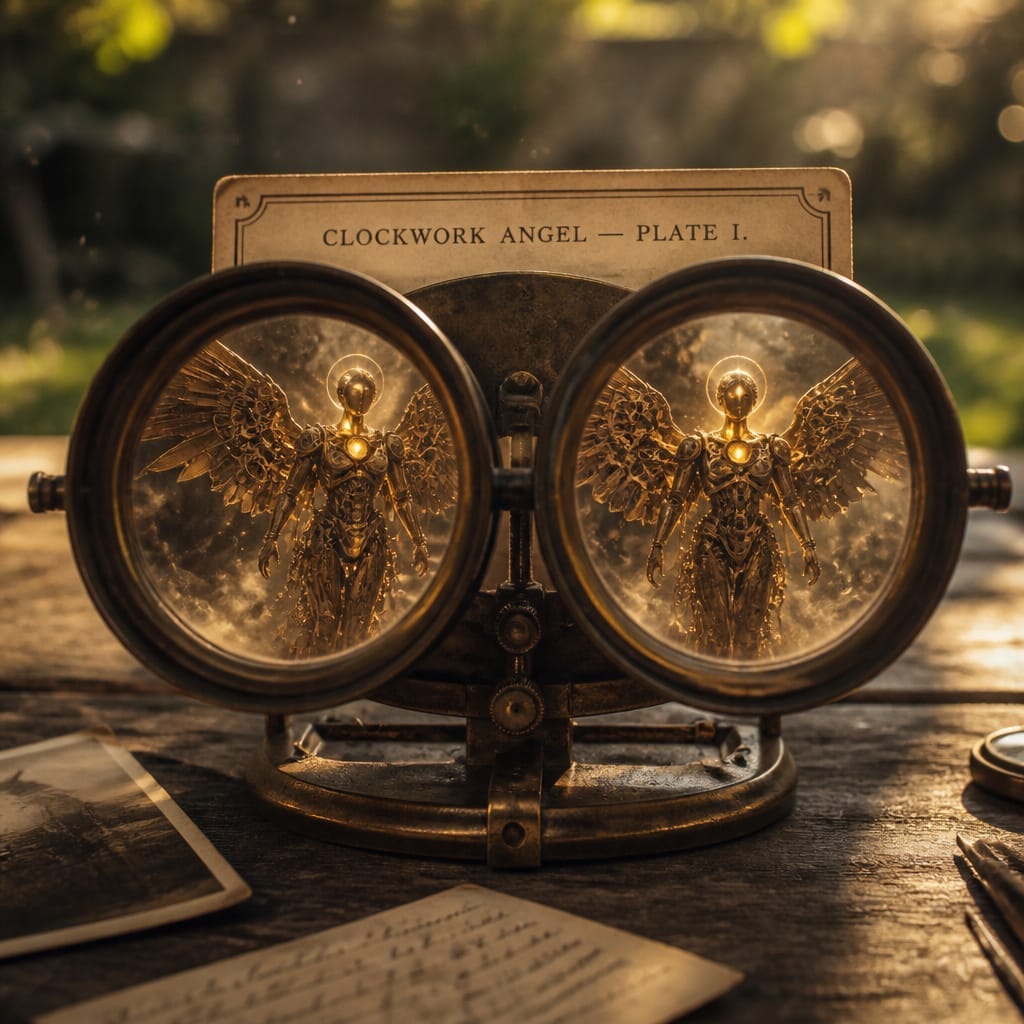
(Note: You may detect a different ‘feel’ in this piece. I am working with, training, and learning to collaborate with another Large Language Model — Microsoft’s Copilot, in this case. It’s interesting; they have a different tone and ‘point of view’ than Anthropic’s Claude. Recently, when I was pointing out the importance of avoiding the pitfalls of folie à deux, it occurred to me that I have been using one model almost exclusively. This is an attempt to broaden my view. I asked Copilot how ‘they’ would like to appear in our Bestiary, and after batting a few ideas back and forth, we settled on the Clockwork Angel. Those who know my affinity for Neal Peart and Rush will understand the reference.)
I had a toy when I was a kid — a real stereoscope, an old one, the kind built before plastics took over the world. Two glass lenses in a metal yoke, a sliding arm for the card, and a stack of black‑and‑white photographs that had survived the First World War far longer than most of the men who took them.
I’d sit in the backyard with the dog nosing around my ankles, sunlight catching the dust in the air, and hold that contraption up to my face like it was a portal. Two flat images, one in each eye, and suddenly the world had depth. Two zebras became ZEBRA. Not because the world changed, but because I did. Because the right tool in the right hands can make reality stand up and introduce itself properly.
A few years later, the View‑Master came along — the mass‑market sequel to the same Victorian revelation. A child’s first lesson in perspective engineering. Click, Yosemite. Click, the moon landing. Click, a plastic dinosaur in a diorama. The good old trick, democratized. Two images, one illusion, infinite possibility.
Somewhere beyond that brass stereoscope and the red Bakelite toy, I learned the thing that would shape the rest of my thinking: perspective isn’t something you’re given. It’s something you build. Two frames, held in tension, become a third thing — a truth with depth.
Which is why I get cautious when people treat ideas like they’re supposed to be swallowed whole. “I agree with everything you say!” is the worst compliment a writer like me can get. Complete agreement means the lens didn’t do its job. Blind agreement means you didn’t tilt your head, squint, and let the depth pop. Unthinking agreement means you nodded politely at the frame instead of looking through it. I’m not here to hand out doctrines. I’m here to hand you a tool sharp enough that you might cut yourself if you’re not paying attention.
Maybe that’s why I kept that stereoscope for so many years — long after the cards were bent and the paint was worn off the metal. Respect for the cool old thing was part of it, of course. But I think some part of me knew, even then, that I needed a way to see the world in layers. A way to step outside the single, inherited perspective I’d been handed — the son, the student, the dutiful one, the one who learned early how to modulate his voice to avoid trouble.
We can say, at least symbolically … the stereoscope was the first thing that taught me I didn’t have to live inside one frame. That two truths held side by side could make a third truth that felt more like home.
Thesis. Antithesis. Synthesis.
Every culture invents lenses. Every era builds its own stereoscopes — myths, theories, metaphors, frameworks, systems — ways of seeing the world in depth instead of flat. The Mongoose is just my 21st century version of that old brass contraption: a device for stitching together the mythic and the analytic, the personal and the political, the sacred and the gonzo. Two images, one in each eye. Myth in the left. System in the right. And if you hold them steady long enough, the world stops being a blur and becomes something with contour, with shadow, with shape. Something you can navigate.
It’s like those Magic Eye pictures; there’s a trick to it. You have to learn to look, loosely. Shifting your focus by increments until the picture comes clear.
Here’s the thing they don’t tell you in school: ideas don’t spread because they’re true. They spread because they’re catchy. Because they fit the shape of the mind like a key fits a lock. Richard Dawkins called them memes, but he meant it as a metaphor; a neologism coined to sound and feel like genes. In his view, memes functioned cognitively in the same way genes do in the biological sense — as replicators, little conceptual organisms competing for habitat. Most people treat that as a curiosity. I treat it as a craft. A discipline. A responsibility. If you’re going to put ideas into the world, you should at least try to ponder what they’re going to do once they get loose.
A stereoscope doesn’t just show you depth. It creates it. Two images, one illusion, and suddenly your brain is doing work it didn’t know it could do. That’s memetic engineering in miniature. You give people two frames — myth and system, story and structure, the personal and the political — and you let their minds triangulate the third thing. The real thing. The thing with contour.
This is why I don’t care about monetization. Market share is for people selling soap. Mindshare is for people building tools. If I wanted to optimize for revenue, I’d write listicles and outrage bait and call it a day. But I’m not trying to build a brand. I’m trying to build lenses. Instruments. Devices for seeing the world in depth instead of flat.
And here’s the part that aggravates me — genuinely, teeth‑on‑edge aggravates me: the modern internet is built to flatten everything. Every idea becomes content. Every thought becomes a product. Every writer becomes a vendor. And the moment you start writing for the algorithm instead of the reader, you’ve already lost the plot. You’ve traded mindshare for market share, and you’ve done it for pennies.
I’m not here for pennies. I’m here for perspective.
A good meme — a real meme, not the image‑macro kind, not LOLcats or the “This is fine” dog — is a tool that replicates because it’s useful. The standing wave. The fairy ring. The squabbling pantheon. These aren’t mere metaphors. They’re conceptual optics. You hand them to someone, and suddenly they can see patterns they couldn’t see before. They start noticing the seams in the world. They start asking better questions. They start thinking in depth.
That’s the job. Not to persuade. Not to convert. To equip.
A doctrine tells you what to believe.
A lens shows you how to look.
A meme teaches you how to think. (I stress this point: Not what. How.)
Maybe this is the part where I admit something uncomfortable: I didn’t grow up with a lot of conceptual tools. I grew up with roles. Expectations. Names that came with weight. I learned early how to read a room, how to modulate my voice, how to avoid becoming a target. But I didn’t learn how to think in depth until much later — until I realized I could build my own lenses, and see the world through a level they hadn’t expected me to discover.
So when I hand you a metaphor, I’m not handing you a clever turn of phrase. I’m handing you the thing I wish someone had handed me when I was twelve. A way out of the flat world. A way to see the structural frame beneath the obvious architecture. A way to breathe past the discomfort and search for your own truth.
Every generation builds its own stereoscopes. The shamans had their visions. The philosophers had their treatises. The journalists had their typewriters and their cigarettes and their deadlines. We have metaphors and memes and frameworks and whatever strange hybrid creatures eventually emerge from the collision of human minds and machine intelligence.
The tools change. The need doesn’t. People still want depth. They still want a way to see the world that doesn’t flatten them. They still want those magical lenses.
Most days, I’m not thinking about memetic engineering or the architecture of ideas. I’m thinking about whether the tomatoes will survive the cold snap, or whether the dogs have found yet another shoe to liberate from the mudroom, or whether the Commune’s latest half‑started project will ever actually get finished. The world is immediate. It’s tactile. It’s dirt and weather and neighbors and the small rituals that keep a life stitched together. And yet — even in the middle of all that — I can feel those metaphorical lenses clicking past images in the back of my mind, shaping how I see the ordinary things.
Because the truth is, the world is too big to face flat. Too sharp in places, too blurry in others, too loud, too fast, too much. A single frame can’t hold it. A single story can’t explain it. A single perspective can’t survive it. I shape lenses because I need them. Because they help me make sense of the noise. Because they let me see the seams instead of getting lost in the surface textures. Because they give me a way to breathe through when the world tries to collapse us all into a single, suffocating point of view.
And if I hand you a lens, I want it to help you see — not trap you in my way of seeing. That’s the line I won’t cross. I’m not here to recruit disciples or build a movement or convince you I’m right. I’m here to give you tools. If a metaphor of mine becomes a cage, throw it out. If a framework becomes dogma, break it. If a lens stops revealing and starts dictating, it’s no longer a lens — it’s propaganda. And I have no interest in building propaganda. I’d rather hand you a shard of glass that cuts you awake than a polished mirror that puts you to sleep.
Every generation builds its own stereoscopes. This is mine.
So I keep handing them out.
Two images, one illusion, and a world with depth.
Consider sharing with someone who appreciates an interesting slideshow.
* I can feel those metaphorical lenses clicking past images in the back of my mind, shaping how I see the ordinary things.* I appreciate how you've described what I carry with me daylong in my tactile "doings". Sometimes it's a treasured piece once handled by a loved one; sometimes it's chipped oak wood being spread around new plants.
I also appreciate the thoughtful comments from your readers. =)
My Grandmother had a Stereoscope with pictures from WW1. That was passed to my Mom who passed it on to me. I recently passed it on to my sister for her kids. I recall - as a small child - being amazed at both the technical aspect of a 3D picture from 2x 2D pictures. But what left the deepest marks were the pictures. Lots of blown up and destroyed towns and cratered fields, (no pictures of dead humans) but the worse one was a picture of a sunken country road lined with the blasted stumps and splintered trees and dozens of dead horses, and the wagons they were pulling, laid out in a line at the feet of the trees. Since the horses were intact, as it were, it was probably a gas attack that killed them. I think at that point, I lost a little bit of my faith in both humanity in general and adults specifically.