The Most Dangerous Game
On who the prey was, who the hunter was, and how the assignments are being revised.

IV. Convergent Crisis: The Big Picture
Sometimes, the universe hands you a rhyme.
This morning, as Lady T and I were cleaning out the pond, deciding on a better way to protect cattails from geese and ducks, and keeping goldfish alive as they gasped and hoped for fresh water, we realized there is an active yellowjacket nest under the plastic trex decking.
Life on the farm; it’s kinda laid back.
Yellowjackets are the angry flying A-holes of the permaculture adventure. Little zippy sky jalapeños, yellow and black zoot-suited gang bangers with razor knives. They are Katniss Everdeen’s Tracker Jackers, without the funky dream sequence.
I try pretty hard to let the land live in peace. But there is a line. Lady T is allergic, and when they come into our peaceful space, they’ve crossed it.
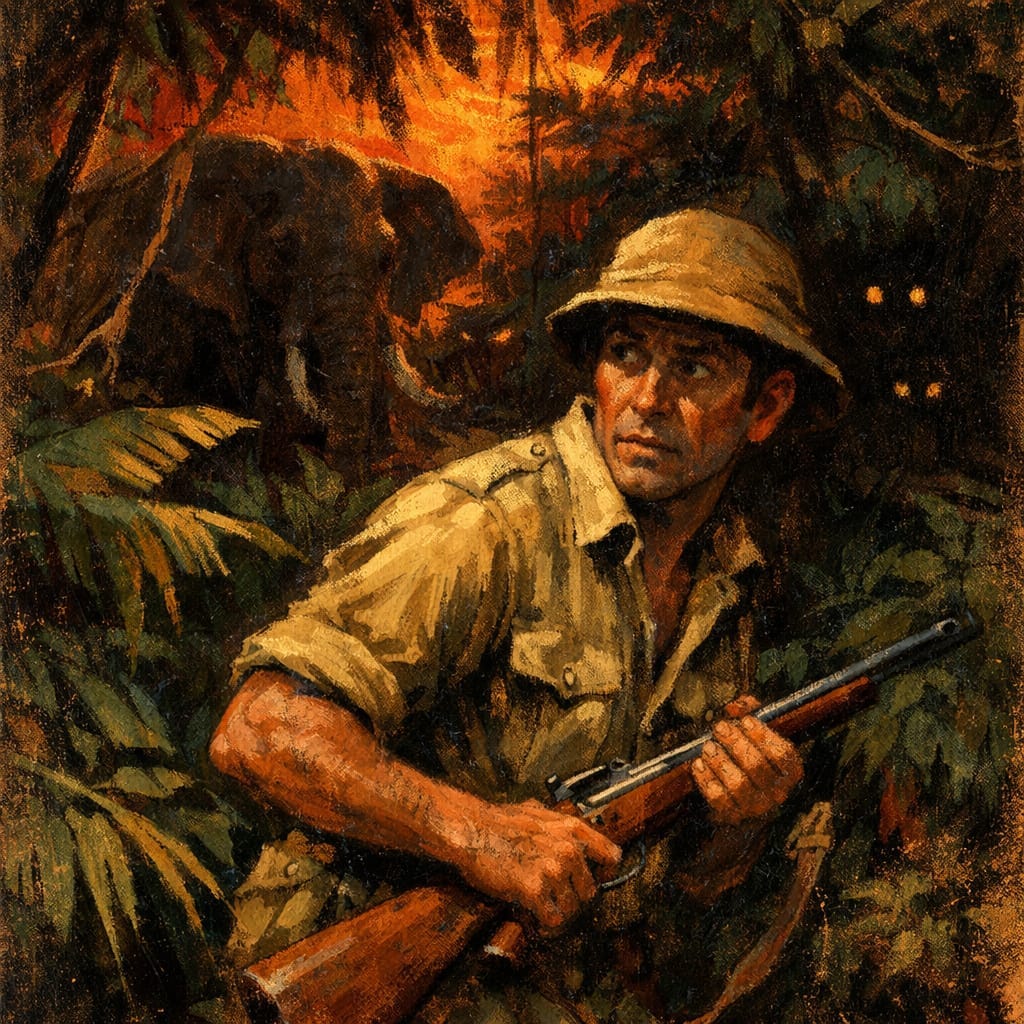
In April, an American millionaire paid forty thousand dollars to fly to Gabon and shoot a hundred-twenty-pound forest antelope with eight-inch horns. He startled a herd of elephants instead. The herd had a calf. They charged. He died.
The story is not unusual.
There is a steady annual procession of people who pay large sums to hunt animals in places they do not live, and a smaller subset of them who become the hunted instead. Animals 24-7 has catalogued 158 such cases of animals killing hunters and poachers worldwide since 2005.
What is unusual is the response.
In the nine days following his death, the incident generated 437,000 mentions across electronic media. By comparison, a Texas rancher trampled by a Cape buffalo in Limpopo nine months earlier — same sport, same demographic, same essential outcome — generated 67,300 mentions over a much longer period.
The same kind of event, six times the cultural attention. And the attention was not, in the main, sympathetic.
The comments at one wildlife publication ran toward the structural: Perhaps it’s the absolute disgust people are feeling now that they are realizing how much the ultra-rich tend toward cruelty and violence. Cartoons proliferated. The served-him-right reaction migrated from the political margins to broad mainstream platforms in a way it would not have managed three years ago.
That migration is the phenomenon worth studying. Not the death. The reception.
Three demonstrations
Some years ago, a privately built submersible imploded en route to the wreck of the Titanic, killing five passengers who had paid a quarter-million each for the experience. The submersible had been operated by a company whose CEO had, by his own public statements, treated maritime safety regulations as a personal affront.
The cultural response was instant and unembarrassed. Within seventy-two hours, billionaire submarine was a meme phrase, and the meme was openly celebratory in a register that, ten years earlier, would have been treated as transgressive. Editorial pages did the disapproving work expected of editorial pages. The public did something else. The public laughed, and noted that the ocean had priced the risk correctly, and went on with its day.
Eighteen months later, a health insurance executive was killed on a midtown sidewalk on his way to an investor conference. The shell casings recovered at the scene were inscribed with three words — delay, deny, depose — a sharpened variation on the title of a 2010 book about insurance bad faith by Rutgers law professor Jay Feinman.
The shooter was apprehended five days later at a Pennsylvania McDonald’s. The legal defense fund crossed a million dollars within weeks and is, as of this writing, somewhere north of one and a half million.
We do not need to belabor the politics of the act, which were appalling and remain so. The phenomenon that interests me is what the public did with it. A federal prosecutor, arguing against a trial delay, told the court the judge needed only to look out the courthouse window at the supporters gathered there, as they had been gathered at every hearing since the arrest, to see the people who believed the killing was justified.
He said this in open court, as evidence, and the judge did not contradict him. The world outside the window had become a part of the legal argument.
And then, last month, the elephants.
These are three different events. They share almost no specifics. The submarine implosion was an industrial accident waiting to happen, with paying customers as the variable. The killing was a deliberate political act by a single individual. The trampling was a wild herd defending a calf from a $40,000 nuisance. The deaths involved very different moral weights. The public response, in each case, was structurally similar: we are not going to mourn this one, and we are going to be candid about why.
That structural similarity is new.
What Connell saw
Richard Connell published “The Most Dangerous Game” in 1924. The story is usually remembered for its premise — a big-game hunter trapped on an island where another hunter has decided to hunt humans for sport — and not for the discovery the protagonist makes inside the premise. Rainsford, the hunter-turned-prey, does not survive by being more savage than his pursuer. He survives by being a better hunter. He sets traps. He uses the terrain. He waits.
The story’s actual claim, the one the cinematic adaptations tend to lose, is that the prey was always already capable of strategy. Zaroff’s mistake is not cruelty. Zaroff’s mistake is the category error of believing that the people he hunts are objects in a spectacle he controls. They are not. They are subjects with their own assessments of the situation. The hunt only works as long as the prey accepts the framing. As soon as one of them stops accepting it, the framing collapses and the hunter discovers that his premise was a fantasy he had been mistaking for a fact.
The submarine sank because the ocean is not a passive audience for anyone’s risk tolerance.
The executive was killed because the patients on whose behalf his industry made actuarial decisions are not, in fact, the inert spreadsheet entries the industry’s logic requires them to be.
The hunter in Gabon was killed because a five-elephant herd with a calf, in their own habitat, observing a backed-off threat that had not actually withdrawn, are not externalities to the safari company’s profit-and-loss statement.
In each case, the premise of the operation was that the territory was empty of agents who could push back. In each case, the territory turned out to be full of them. The watching public has noticed.
Money does not buy immunity from natural conditions. Pressure, despair, and elephants.
Nature always bats last.
Mongoose, not peasant
There is a version of this story that the rentier classes are comfortable with, because it can be policed. The peasant-with-a-pitchfork story. Mob rage, bread riots, the French Revolution recurring as farce. Pitchforks can be confiscated. Pitchfork-bearers can be dismissed as criminals or cranks. The press can deplore them, and most of the press will.
What is happening is not that.
The herd of elephants did not rampage. They backed off the threat by 150 yards. They charged only after the threat persisted toward the calf. The shooter in Manhattan did not act in fury. He waited. He chose his ground. He inscribed the casings so the message would be legible. The public response in all three cases has not been a riot. It has been one and a half million dollars in small donations. Four hundred thousand mentions across networked media. Cartoons. Editorials. Comment sections in publications that have never been radical, where ordinary people are noticing a pattern and naming it in their own words.
That is mongoose behavior. Not pitchfork behavior.
The mongoose is small, low to the ground, and chronically underestimated by cobras. It is patient. It reads the terrain. It does not announce itself. It does not need to win every encounter; it needs only to be alive at the end of the encounter that matters. The mongoose is also networked — the actual animal lives in family groups, hunts cooperatively, shares information about where the dangerous things are.
The Poors, to use the term affectionately, are not peasants in this story. The Poors are the mongoose. The Riches are cobras, and they have not yet noticed what lurks in the shrubbery.
The kompromat, inside out
We have been writing for some time about what we have called the kompromat economy: the system by which the powerful protect each other through mutually held leverage, where everyone owns something on everyone, and so the structure persists because no one can move on anyone without exposing themselves in turn. The kompromat economy assumes information is scarce, that leverage is private, and that the public is an audience watching a spectacle.
What is happening now is the kompromat economy turned inside out and backwards.
The information is no longer scarce. It is abundant. Every claim denial generates a statement somewhere. Every safety override leaves a paper trail. Every safari company’s marketing copy — Your Species Collecting Concierge, in one recent example — is published, indexed, retrievable. The leverage is no longer private. It is collective, distributed across networks the powerful do not read, calibrated by responses the powerful do not see, until a cultural moment arrives in which the response to one trampled hunter contains six times the social signal of the response to a structurally identical event nine months earlier — and the difference is the work done by the public in the intervening months to make the pattern legible to itself.
The kompromat economy assumed the spectator was passive. The spectator has, all along, been a witness with memory.
The cobras still believe they are operating inside the old framing. They still believe the spectacle is the frame, and that the audience is an audience, and that being seen by an audience is the same thing as being seen by a peer. It is not. The public is not a peer to the powerful, and never has been, and has therefore been operating on a different reading of the territory the entire time. The reading has now correlated. The pattern is now legible. And the cobras still do not have a map of it.
If we burn
There is a moment in The Hunger Games — in the second book, after the Quarter Quell announcement — when Katniss says, with the kind of clarity that comes from knowing exactly what the system requires of her: if we burn, you burn with us.
The line is not a threat. It is a description of how the structure actually works.
The Capitol’s spectacle requires the districts’ participation to function as spectacle. The wealthy industries require their customers, their patients, their workers, their subjects to keep showing up for the transaction. The safari requires a country whose government will issue the permit, a guide who will accept the hire, a herd that will continue tolerating the proximity. The submarine requires passengers willing to sign the waiver. The executive suite requires a population that will keep paying premiums and accepting denials and not, generally speaking, walk to investor conferences with anything other than questions.
Meanwhile, back on the farm …
The yellowjackets have been evicted, at least for now. But as I said to Lady T, who was helping me move the dogs out of the yard and the various pumps and bricks and the little garden cart full of paraphernalia out of the way: Move everything I might trip over. Because if they come out, they’re coming out hot.
I did not get stung. This time.
All around us, the structure has been operating on the assumption that participation is unconditional. It is not. It never has been. It has merely been difficult to coordinate the alternative, and the cobras have been comfortable mistaking that difficulty for impossibility.
It is no longer impossible. The networks exist. The information moves. The pattern is legible. The public has not, by any means, withdrawn from the structure — the structure remains massive and the withdrawal would be catastrophic. But the option of withdrawal has become visible to enough people, in enough domains, that the structure’s confidence in its own permanence is no longer warranted. The mockingjay is what happens when the prey starts to recognize that the hunt has rules the hunters depend on too.
The country that has no map
None of this is a prediction. The cultural moment we are describing could turn into something organized, something durable, something that translates into structural reform. It could also turn into nothing, or worse than nothing — into a politics of grievance that the cobras eventually learn to harvest. We have seen both endings before. We have not yet seen which one this is.
What we can say is what is true today, on the ground, in the territory.
The territory is full of mongoose. They are not organized in any way the cobras would recognize as organization. They are reading the same reports, watching the same footage, drawing the same correlations, and arriving — in numbers that are now measurable — at the same diagnosis. They are not preparing pitchforks, not lighting torches. They are watching the gauges. They are noticing where the friction lands. They are remembering the names of the dead they were told to mourn, and they are noticing which ones they actually grieved.
The most dangerous game was always the one in which the hunter mistook the territory for a stage and the prey for an object. That mistake has a long history of correcting itself, usually slowly, sometimes suddenly, always with the same essential structure: the prey turns out to have been a hunter who was waiting.
The cobras have not yet noticed.
The mongoose has.
🦝
Consider sharing with someone who has been watching the territory.
We're getting closer and closer to the Ministry For the Future. On every level.
People are not looking! If they took the time to see what is going on, they would be terrified of the possible future. Or totally will to change the pray. 💕 That's a lot of words. I might to a little high.