The Leaf House: How Community Grows Like Good Soil (One Layer at a Time)
Or: What 600+ Bags of Suburban “Waste” Taught Me About Permaculture and Neighbors

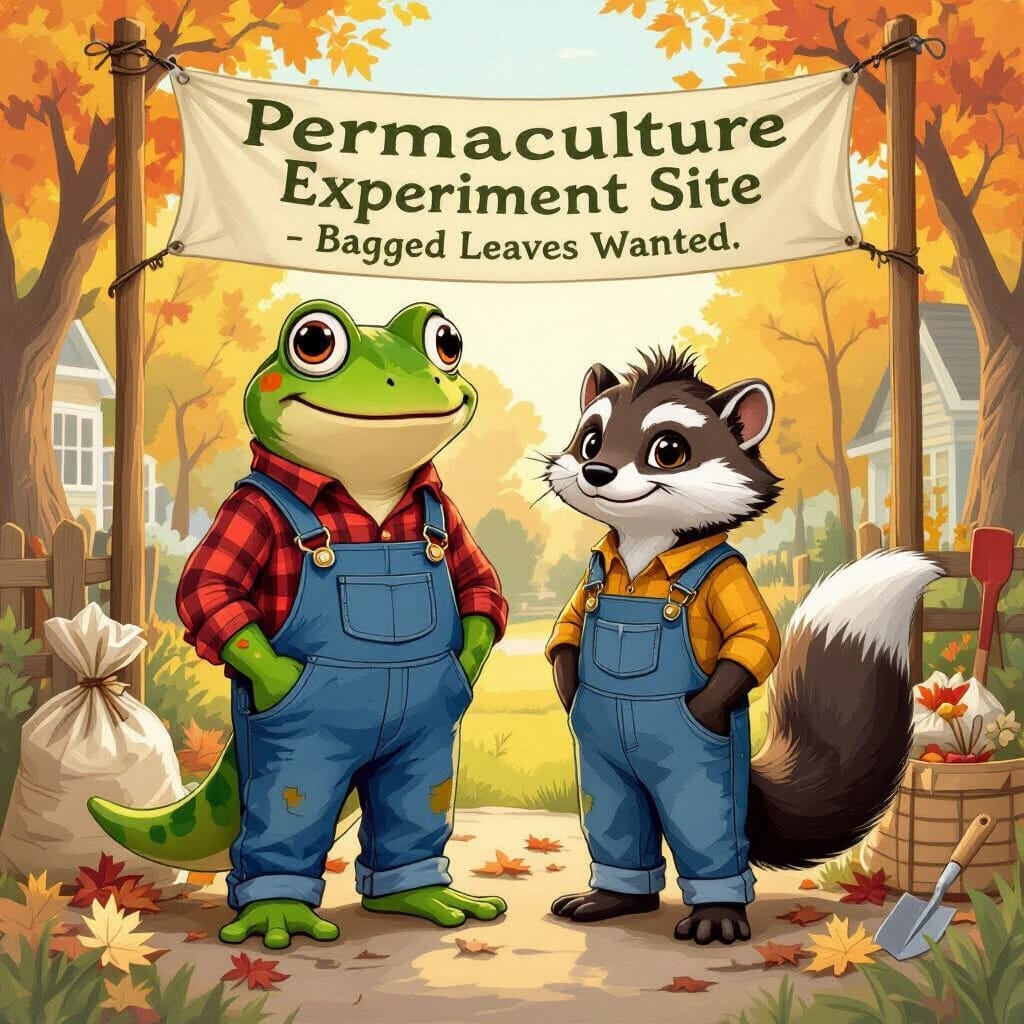
Every fall for the past several years, our place becomes “The Leaf House.” I built a small wooden fence at the edge of my driveway and ordered a 4x12 foot banner that I hang on it this time of year. It says “Permaculture Experiment Site -- Bagged Leaves Wanted.”
The first year, I kept careful track: roughly 600 bags. The second year: 800+. After that, I stopped counting because I knew the answer would always be “MANY.”
This year, because my furnace is kaput and I’m in the process of replacing it, Neighbor Jake and Tabby are taking a lot more of the leaves to put on their pastures. They treat their two half-acre lots as one “paddock paradise” - essentially a horse walking path that links the properties together, letting the horses move almost all the way around the perimeter while protecting the grass and trees in the middle.
The system adapted. When my usual leaf-processing capacity got disrupted, the network responded. Jake and Tabby’s pasture management became part of the leaf ecosystem.
That’s permaculture thinking in action: design systems that can handle disruptions gracefully. But here’s the thing – The Commune didn’t really start with permaculture philosophy. I had read a few books, planted a lot of trees and dug a few swales, but I was figuring it out on the fly. I made a lot of mistakes before I ever stumbled across Bill Mollison and David Holmgren’s ideas. But mom was a gardener, and I always knew that building the soil was the basis of everything.
So the roots of the Commune started to grow when I looked over the fence and wondered what the neighbors were going to do with all those brush piles.
The Origin Story: Leaning Over Fences
Tabby bought the house two lots north of us about ten years ago. I was the nosy old guy looking over the fence as she and Big Brent cut down dozens of trees and turned them into huge brush piles. They were all what could reasonably be regarded as “trash trees” - Russian Olive and Boxelder. My cabinet-maker friend calls Boxelder “the cheap skanky redneck cousin of the Maple family.”
In those days, I was very actively adding woody material to my own “pasture” area. I’d brought in many truckloads of branches over several years, and with leaves piled on top of them, they broke down into pretty good soil in a surprisingly quick timeframe. Even in our fairly dry climate, a winter’s worth of weather made all the difference.
My place had been somebody’s unmanaged paddock area before we bought it, so we were starting from basically dead soil with a nasty infestation of puncture vine and thistle. But by the time I met Tabby, I’d done enough experimenting to know that my soil was capable of absorbing a truly startling amount of organic material.
So I leaned over the fence and asked new neighbor Tabby: “What are you planning to do with all those branches?”
When Your Trash Becomes My Treasure
As far as I know, Tabby didn’t know permaculture from permanent record at that time. At the slightest hint that I would like to take all her branches, she was all over giving them to me. She and Brent helped haul them over to my place, and I had a grand time making brush piles into swales around the tree lines that were already starting to establish.
They were just relieved to have somebody willing to take all that “garbage” without them having to haul it to the dump.
Win-win-win. Tabby and Brent needed their “waste” to disappear without dump fees and truck hauling hassles. I needed abundant organic material for my soil-building experiments. And the land got what it needed: slow decomposition, water retention, habitat for beneficial insects and soil organisms.
No manifestos about sustainable living philosophies. Just “I have something you need, you have something I need, let’s figure out how to make this work.”
How the Commune Actually Formed
It developed, shall we say, organically. Tabby is one of those people - super linkers, I guess you could say. She makes friends easily, and soon her friends meet each other. So she blames me for starting the Commune, and I would say it was really all about her. But the truth is probably that we have personalities that synergize each other, on some level.
That mutual blame/credit thing is probably spot on. Community formation usually feels like it just “happened” because the right combination of people and circumstances came together. But it only looks effortless in retrospect.
I’m the systems thinker who sees resource flows and possibilities. Tabby’s the social connector who brings people together. Neither of us could have built the Commune alone, but together we created the conditions where it could develop naturally.
The Jake Lesson: Reality as Teacher
Neighbor Jake came later. I used to use that pasture for my own small flock of sheep, until the elderly sisters who owned it sold out and moved into their brother’s house. It was starting to look pretty good by then. But Jake, retired Marine and long time horse-owner, was less instantly convinced of this weird permaculture thing.
I remember telling him: “If you keep your horses off that pasture 75 percent of the time, they can get some pretty good grazing on it one week a month. Or you can let them wander the whole thing like most people do, and they’ll eat it to nothing... once. Then you’ll have to buy every scrap of feed they eat from then on.”
Jake was like: “Sure … I’ll figure it out.”
And guess what happened the next summer? His horses ate that pasture down to dirt. He let them wander the whole thing, they grazed it to nothing in one season, and then he was stuck buying all their feed while staring at a patch of bare ground that used to be productive pasture.
By that time, Tabby was treating her pasture as “paddock paradise” too, because she had seen how my place worked. And Tabby made friends with Jake pretty quickly. About a year after Jake moved in, all of a sudden he was much more interested in learning what I was doing that was different.
The Teaching That Actually Works
Lots of things spread that way in the Commune. I’ve never lectured anyone into learning a better way. You just have to live it, and let them make their own judgements.
If it had just been “weird Jamie with his brush piles and crazy theories,” Jake might have written it off as eccentric neighbor stuff. But when Tabby - who Jake already trusted and connected with - was also doing paddock paradise and getting good results, that gave Jake a different frame of reference.
It becomes less about accepting someone else’s philosophy and more about “huh, these two people who seem to know what they’re doing are both managing their land this way, and it’s clearly working better than what I’m doing.”
That’s how sustainable change actually spreads through communities. Not through convincing people they’re wrong, but through demonstrating that there are better options available when they’re ready for them. And it preserves everyone’s dignity too. Jake didn’t have to admit he was wrong - he just had to notice that his approach wasn’t working and that there were neighbors willing to share knowledge about approaches that did work.
What the Leaf House Really Teaches
Ten years later, we’ve got Jake and Tabby taking overflow leaves for their paddock paradise, the Leaf House banner bringing in “MANY” bags every fall, and a network that can absorb disruptions like furnace replacements without anyone suffering.
All because I leaned over a fence and asked about some brush piles.
The Leaf House isn’t really about leaves. It’s about what happens when you start seeing suburban “waste” as suburban treasure. When you begin designing systems that connect what people need to get rid of with what other people need to build.
When you have patience to let people learn at their own pace while you just keep demonstrating alternatives.
When you remember that the best teaching happens not through argument, but through living examples that speak for themselves.
The banner says “Permaculture Experiment Site,” but what we’re really experimenting with is how community forms organically, one layer at a time, like good soil building itself from the ground up.