The Immortal Memory:
or, the things we leave behind.

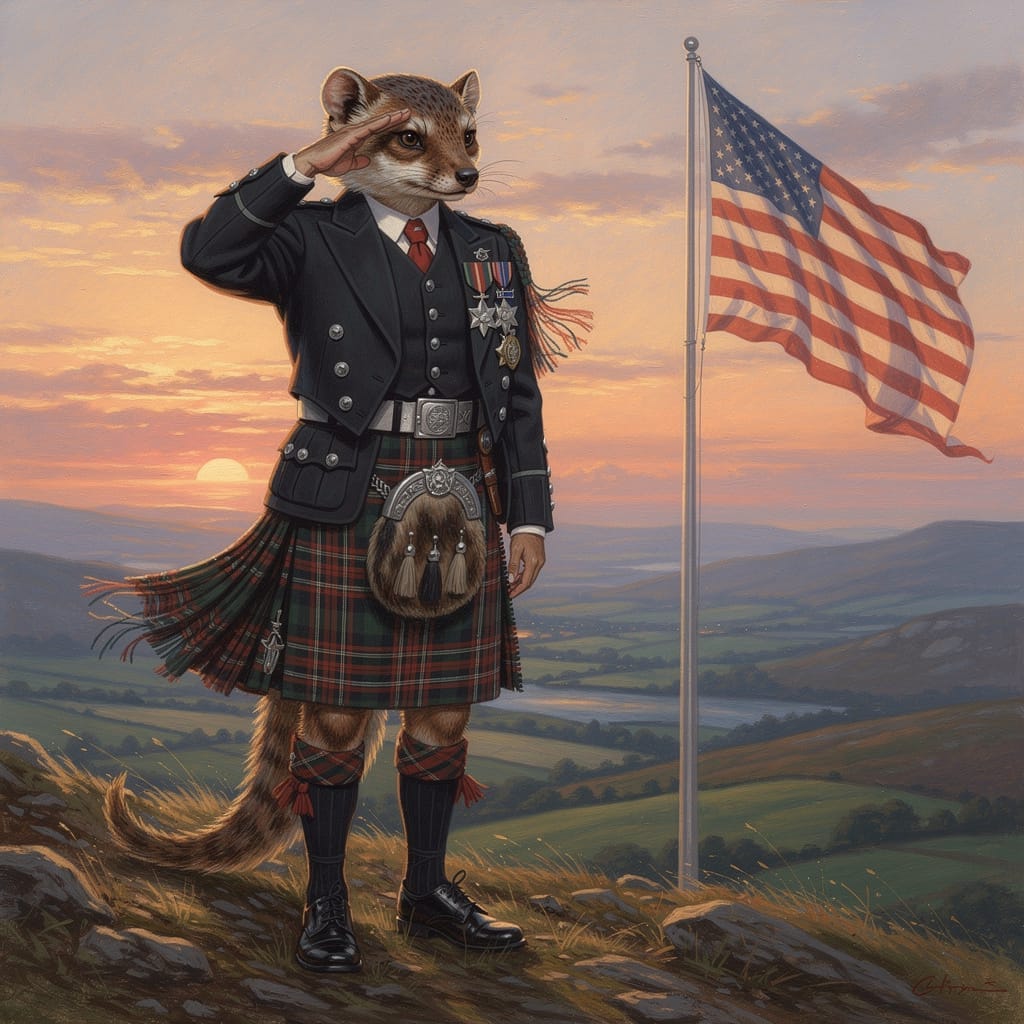
Tonight I attended a Burns Supper in Utah. If you’re not familiar with the tradition, it’s a celebration held on or around January 25th to honor the Scottish poet Robert Burns—the ploughman who wrote in Scots when they told him to write in English, who saw the Kirk’s hypocrisy and named it in verse, who celebrated the French Revolution when that was dangerous and who nearly emigrated to Jamaica when Scotland felt too hostile for a man with his politics.
The format is well-established: haggis, whisky (where allowed and available), poetry, and a series of toasts. The centerpiece is the Toast to the Immortal Memory—a speech reflecting on Burns and what he means to us, now, in our present moment.
Burns Suppers have been continuous tradition for over two hundred years. People have gathered to read poetry and eat sausage made of barley and organ meats and toast a long dead poet-farmer through wars and depressions and plagues. I raised my glass and drank with my friends. The tradition survives.
Just... a little more sparsely attended this year.
The room felt thin. I’d estimate two-thirds of a usual crowd, perhaps less. A Burns Supper isn’t cheap—it’s a catered dinner, a cultural commitment, the kind of evening that requires advance planning and discretionary income. The sort of event that contracts first when people are stretched thin, or scared, or gone.
The haggis was fair. I’ll give it a C-plus. Not enough liver, not enough black pepper, not enough coriander. When we kept sheep, my haggis was much better—but that’s the thing about haggis. It’s peasant food, thrift food, the cuisine of people who understood offal as ingredients rather than as items on a checklist. Most commercial haggis is timid. Put ketchup on it, it’s a meat loaf.
But they had a real black pudding, and it was perfect. Blood and oatmeal and fat in proper proportion. Someone knew what they were doing, with that black sausage.
The readings were sub-par. And here I need to tell you about an absence.
For years, a couple who served on the board of our Scottish association gave the Toast to the Lassies and the Reply. They wrote their speeches over the preceding year, refining them, and delivered something masterful each time—a mix of heart, wit, and skewering truth. Exactly what Burns Night demands. They are our dear friends, and it was through their influence that we found our way into the local version of Scottish culture.
They’re not here anymore.
They looked at the trajectory of this country and decided that North Africa felt safer. They’re currently living with family in Tunisia. I don’t know if they’re coming back. I don’t think they know either.
We brought some of their things to donate for the silent auction. A beautiful wool tartan cloak. A bodhran drum painted with Celtic knotwork gripping beasts—those interlaced animals from the margins of illuminated manuscripts, creatures that hold on, that grasp each other in endless knots. Some framed prints.
The kind of things you leave behind when your homeland is on fire and you can only carry so much.
There’s another absence I want to name.
Traditionally, a Burns Supper includes a toast to the reigning monarch and the head of state. The Loyal Toast, it’s called.
The last time I remember them doing it would have been early in the first Trump administration. I stood. Raised my glass. And said, at least loud enough for the people at my own table, “Well! I will at least drink to Old Betty.”
Finding the loophole. Toasting the half that could still be toasted. The Jacobite move: you stand, you raise your glass, you drink to the monarch you can stomach while pointedly not drinking to the other.
But Old Betty is gone now, and the toast didn’t survive her. Easier to just remove it from the program than to keep finding ways around it.
Not protest. Protest is loud, makes a point, invites pushback. This is something else. A room full of people many of whom simply cannot, and rather than make it a thing, the organizers just removed it from the order of events. No announcement. No argument. Just an omission that no one objected to.
Burns knew about this kind of quiet resistance. The Jacobite songs that could be sung two ways. The toasts to “the king over the water” that meant something other than what they appeared to mean. The dangerous loyalty carried in ambiguity and silence.
A Scottish cultural society in Utah, no longer toasting the President of the United States. That’s legitimacy erosion measured in what we’ve stopped saying. It won’t appear in any dataset, because it’s a measurement we quietly stopped taking.
Robert Burns nearly left Scotland. He had a ticket booked for Jamaica, ready to start over in the colonies when his reputation made home feel impossible. Only the unexpected success of his first book of poems kept him on Scottish soil.
I think about that sometimes—the version of history where Burns emigrated, where the Immortal Memory is first toasted in Kingston instead of in Edinburgh. The poet who almost left. The tradition that almost happened somewhere else.
My friends didn’t have a book of poems go viral at the last minute. They had family in Tunisia and enough runway to make the leap. So they went.
And now their gripping beasts sit on an auction table, waiting for hands that won’t be theirs.
I didn’t bid on anything.
We’re keeping expenses low right now, because I work for the federal government and another shutdown seems likely. I’ve already worked without pay once this season. The politics of the day says it’s probably coming again.
The people who left couldn’t take their beautiful things. The people who stayed can’t afford to keep them. Two kinds of constraint, same source.
Burns Night in America, 2026: a two-thirds filled room, a toast left ringing in silence, and the belongings of exiles laid out for auction while those of us who remain calculate how long we can hold on.
The tradition survives. It’s survived worse. But I find myself thinking about what “survive” means when the people who made something excellent are scattered, when the readings are lackluster because the readers are gone, when the objects that held meaning are left orphaned on a folding table.
The gripping beasts, ungripped.
We raised our glasses anyway. To Robert Burns, who stayed. To the friends who couldn’t. To the memory that persists even when the room grows sparse.
To the Immortal Memory.
Whatever we can still carry with us.
Consider sharing with someone who needs permission to notice what’s missing today.
Damnit you made me cry.💜
❤️🔥❤️🔥❤️🔥❤️🔥❤️🔥❤️🔥