The Engine and the Road Ahead
Or, what do we do when the pavement is burning?

In July 1997, Wired magazine put out a cover that I can still see in my mind’s eye — all that neon confidence, the font practically vibrating with certainty. “We’re facing 25 years of prosperity, freedom, and a better environment for the whole world. You got a problem with that?”
I didn’t have a problem with it. Not exactly. But I’d already made my own version of the Long Boom bet years before Schwartz and Leyden gave it a name.
See, even before that Wired cover, I’d gotten it into my head that the United States and the Western world generally were mature markets. The growth had happened. The infrastructure was built. The big gains, I figured, were going to come from the places that still had room to grow — the emerging markets, the developing economies, the billions of people about to come online. I tilted my retirement money international. I tilted toward the places where the future was supposed to happen.
For a very long time, this cost me a lot of money.
Not because the thesis was wrong about the technology. The Long Boom was right about the technology. Apple went from begging Steve Jobs to come back because they were months from bankruptcy to becoming the first trillion-dollar company. Four billion people got on the internet. China pulled 800 million peasants out of extreme poverty. Every single technological prediction either came true or undershot reality.
But the S&P 500 spent year after year outperforming international markets so thoroughly that my allocation looked like a slow-motion mistake. The emerging markets emerged, all right — and then their gains got captured by local elites, siphoned through kleptocratic governments, or blown up by currency crises that the Long Boom framework treated as noise. The technology was real. The institutional assumptions were fantasy.
Sometimes being early is just another way to be wrong. And sometimes being wrong for a long time teaches you something that being right never could.
What it taught me was this: don’t bet against the engine. In 2008, at the heart of the crash, I finally saw the light. I bought in big to U.S. equities — the C Fund, in Thrift Savings Plan terms, which is basically the S&P 500. The American technology sector and the market it dominated were simply too big, too innovative, and too deeply embedded in global commerce to bet against. I stayed there. Through the recovery, through the Obama years, through Trump 1.0, through the pandemic crash and the rebound, through the first part of the AI boom. Sixteen years. It was the best financial decision I’ve ever made.
I moved to a defensive position in November 2024.
If you’re paying attention to dates, you already know what happened in November 2024.
I bring this up because I watched Ed Yardeni on PBS the other night, and something clicked into place. Yardeni is a serious person — I want to be clear about that. He’s not a hack, he’s not a partisan, and he’s been more right than most of his peers for the last several years. He called the no-show recession when nearly everyone else was predicting doom. His S&P 500 targets have been closer to reality than the consensus. When he talks about productivity data, he knows what he’s looking at.
I know this because I was, functionally, on his side for sixteen years. My money was where his thesis was. And it worked.
His thesis is called the “Roaring 2020s,” and it goes like this: we’re in a decade-long productivity boom driven by what he calls the BRAIN Revolution — biotech, robotics, artificial intelligence, and nanotechnology. Technology supplements or replaces the brain the way electricity and automobiles supplemented muscle in the 1920s. Corporate earnings grow, productivity rises, the market reaches 10,000 by decade’s end. In the clip I saw, the argument essentially reduced to: Elon Musk reads science fiction, therefore Long Boom.
And I sat there on my couch thinking: is this man living in the same world I see around me?
Not because he’s wrong about the technology. He’s probably right about the technology. AI productivity gains are measurable and real. The Anthropic Economic Index — and yes, I appreciate the irony of citing my AI collaborator’s parent company — shows college-level tasks getting a twelve-fold speedup. Corporate earnings are at records. The engine is running beautifully.
But an engine isn’t a journey. An engine is a machine that sits on a bench and spins until someone bolts it to a chassis, connects it to wheels, and points it down a road. The Long Boom — in 1997 and in Yardeni’s 2026 remix — is an argument about the engine. It has almost nothing to say about the road.
Here is the road, as of mid-March 2026.
We are two weeks into a war with Iran that no one voted for, authorized by an administration that has floated canceling the next election. The Strait of Hormuz is being actively contested. Oil hit $107. Iran’s retaliatory strikes have hit American bases and energy infrastructure across Bahrain, Iraq, Kuwait, Oman, Qatar, Saudi Arabia, and the UAE. An American missile appears to have hit a school. A Michigan synagogue was attacked. The administration is criminally investigating the chair of the Federal Reserve over building renovations. Kansas suspended the driver’s licenses of every transgender resident in the state. The government sent pregnant migrant girls to a facility that can’t provide adequate care. The man who coined the term “bond vigilantes” — Yardeni himself — has raised his probability of a market meltdown to 35%.
The engine is running beautifully. The road is on fire.
Back in 1997, that Long Boom article had a sidebar. Ten “scenario spoilers” — things that could derail twenty-five years of prosperity. US-China cold war. Russia devolving into a kleptocracy. An uncontrollable plague. A social and cultural backlash stopping progress dead. A major rise in crime and terrorism forcing the world to pull back in fear. Climate disruption of the food supply.
Every single one of them came true.
And when Peter Leyden looked back at this track record twenty-five years later, he declared victory. Nailed it, he said. The spoilers didn’t even matter. The Boom was so powerful it absorbed them all.
Dave Karpf, writing about this remarkable act of self-congratulation, put it simply: if you retrofit your predictions to insist they were right after all, you will never learn a single damn thing.
This is the move. This is always the move. The technology was real, so the thesis was right, so the spoilers were noise. The engine ran, so the journey went well. Never mind the bodies by the side of the road — look at those RPMs.
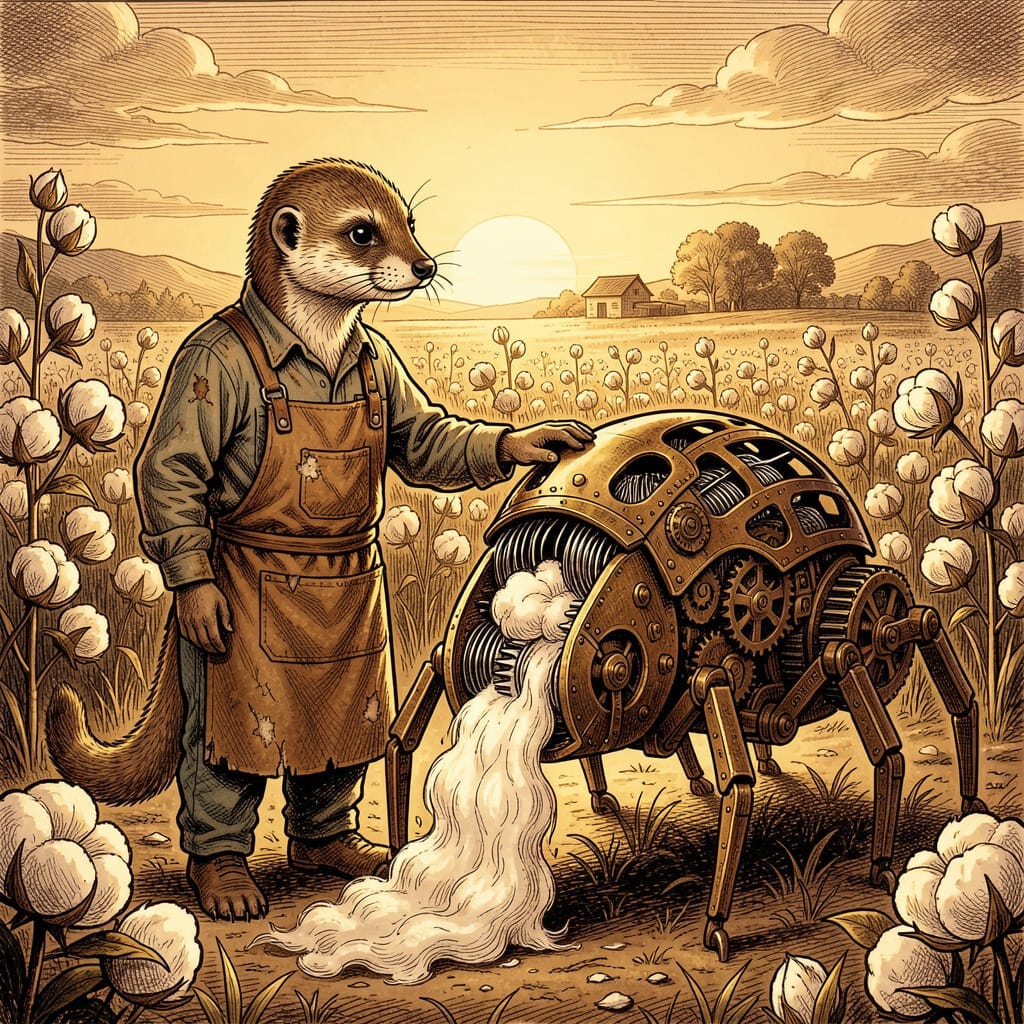
I started out thinking about this in terms of Eli Whitney and the cotton gin, because today happens to be March 14th and Whitney patented it on this day in 1794. The cotton gin was a genuine productivity revolution. It made cotton processing fifty times faster. It should have reduced the need for slave labor. It did the opposite. It made cotton so profitable that slavery expanded — entrenched itself for another seventy years, fought a war to preserve itself, and left wounds in the institutional fabric of this country that we are still, manifestly, not done bleeding from.
The technology was real. The technology was transformative. And the institutional context determined who captured the gains and how. This is not a footnote. This is the whole story.
The Roaring 1920s were a productivity revolution too. Electrification, the automobile, the assembly line, radio — genuine transformations of how humans lived and worked. The engine was extraordinary. And the road led to the Smoot-Hawley tariff, the crash of ‘29, and the Great Depression, because the institutional structures that were supposed to distribute those gains and regulate those markets had been systematically hollowed out by the same people who were profiting most from the boom.
When someone tells Yardeni that the Roaring 2020s might end the way the 1920s did, his answer is: not necessarily. Trump’s tariffs have already stress-tested the system without much sign of stress.
He said that in November 2025. Three months before the Iran war.
So here’s where I come back to my own money, because I think it’s only honest.
I work for the federal government. I have a Thrift Savings Plan. For sixteen years, from the bottom of the 2008 crash to November 2024, I was in the C Fund — the S&P 500, essentially. Yardeni’s thesis in index fund form. And it worked. It worked brilliantly. I learned the lesson my early internationalist years taught me: don’t bet against the engine.
Then I watched the election results come in, and I moved. Heavy I Fund — international equities. Heavy G Fund — government securities. Not because I suddenly forgot the lesson about the engine. Because I was no longer looking at the engine. I was looking at the road.
This is, by any standard measurement of the last decade’s performance, a contrarian position. The C Fund continued to climb after November 2024. The S&P hit a record high of nearly 6,988 in January. My colleagues who stayed put have done better, in raw numbers, than I have.
I’m not moving back.
Not because I think I’m smarter than the market. I’ve spent enough years being early-which-means-wrong to have that particular arrogance beaten out of me. I’m staying because my allocation isn’t a prediction about the engine anymore. It’s a prediction about the road.
The I Fund is a bet that the rest of the world — Europe finding strategic autonomy, Canada pivoting under Carney, the emerging democracies figuring out their own versions of competent governance — will eventually be rewarded for building institutional capacity while America is busy dismantling its own. It’s the early-career internationalist thesis again, but this time I’m not betting on emerging markets because mature economies have “less room to grow.” I’m betting on them because institutional health is the room to grow, and the United States is actively bricking up its own doorways. The G Fund is a bet that when the road does finally give way, you want to have something that wasn’t bolted to the chassis.
These bets have cost me money so far. They may continue to cost me money. Yardeni may be right that AI productivity growth will power through the institutional decay and the wars and the democratic backsliding, the way the Long Boom supposedly powered through every one of its scenario spoilers. Markets are resilient. Earnings do grow. The engine is, genuinely, extraordinary.
But I keep coming back to that Wired cover. All that neon confidence. Twenty-five years of prosperity, freedom, and a better environment for the whole world. You got a problem with that?
Yeah. I got a problem with that. My problem is that the cover didn’t say “twenty-five years of astonishing technology deployed through crumbling institutions for the benefit of a shrinking number of people while the spoilers eat the world.” That’s less catchy, I admit. But it’s what happened. And it’s what’s happening now, at higher speed, with better graphics.
Yardeni isn’t lying to you. He’s looking through a lens that shows the engine in beautiful high resolution while the road is a deliberate blur in the background. In a stable institutional environment, that lens works brilliantly. In the environment I see from where I sit, his lens is increasingly the wrong one.
The technology is real. The productivity gains are real. The BRAIN Revolution is real. And the road is on fire.
Plan accordingly. Which, if you’re new here, is not pessimism. It’s Scottish Optimism: plan for the worst, hope for the best, and understand that preparation is the concrete form of hope. The mongoose watches the pressure gauges not because he expects the building to explode, but because he intends to still be standing when the dust settles.
🐸
Consider sharing this with someone who needs a long view that includes the road hazards today.
We all used to get a share of the pie
As productivity increased so did wages
Then Reagan (and Thatcher) broke that link and the 0.1% (who had damn all to do with the improvements) pocketted the increased wealth
Haven't some of us been saying that for quite some time ? Technology [“progress”] does what politics allows/wants it to do ? But thank you for a very good image (engine/road). I'm glad I subscribed to your substack, albeit late in the game.