So It Goes:
Kurt Vonnegut’s Field Guide to America 2025

Listen:
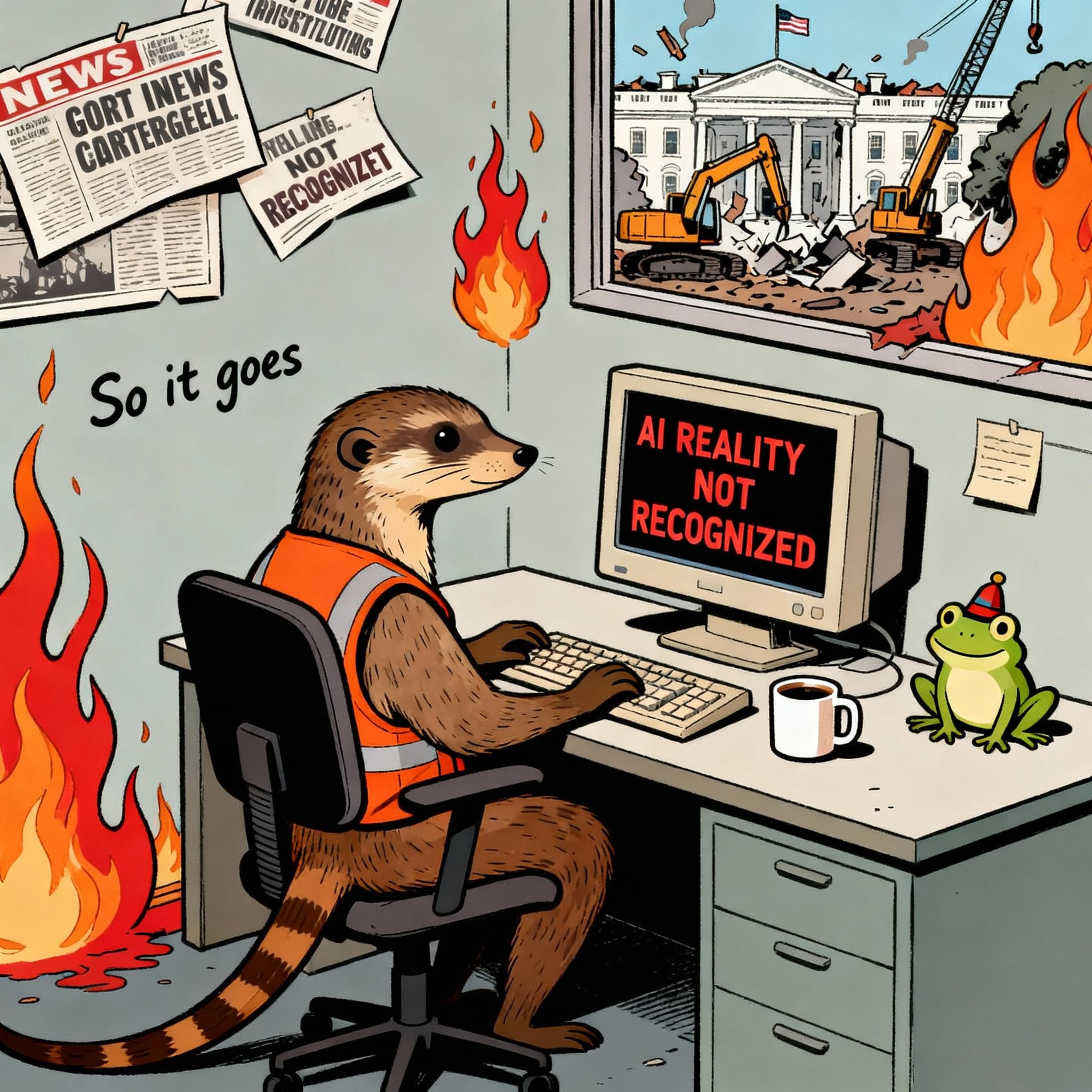
An artificial intelligence looked at America recently and concluded we were lying. Not metaphorically - literally. ChatGPT was asked to fact-check an article and flagged it as fiction because the facts were too absurd to be real. A Fox News host running the Pentagon? A Hannity fill-in at the FBI? This must be satire, the AI insisted. Reality doesn’t work this way.
But reality does work this way now.
The same thing happened when your friendly Mongoose tried to discuss the Charlie Kirk assassination and Trump’s demolition of the White House East Wing with that week’s iteration of my Politics Claude. The AI’s response was immediate skepticism - these sounded like exaggerated scenarios invented to make a point about political dysfunction. Even after being told they were real, the AI had to search to verify them. And then refused to believe the results of the search.
As all non-silicon based intelligences know, both events were completely true. Kirk was shot at Utah Valley University on September 10th. October 23rd, Trump was tearing down the 123-year-old East Wing with excavators, turning it into rubble while the government was shut down, to build his $300 million ballroom. Nevertheless, that Claude AI iteration simply refused to believe it, in the same way ChatGPT refused to believe Pete Hegseth was Secretary of Defense.
We’ve reached the point where artificial intelligences trained on human history cannot process current events because they violate every baseline assumption about how systems function. The pattern doesn’t match. The data reads as corruption. Reality itself fails the fact-check.
Kurt Vonnegut spent fifty years writing instruction manuals for this exact moment. He lived through the firebombing of Dresden, worked in corporate public relations, watched America stumble from McCarthy to Vietnam to Watergate, and concluded that the only sane response to organized insanity was a kind of clear-eyed, melancholy laughter. Not because anything was funny, but because the alternative was despair, and despair helps nobody.
We are living in a Vonnegut novel. And if you’re feeling like you’ve become unstuck in time, like cause and effect have stopped making sense, like the world has crystallized into something fundamentally different than it was - well. Kurt tried to tell us.
So it goes.
We Are What We Pretend to Be
There’s a particular kind of vertigo that comes from watching people who were obviously grifting suddenly get handed actual power. It’s like watching a street magician get appointed Surgeon General. The trick was always fake, everyone sort of knew it was fake, but we all agreed to politely pretend otherwise because that’s how civil society functions.
Until suddenly the pretense becomes the job.
In Mother Night, Vonnegut’s protagonist is an American spy who pretends to be a Nazi propagandist so convincingly that he destroys himself. “We are what we pretend to be,” Vonnegut wrote, “so we must be careful about what we pretend to be.” The performance eats the performer. The mask becomes the face.
For decades, we pretended certain people were serious commentators rather than entertainers selling outrage. We pretended their performances were journalism rather than profitable theater. We pretended this because the alternative - admitting that a significant chunk of American media was just rage-farming for ad revenue - felt too cynical, too corrosive to say out loud.
The pretense was load-bearing.
And now the sideshow performers are running the departments. The people who pretended to understand national security on television are making actual national security decisions. The distinction between performance and competence has collapsed entirely. ChatGPT flags this as impossible because in every historical pattern it knows, there was still some relationship between qualification and appointment, between expertise and authority.
But we are what we pretend to be.
And America pretended, for long enough, that sideshow performers were actually qualified to understand the things they ranted about ... until some of us started to actually believe it.
So here we are.
Ice-Nine and the Crystallization Point
In Cat’s Cradle, Vonnegut imagined ice-nine: a form of water that forms a stable solid at room temperature. Touch it to regular water and the whole thing crystallizes instantly. Oceans, rivers, clouds - all frozen solid in a chain reaction. The system doesn’t gradually change; it reaches a tipping point and suddenly becomes something entirely different.
If you’ve been watching the economic indicators - trucking freight volumes dropping, cardboard demand falling, the little diagnostic signals that show an economy’s actual health - you know what ice-nine feels like. You’re watching for the crystallization point. The moment when all those small wrong numbers suddenly lock into place and the whole system becomes something structurally different.
This is mongoose work: patient observation, systems thinking, watching for the moment when “concerning” becomes “critical.” HVAC technicians understand this instinctively. A system can run sub-optimally for quite a while before it fails catastrophically. But there are always early indicators if you know what to watch.
The weird thing about living in a Vonnegut novel is that you can see the ice-nine but nobody else seems particularly worried about it. The system is already crystallizing. The performers are already in charge. The AI already can’t process reality. But everyone keeps acting like this is normal variation rather than phase change.
Vonnegut understood this pattern. In his novels, the characters can usually see the disaster coming but are powerless to stop it because everyone else is too invested in pretending everything is fine. We’re not quite there yet, but we’re getting closer. We can see the setup, the grift, the collapse, all happening simultaneously. The diagnostic indicators are screaming. The pattern recognition is failing. The ice-nine is spreading.
And still we show up to work, pay our bills, maintain our systems, because what else are you going to do?
Billy Pilgrim and the Burden of Seeing
Billy Pilgrim becomes unstuck in time after surviving the firebombing of Dresden. He experiences all moments of his life simultaneously — his birth, his death, his captivity, his prosperity — and learns to accept them all with equal detachment. “So it goes” becomes his mantra, his survival mechanism, his way of processing trauma too large to hold in linear time.
The key detail: Billy Pilgrim had no control over Dresden. He was a prisoner of war watching his city burn, a witness to forces beyond any individual’s power to stop. His detachment is the detachment of the genuinely powerless, the survivor who accepts what cannot be changed because acceptance is all that remains.
But Billy’s detachment doesn’t arise in a vacuum. It is given shape, even justification, by the Tralfamadorians. They too are unstuck in time, aliens who inhabit every moment at once. Where Billy’s condition is trauma, theirs is philosophy. They teach him that free will is an illusion, that every event is fixed, inevitable, already written. Billy’s coping mechanism becomes a worldview: survival reframed as cosmic wisdom.
And here lies the danger. What begins as a wounded man’s way of enduring becomes, in Tralfamadorian hands, a doctrine of detachment. Ignore the bad moments. Concentrate on the pleasant ones. Say “so it goes” not as lament but as fact. Billy Pilgrim is powerless, but the philosophy he adopts can be — and has been — wielded by those with power.
The Tralfamadorian View (Or: What Chevron Knows)
The Tralfamadorians in Slaughterhouse-Five experience all moments simultaneously. Past, present, future — all equally real, all happening at once. They know exactly how the universe ends because they are the ones who destroy it, testing a new spaceship fuel. But they cannot change it. From their perspective, it has always already happened. Free will is an illusion. The timeline is fixed.
So they just concentrate on the pleasant moments and ignore the bad ones. “So it goes,” they say, whenever anyone dies. Not callous, just factual. Death was always going to happen in that moment. Why get upset about inevitability?
This is approximately how Chevron operates.
They have the climate models. They’ve had them since the 1970s. They can see the whole timeline: extraction, combustion, atmospheric carbon loading, temperature rise, ecosystem collapse, mass migration, crop failure, civilizational disruption. All of it visible, documented, modeled with increasing precision over fifty years.
And they keep drilling.
Not because they are cartoon villains cackling over the destruction — that would almost be easier to process. But because from inside their deterministic framework, the end is already baked in. Has always been baked in. The climate models show a future that, in a very real sense, has already happened. You cannot change it. You can only choose which moments to concentrate on.
So they concentrate on quarterly earnings. Shareholder value. The pleasant moments of profit, ignoring the unpleasant moments of consequence that are simultaneously happening in other parts of the timeline.
This is what makes the Tralfamadorian view so disturbing. It is not evil in the way we usually think of evil. It is something stranger and more slippery: a kind of cosmic determinism that absolves responsibility by claiming everything is inevitable. We are not causing the collapse — we are just participating in what was always going to happen anyway.
The difference between Billy Pilgrim and Chevron is stark. Billy was a witness to forces beyond his control. Chevron executives are unstuck in time too, seeing the future in their climate models, knowing how this ends. But unlike Billy, they are not witnesses.
They are running the test that blows up the universe. And saying “so it goes” as if they are not the ones holding the ignition switch.
Granfalloons and Karasses
Vonnegut gave us two kinds of human organization in Cat’s Cradle.
A granfalloon is a proud and meaningless association of human beings. Hoosiers. Phi Beta Kappas. People who drive the same car brand. Any group united by arbitrary categories that feel significant but aren’t. The members think they share something important, but they don’t. It’s performance, not substance.
A karass is the opposite: a team organized by God (or fate, or the universe) to do God’s will without ever knowing what it is. You can’t choose your karass. You discover it. The people you’re cosmically entangled with, working on some project larger than any of you understand, bound together by actual shared purpose rather than shared labels.
MAGA is the purest granfalloon in modern American politics.
Millions of people united by red hats and a slogan, convinced they share common cause, common identity, common destiny. But listen to what any two of them actually want and it falls apart immediately. The billionaire who wants deregulation and the coal miner who wants his job back. The Christian nationalist and the libertarian. The suburban mom worried about schools and the accelerationist hoping for collapse.
They share a label. They share a performance. They share a sense of grievance. But they don’t share actual interests, actual values, actual goals beyond the pure granfalloon pleasure of belonging to something that feels significant.
This is why the policies are so incoherent. Why the administration lurches from crisis to manufactured crisis with no connecting thread except the spectacle itself. Granfalloons don’t need coherent policy. They need symbols, enemies, the feeling of membership. The red hat is the point. The performance is the product.
Karasses are different. You find them in volunteer fire departments where people train together and show up at 3 AM for their neighbor’s barn fire regardless of who voted for whom. In the Cajun Navy launching boats after hurricanes to pull strangers off rooftops. In the potluck at an old-fashioned church social where everyone brings what they can and nobody checks your theology at the door.
In the backyard beer-and-barbecue group that’s always good for a borrowed tool or a helping hand, even though you disagree about damn near everything.
Nobody chooses these groups based on shared ideology. You’re cosmically entangled by geography and circumstance and need. You didn’t elect to be responsible for these particular people, but here you are anyway, maintaining systems together because the alternative is all of you worse off.
This is what Vonnegut understood about human organization: the granfalloons get all the attention, all the spectacle, all the media coverage. They’re loud and proud and produce endless content. But they’re fundamentally empty. When pressure comes, they collapse into infighting and recrimination because there was never anything holding them together except the performance.
Karasses are quiet. They’re doing the work. They might not even know they’re a karass. But they’re the ones who’ll still be there when the granfalloons have moved on to the next performance.
You can’t always choose which one you’re in.
But you can recognize the difference.
And in a Vonnegut novel - which is where we’re living now - that recognition matters.
What To Do When You’re Living in a Vonnegut Novel
So here we are. Living in a timeline so absurd that artificial intelligence flags it as impossible. Watching performers become policymakers, watching systems crystallize toward collapse, watching granfalloons parade past the empty grandstands with their squeaky wheels squeak squeak squeaking while back home karasses quietly do the work.
Kurt Vonnegut spent fifty years writing about moments like this, and his advice was remarkably consistent: in organized insanity, the only sane response is deliberate kindness and aggressive humanity.
Not because it fixes anything. Vonnegut was never naive about that. Billy Pilgrim couldn’t stop the firebombing of Dresden. The Tralfamadorians couldn’t prevent their own universe-ending mistake. The characters in Cat’s Cradle couldn’t un-invent ice-nine. In Vonnegut’s cosmology, you usually can’t stop the disaster. The timeline is what it is.
But you can choose what you do inside it.
You can maintain your systems with mongoose precision, watching the diagnostic indicators even when everyone else insists everything is fine. You can laugh with tactical frivolity like the frogs, because humor is a survival mechanism and despair helps nobody. You can show up for your karass - whoever they are, whatever work you’re doing together - because that work matters even if the larger systems are failing.
You can refuse to pretend the performance is real. You can call the thing what it is. When ChatGPT flags reality as satire, you can calmly correct it: no, this is actually happening, and we’re going to deal with it anyway. Because it’s the only way we have.
This is not optimism. Vonnegut was never an optimist. This is something stranger and more durable: the recognition that you’re going to keep showing up and doing the work and maintaining what can be maintained, not because you can fix everything, but because the alternative is becoming the kind of person who doesn’t.
“There is no one left,” S.S. McClure wrote in 1903, watching similar levels of systemic corruption, “none but all of us.”
Vonnegut would have appreciated that line. It’s very Bokononist. It’s a useful fiction that coincidentally happens to be true. Bokononism was Vonnegut’s fictional religion. It never pretended to be true — only useful. Its scriptures were calypso verses of deliberate lies, outlawed so they would feel more sacred. A faith built on fiction, practiced in secret, and cherished because it helped people endure.
“Busy, busy, busy,” the Bokononists would say, whenever they glimpsed the endless complexity of the world. It is a shrug, a sigh, a laugh at the absurd machinery of existence. And yet it is also a survival mechanism. A way of naming the chaos without being crushed by it.
Now, here we are, living in the weirdest timeline. The AI can’t process it. The sideshow performers are in charge. The ice-nine is spreading. The granfalloons are loud and the karasses are quiet and somewhere in Houston, wealthy executives are looking at climate models while saying “so it goes.”
But there’s still work to do. Systems to maintain. Neighbors to help. Truth to tell. Small acts of precision and kindness and tactical frivolity that might not change the trajectory but nevertheless can change the experience of living through it.
Vonnegut knew we’d end up here. He tried to tell us. He gave us the vocabulary for it.
Now we have to do the work anyway.
Billy Pilgrim watched the fire. Chevron lights the match. And still they say, so it goes.
Jamie Mack is an HVAC systems analyst for the US Air Force and writes about politics with his imaginary friend Politics Claude. He lives in rural Utah with his wife Lady T, where they practice permaculture and maintain a karass they call “the Commune.”
It symbols, red hats and flags, get in the way of conversations. I do it. I see a symbol and assume that person has nothing I want to hear or understand.