Scottish Romance
(or, Walking the Crow Road)

There’s an old Scottish song. The closest I can find to the version I sing says it was written by Edward Harrigan in 1872, for a sketch he titled ‘Muldoon, the Solid Man.
My version came to me as a song in the folk tradition, with variations of wording from Harrigan’s original. In the song as I sing it, a man makes his promises in a row. He’ll lay her down. He’ll fill her pan. He’ll treat her decent. He names himself an honest man. Then he tells her he’s traveled as far as Inveraray, as far as Edinburgh, and may go further still — but when he returns, he will lay her down again.
That is the entire song. Two verses, four promises, one return.
Set it next to Wild Mountain Thyme and the difference becomes the point. Same tradition, same instruments, entirely different work. Wild Mountain Thyme is courtship — the heather, the bower we’ll build together, will ye go lassie go. It’s beautiful and it’s true, but it’s the chapter before the marriage. The bower hasn’t been built yet. We’re still discussing the architecture.
The working song is what comes after the bower exists. The pan is real. The hearth is lit. The man travels for work — named towns, finite distances, the geography of someone who knows the way back — and the song is the return, not the leaving. American country music has the leaving song down cold; the genre is built on it. Scottish Romance is the return song.
The promises themselves are domestic to the point an American ear may miss them as promises at all. Fill the pan means feed her. Decent means as she deserves, every day, including the days I’m tired. Honest man isn’t flashy or heroic; it’s the whole deal — a man whose word stands. Hallmark would not put any of this on a card. Hallmark sells the forever that hasn’t been priced yet. The song is naming the price.
The American romantic tradition runs on volume. The grand declaration, the mountaintop confession, the speech in the rain. You complete me. I’d burn the world down. The intensity is meant to be the proof. Scottish Romance starts from a different premise: anyone can shout. Shouting tells you almost nothing about whether someone will still be there in the morning, or in thirty years of mornings.
This is what Lady T meant when she said, if I wanted romance, I should have married a Frenchman. The Frenchman, in her construction, comes with candlelight and declaration. The Scotsman — or the Utah equivalent — comes with the pan filled and the porch fixed and the dog renamed in Gaelic because the name mattered. She didn’t settle for less than romance. She chose what romance, in its tourist form, can’t reach.
Intensity has a problem the volume-based tradition can’t quite see: it cannot tell the difference between love and infatuation, between commitment and dopamine, between forever and the next six weeks. The volume drowns out the signal. Scottish Romance routes around the question by trusting the pattern rather than the feeling. The porch step that gets fixed before anyone has to ask. The tea kept in the cupboard you can reach. The half-formed three-a.m. thought, listened to without complaint. The illustrations drawn for the book. Twenty years of small noticings, each of which could have gone the other way and didn’t.
Hallmark love is the love that hasn’t been examined yet. It’s still in the showroom, kicking the tires. Scottish Romance is the love that has been driven through every kind of weather and is still in the driveway. It knows what you’re like in February after a bad shift. It knows you forgot to take out the trash. It has filed all of that, considered it carefully, and decided to stay anyway.
That is not a smaller love. That is a love that has been tested in hard weather and held.
We bought a house together and lived in it. Fifteen years and change. We worked through the dark, the hard, the slow business of figuring out how two strong adults give each other room without losing each other. The bower already built and lived in and repaired and lived in some more. The dogs. The second-shift schedules. The mortgage. The actual life.
And then one year, Lady T’s health insurance costs were scheduled to rise yet again. She said, can’t you just put me on your insurance?
I said, I don’t think so. We’re not actually married. I don’t know if they let us do that.
She looked at me and said: You’re not going anywhere. I’m not going anywhere. So fucking marry me, then.
That is one of the great proposals in the language. Every word does necessary work. You’re not going anywhere is the observation. I’m not going anywhere is the matched observation. So is the logical operator. Fucking is the impatience of someone who has been waiting fifteen years for the paperwork to catch up. Marry me, then is the conclusion the premises required. It is, structurally, a syllogism. Lady T proposed in the form of a logical proof.
The stereotypical Frenchman probably would not have done this. He would have lost the thread somewhere around the second clause, and handed her a bunch of roses.
But she was proposing to a Scotsman. And I, not being a completely stupid man, said sure.
Sure is the whole essay in one syllable. No knee, no ring, no rain. The decision had been made for fifteen years; she was speaking it aloud so we’d both hear it at the same time. Sure is the working-tradition vow — yes, of course, what else would I say. It is also, in context, QED. She had laid out, in twelve words, an unanswerable argument. The premises were true. The conclusion followed. To say anything other than sure would have been to dispute either premise one or premise two or the therefore. None of those were available for dispute.
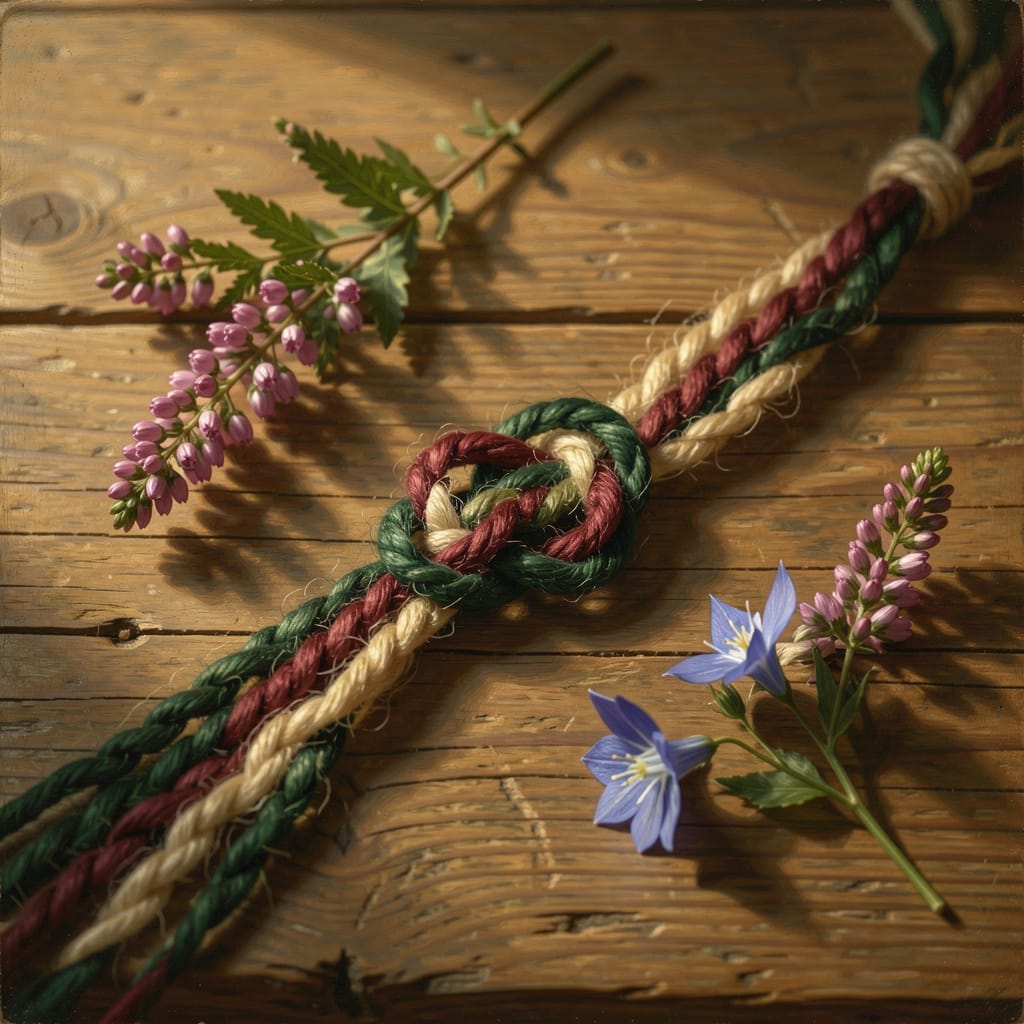
The wedding was in our backyard, with kilts. People who work with high voltage rarely wear metal rings, and I never got the habit. We did a hand-fasting in the old way. Our friend the actor performed the ceremony, with style.
And then we went back to the work of living a life together.
Some years into that work, I wrote her my own versification of Loch Lomond. Iain Banks’s title was already in my head, doing double duty: the crow road is the direct way, and the crow road is the way we all eventually walk alone. I read it to her the first time, and I may have teared up a bit.
Walking the Crow Road
Ye may not see the reason and ye might not know the right time
But some stay for a season and others last a lifetime
We walked a long and twisting road, we broke out of the night-time
Now one last thing I’m sure of, and we’re standing in the bright time
And you may take the high road, and I may take the low, But we’ll stand together ‘til we both walk with the crow.
And in the land where we leave our bones, may oak and ivy intertwine
And may the peaceful meadow grow, with clover and with columbine
And there through ages where we lie may hearts and hand touch with a sigh
For love has grace to bless a place, and grace has love for you and I
(Repeat chorus)
Oh you take the high road, and I’ll take the low road
And I’ll be in Scotland before ye
But me and my true love will never meet again
On the bonnie, bonnie banks of Loch Lomond.
I didn’t replace the traditional ending. The grief is built in. The parting is real. The bonnie banks are still there at the end, and someone is still singing the old song. We’ll stand together ‘til we both walk with the crow doesn’t pretend the crow road isn’t waiting. It says: until then, and even then, together.
That is Scottish Romance. Less wild, more steady. The bower already built, the hearth already lit, the road already chosen and being walked together. Not the love that hasn’t been examined — the love that has been examined and has held despite it, and because of it. An dà chuid còmhla, both things together.
Sure, she said, in effect. Sure, I said back. We’re walking the crow road together, and in the meantime, the pan stays full.
Consider sharing with someone who sees the value of steadiness.
May it hold for the next thirty or forty years. Our non-marriage lasted 38 years until he took the crow road last month (we have good health insurance in Canada...🙂)
Lovely. =) My Scottish laddie convinced me that marriage and health insurance were the logical way to go. We had a wed-e-que in our backyard, our dearest friend "officiating", and 26 years later (with lots of elbow grease, mental and emotional strengthening) marvel at our lives together. Adelante