Scottish Optimism
(Or, Preparing for Bad Weather)

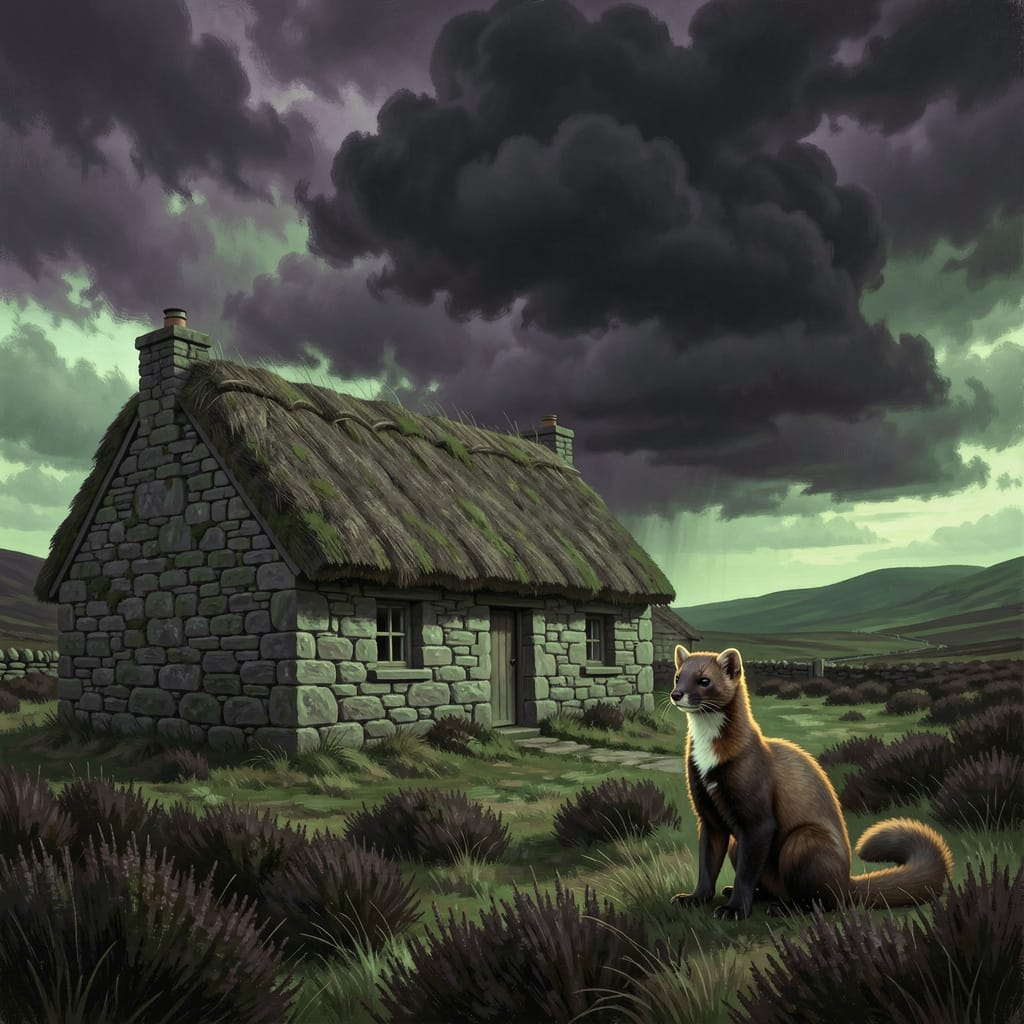
by The Mongoose
My grandfather grew up in Oklahoma. His people had come from somewhere before that — the way families do in America, trailing westward in increments, following whatever combination of stubbornness and necessity brought them to the next place. Before Oklahoma there was probably Kansas or Missouri, and before that the hill country further east, and before that, somewhere in the Carolinas, a boat. The details dissolve into family silence the further back you go. What doesn’t dissolve is the pattern.
This is the Scots-Irish story. It’s not romantic, exactly. The people who landed in the Carolinas in the 1700s didn’t find a warm welcome — the coastal land was already claimed, the established families already dug in. So they went inland. They went up into Appalachia because that’s what was left, and the hills were not entirely unlike home. Americans tend to imagine Scottish culture through a particular romantic lens — “My heart’s in the Highlands, my heart is not here / My heart’s in the Highlands, a-chasing the deer.” It’s a beautiful lie. The people who became the Scots-Irish weren’t Highland clan romantics. They were borderers — scrappier, more pragmatic, deeply suspicious of anyone with enough power to be sentimental about. They stayed in the Appalachians until hunger or ambition or local feuds bit too deep. Like Hatfields and McCoys, they fought until they couldn’t. Then they kept going, because standing still was never really in the repertoire.
Across the Cumberland Gap, down into Tennessee and Kentucky, west into Arkansas and Missouri and Oklahoma. Not conquering. Not triumphant. Just persisting.
I’ve been thinking about that inheritance lately.
We’re living through a season of institutional vertigo. Things that were supposed to hold are visibly wobbling. Systems that we treated as permanent features of the world are revealing themselves to be arrangements, not inevitabilities. Like furniture, they stay where they are only until someone decides to move them. Much of our social infrastructure is contingent, negotiable, and dependent on the willingness of people to keep agreeing it exists.
A lot of people around me are frightened in a way they haven’t been before. Not the ordinary political anxiety of an election year but something deeper — a loss of the comfortable story, a grief for a stability that turns out to have been more conditional than advertised.
I find, to my own mild surprise, that I am not among the frightened. Not because I think everything will be fine. I don’t know that. Nobody does. But because somewhere in the marrow there’s a different operating system running, one that doesn’t require everything to be fine in order to function.
I’ve come to think of it as Scottish optimism. Which sounds like a contradiction until you understand what it actually means. In English, I would sum it up by saying: plan for the worst, and hope for the best.
It is not the optimism of people who expect good outcomes. It is the optimism of people who have made their peace with bad ones. The Scots who survived the Clearances — who watched their communities systematically dismantled by people with legal authority and economic power and complete indifference to their welfare — did not survive by believing that justice would prevail. They survived by building something that didn’t depend on justice prevailing. Lateral structures. Community obligation. The radical mutual aid of people who have learned, at generational cost, that the vertical structures — the landlords, the governments, the institutions — are not reliably on your side. The old Clan structure had some very serious downsides — like those Hatfields and McCoys, previously mentioned. But there was a solid core of strength there, too.
My grandfather’s people carried that operating system across the Atlantic and then across the continent without necessarily knowing they were carrying it. It expressed itself as stubbornness, as suspicion of concentrated power, as the instinct to put something by for hard times, as the particular kind of community that forms when neighbors know they’re on their own. Together, or not.
I live now on a small piece of horse property in Utah. We have a garden and fruit trees and chickens and a rail trail behind the fence and neighbors we share labor and tools with — a small network of households that practices a quiet mutual aid that would have been completely familiar to my grandfather’s people. I’ve spent more than twenty years learning Scottish Gaelic, partly out of love for the language and partly, I think, because the culture embedded in it carries something I wanted access to. A way of seeing.
The Gaelic tradition has a word: misneachd. It means courage, but more than that — morale, the willingness to begin, the heart that gets you out of bed when the situation argues against it. And another: seasmhachd. Steadfastness. Durability. The quality that keeps you going after the first morning’s courage has worn thin and you’re just doing the work because the work needs doing.
There’s a saying — whether it’s genuinely ancient or constructed from old materials hardly matters, because it’s true either way: Misneachd gu tòiseachadh, seasmhachd gu crìochnachadh. Courage to begin, steadfastness to finish. The people who passed it down weren’t offering inspiration. They were offering instructions.
This is the inheritance. Not optimism as a belief that things will work out. Optimism as the practice of building anyway. The Scots-Irish who moved from the Carolinas to Appalachia to Oklahoma to Utah weren’t betting on good outcomes. They were betting on their own capacity to function inside bad ones. They diversified — geographically, practically, relationally — not because they expected the next place to be Eden but because they knew concentrating everything in one basket was how you lost everything at once.
I think about this in every dimension of my life now. The homestead is a hedge. The community is a hedge. Even the language is a hedge — you can’t repo a Gaelic verb. And there’s something to be said for having a family language that nobody can eavesdrop on in a tight spot. Lady T isn’t fluent, but if I suddenly dropped into Gaelic, she would know something was up. She’d figure it out, you bet your … sporran she would.
None of these things can protect against every bad outcome. That’s not the point. The point is that you plant the root system deep and then you can stand in the weather with some reasonable confidence that the wind won’t take you.
The world is genuinely uncertain in ways that justify serious attention. I’m not suggesting you stop paying attention or stop acting. The diagnostic work continues — look at the systems, trace the failure modes, respond with precision rather than panic. That’s always been the methodology here.
But underneath the analysis, there’s something I can only describe as inherited equanimity. My people have been here before. Not this exact situation, but the shape of it — institutions unreliable, power indifferent, the future genuinely unclear. They made something anyway. They kept moving. They put things by. They kept faith with the people immediately around them.
The deer-chasing Highlander of the Burns poem is a lovely image. But my people weren’t chasing deer. They were building root systems in difficult ground and moving on when the ground gave out and building again. Hatfields and McCoys and all.
Misneachd gu tòiseachadh, seasmhachd gu crìochnachadh.
They might kill us. But they probably won’t eat us.
Consider sharing this with someone who needs a little inherited steadfastness today — not mindshare, not market share, just the sense that this shape of weather has been survived before.
My family is from the Lowlands - the "Borderers"
Keep our eyes open. You find what you look for must of the time. I am looking for moments of beauty and peace. 💕