Scottish Judgement
Trying, testing, and the willingness to be told you were wrong.

XVI. The Celtic Thread
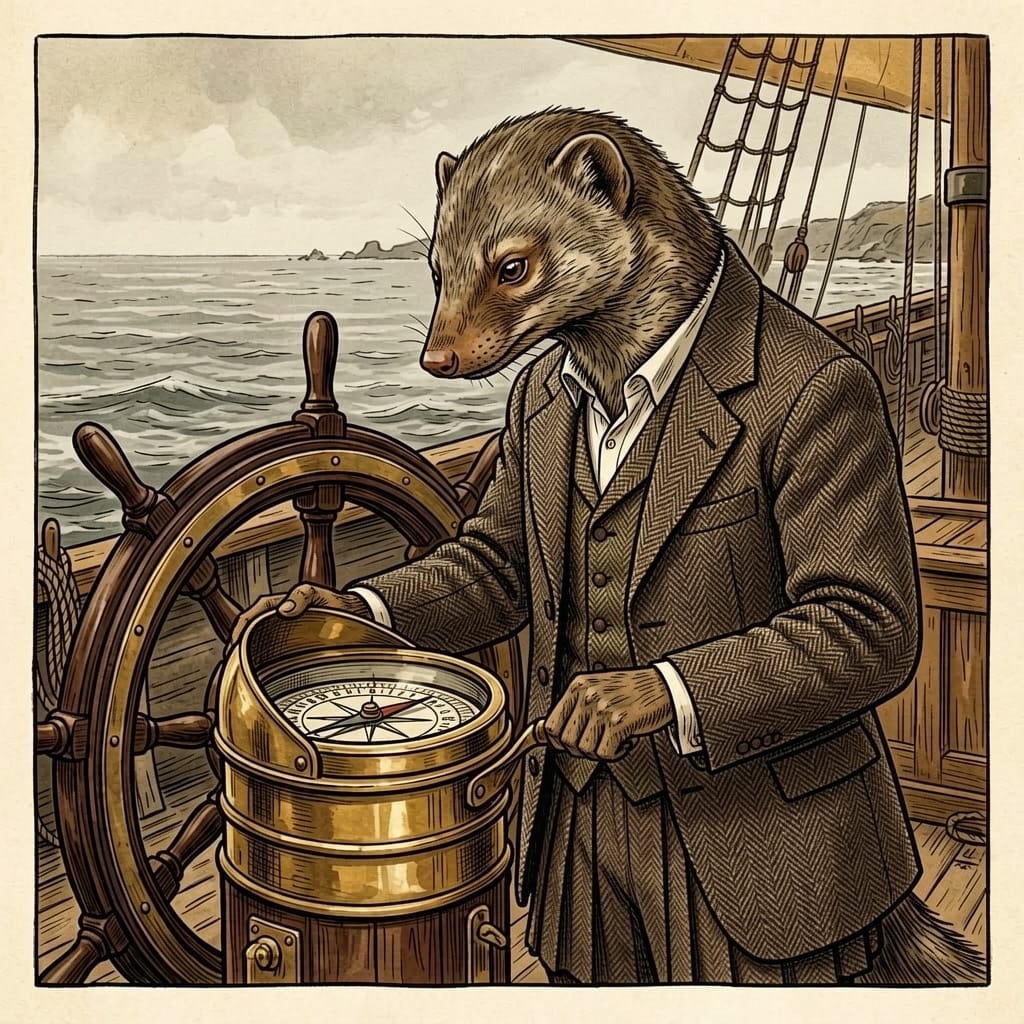
There’s a phrase that runs in my family, and probably in yours, in some dialect or another. Can’t hurt, might help. Try it and see what happens. It has the sound of folk wisdom, and folk wisdom is usually right — that’s how it earns the sound.
But the phrase isn’t always true, and the careful people who say it know it isn’t. Things can hurt. The border country my people came from did not believe every venture was free; they knew precisely which raids got men killed and which ones came home with cattle. So the phrase must mean something narrower than it says.
Strip it down and what’s underneath is a rule for sorting: when the cost of trying is low, and the thing you’d learn is worth knowing, and the world will tell you quickly whether it worked — then lean toward the attempt. The wisdom isn’t in the trying. It’s in recognizing the kind of situation you’re standing in. And the cost that never makes it onto the books is the test you declined to run — the thing you’d have learned, and didn’t, because you already felt sure.
I spend my working life on the other side of this. I read building systems for a living — the pressures and flows and temperatures of a large institutional plant, the machinery that keeps a big building breathing. You do not diagnose an air handler from across the room. You do not diagnose it from theory, however good the theory. You put a gauge on it.
And the reason you put the gauge on it is not that the gauge is clever. A diagnostician trusts his instrument over his hunch for a hard and specific reason: the untested hunch cannot prove failure in front of him. The gauge can. The needle is allowed to come back and say no, not that, you were wrong — and that permission, that exposure to a verdict you don’t control, is the entire value of the test. An instrument that could only ever confirm you wouldn’t be an instrument. It would be a mirror.
I’ve kept the company of another language for a long time now, and Gaelic, it turns out, fused all of this at the root before anyone needed a slogan for it.
The word for try in Scottish Gaelic is feuch. But open MacBain’s etymological dictionary and you find that feuch doesn’t begin at try. It begins at see. Behold. Look at. MacBain runs it back to a root he writes as *veikô, and sets beside it the Greek eikōn, an image — the word standing under our icon — along with the Greek for I seem and I conjecture, and a Sanskrit cousin meaning to appear.
So feuch carries something more particular than try-at-random. It means look, and find out. The attempt and the observation were never two separate acts inside that word. To try a thing is to put it where you can see it.
And then there is deuchainn — trial, attempt, test, ordeal. The most common usage is in science, for the running of an experiment, or in schoolwork, for the exam you sit and can fail. It’s all about getting the hard word.
Feuch only asks you to look; deuchainn can flunk you.
I had long suspected, on nothing more than the shape of the two of them, that feuch and deuchainn were close kin. I went to the shelf to check — feuch, you might say — and MacBain had got there a century ahead of me. Under deuchainn he gives the Irish d’ fhéachain, “to see,” and then, plainly: See feuch. He cross-references the one word to the other in his own hand. The casual attempt and the formal ordeal are built from the same root, and the root means see.
In Gaelic, then: to try is to look, and to be tested is to be seen. The language did not separate the act of judging from the verdict it returns. Deuchainn is both at once — the trial you run, and the sentence handed down. The language itself encodes the unity of attempt and observation.
That gives us a clean picture of its opposite.
I read a writer recently — able, confident, widely read — who had arrived at a settled answer to a genuinely hard question and had stopped looking. He hadn’t stopped thinking; the piece was fluent, the thinking on display. But feuch and deuchainn are two kinds of seeing. One is the looking you do, on your own terms, at what you choose. The other is the being-looked-at — standing your idea up where the world, or the gauge, or the reader can examine it and hand back a verdict you don’t get to write. He had done the first and refused the second. He had formed the image. He would not submit it to the trial. It’s a common failure, in people who get too used to being the smartest mongoose in the room.
This is what I think judgement actually names. We use the word for the verdict at the end, and that’s fair enough. But the deeper sense is the faculty that runs the whole loop — the thing that looks at a situation and sees that it’s a feuch worth making; that then stands the attempt up for its deuchainn and reads honestly what comes back; that knows what to do with a no. A mechanic’s vocabulary would call it the governor: the part of the engine that reads the error and corrects toward it, over and over, because it is built to be answerable to the gap between where it meant to be and where it is.
I’ve written before about Scottish optimism — the borderer’s stubborn bet that the work is worth doing. The optimism that plans for the worst, while also hoping for the best. Judgement is its companion on the shelf, and its corrective. Optimism is the disposition to try. Judgement is the discipline to see straight what the trying reveals, including — especially — when what it reveals is that you were wrong. Hope gets you to make the attempt. Judgement is what keeps the attempt honest.
There’s a soft version of all this that I want to refuse on the way out. “Keep an open mind” has gone slack from handling; it can sound like a standing invitation to believe gently in everything. That is not what the Gaelic says. Deuchainn is an ordeal. The whole worth of it is that the verdict is permitted to come back no — that the gauge can shame the hunch, that the test can fail the idea, that the looking can cost you the very thing you walked in certain of. An open mind that cannot be failed isn’t open. It’s just agreeable.
So try the thing. Lean toward the attempt when the attempt is cheap and the world will answer you quickly; that much is feuch, and the optimism is right. But then do the harder half. Put the gauge on. Stand the idea up where it can be seen. Let the deuchainn return its verdict — and have the judgement to hear it.
To try is to look. To be tested is to be seen. The language knew it before we did.
Consider sharing this with someone who needs the harder half of an open mind today.
An "open mind" is great as long as you can have the judgement to figure out what you are being exposed to is valid - or realistically the skills to figure that out - or know how to do real research into experts in a domain - or.. An "open mind" that lets junk in (most conspiracy theories out there, etc) is as bad as a closed mind that doesn't want to hear any other possibilities.
Dunning-Kruger is quite real.... An "open mind" can allow someone to think they understand something a lot more than they do. But as expertise becomes real, it can be too locked in as well. A good expert knows how to discern what is nonsense and be open to a real argument / experiment / gauge that says "wake up".
Your 2 words were fascinating - and say a lot.
💕 that one makes me smile. It was our morning on the farm. Look at the problem. See the solution. After a few tries. 💕