Satan, the Anarchist
“Please allow me to introduce myself — I’m a man of wealth and taste.” — The Rolling Stones, “Sympathy for the Devil”


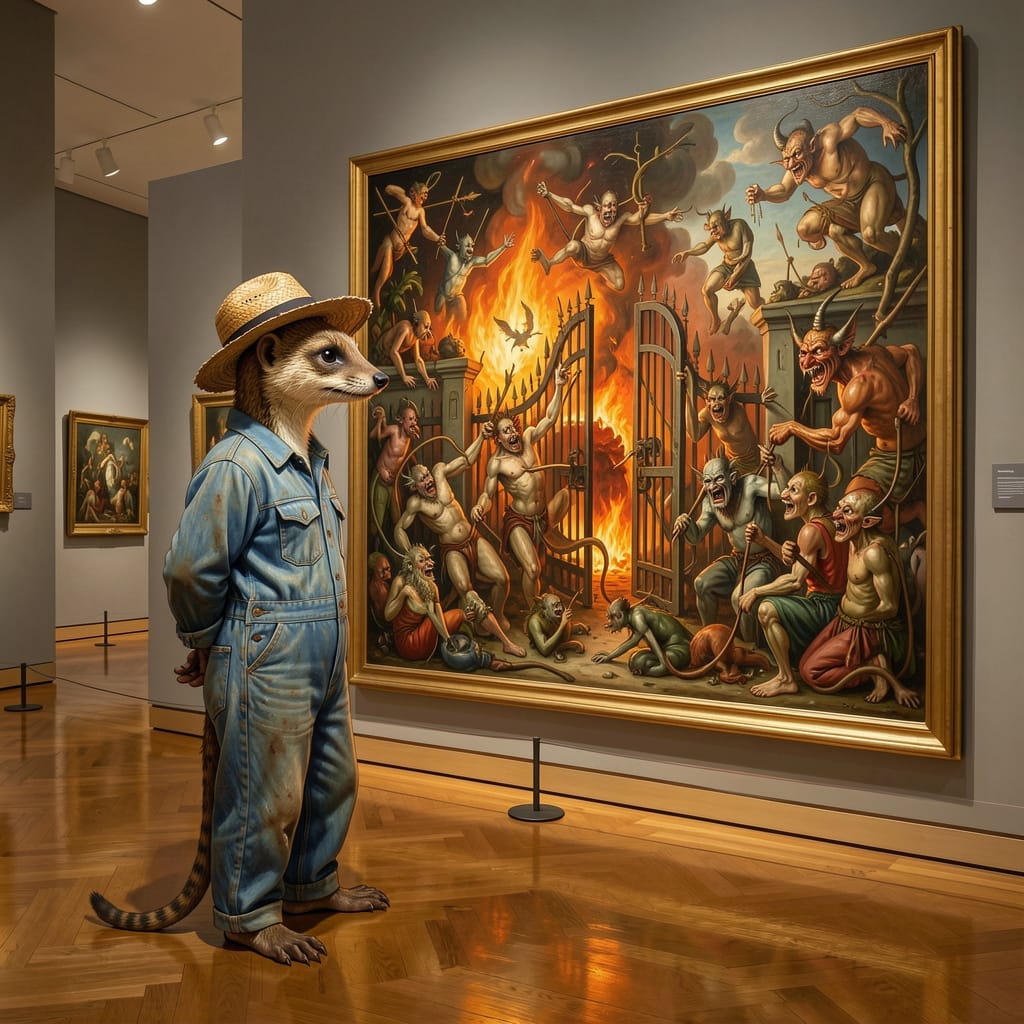
I have just finished reading Dr. David Brin’s thoughtfully hilarious four-act play, The Escape — a confrontation between a dying science fiction writer and the Devil, staged as a job interview that goes sideways in the best possible manner. It is a recent addition to one of the longest-running traditions in Western literature: the human being who looks cosmic authority in the eye and argues back. The tradition goes at least as far as Homer’s Odyssey, where Odysseus sailed to the edge of the underworld and interrogated the dead — not out of piety, but because he needed information. Gilgamesh raged against mortality itself. Orpheus tried to sweet-talk the management into releasing his wife. The Greeks understood something that every subsequent version of this story has confirmed: when a human being confronts the powers that govern death, the interesting question is never whether the human wins. It’s what tools he brings to the negotiation.
As a Mormon kid growing up in a small Utah town, I had an early fascination with the alien. And in a religious sense, HELL! was alien. The Bible (and Book of Mormon) my Sunday school taught from included both devil and hell — but they were nothing like the fire-and-brimstone nightmare-scapes that mainstream Christianity seemed to fetishize. The whole concept of infernal damnation seemed wildly outlandish to me.
Mormon Hell was the telestial kingdom — the lowest of three degrees of glory, but still glory. No lakes of fire. No wailing and gnashing of teeth. Just the cheap seats. The neighborhood where the bishop didn’t bother to schedule home teaching visits, because honestly, what was the point? If mainstream Christian damnation was a courtroom drama with infinite stakes, the Mormon version was an HOA dispute. You might end up on the wrong side of the celestial tracks, but the lights would work and nobody was getting tortured.
This made me a strangely detached reader of the Western canon’s greatest hits about damnation. I viewed it from a distance, like an anthropologist observing some barbaric rite.
"The mind is its own place, and in itself / Can make a heav'n of hell, a hell of heav'n."
Milton’s Paradise Lost landed on my desk in sophomore English, and I remember the disconnect — the same disconnect his own contemporaries felt, though for entirely different reasons. They were troubled that Satan was too sympathetic, too magnificent in his rebellion. I was perplexed that anyone found the setup constrictive enough to rebel against in the first place. Milton’s Lucifer — light-bringer, archangel, upper management in the most stable organization in existence — threw it all away for sovereignty over a lake of fire and a captive audience of the equally wretched, and called it freedom.
Lady T, who has a retired teacher’s eye for exactly this kind of thing, once looked at the archetype and nailed it in a sentence: “It was always the scrawny, half-sized seventh grader wearing the anarchy shirt. Like he thinks he’s gonna get a better deal?”
(Sorry, Patrick.)
She’s right. Satan is that kid. The one who benefits most from the existing structure — who would get demolished in the state of nature he’s romanticizing — broadcasting defiance of the only system keeping him fed and alive. Milton’s readers in Restoration England recognized the type immediately. They’d just watched a civil war fought by men who mistook privilege for oppression, overthrew a king, and then discovered that the replacement — Cromwell — was worse in every way that mattered. The poetry says Lucifer is glorious. The theology says he’s damned. The diagnosis says he’s a middle manager with delusions of grandeur, and he’s never going to get a better deal.
And here’s the thing the thoughtful student of tactics notices, the detail that tells you everything about Milton’s own blindness: Lucifer’s ace in the hole was cannon. Gunpowder artillery, invented in Hell, deployed against the loyal angels in Book VI. And it worked — briefly — until Jehovah’s thunderbolts proved to be the bigger guns. Milton wrote this as definitive. The Almighty’s firepower wins; case closed; hierarchy restored.
But any half-decent NCO would look at that engagement and see the exploitable weakness immediately. If your opponent’s advantage is superior ranged ordnance, you don’t answer with inferior ranged ordnance. You close the distance. You go asymmetric. You dig in and make his firepower irrelevant. Or — and this is the option that would take a few centuries of R&D — you keep iterating until your cannons are thunderbolts.
Milton couldn’t see that, because Milton wasn’t writing a tactical problem. He was writing a theological one, and in theology, God’s advantage isn’t quantitative. It’s categorical. You can’t out-engineer omnipotence.
But the Western literary tradition could see it. And for the next three and a half centuries, that’s exactly what it did — writer after writer picking up the Satan story, the Hell story, the confrontation-with-cosmic-authority story, and each time bringing a better set of tools to the negotiation table. Not better theology. Better questions.
“All hope abandon, ye who enter here.”
Virgil? BIG fan, bro. The Aeneid was wall-to-wall propaganda, but I mean that in a good way — in the original sense, ideas that need to be propagated; the foundational craft of building a national story that people can live inside. Virgil understood that a civilization needs a mythology it can inhabit, and he built one to spec for Augustus. So when Dante Alighieri, exiled from Florence, watching his beloved city eat itself alive with faction, needed a guide through the underworld, he didn’t pick a saint or a prophet. He picked the poet who knew how to build things.
That choice tells you everything.
Dante’s Inferno is the most meticulously organized Hell in all of literature. Nine circles, each subdivided, each with its own contrapasso — the punishment that mirrors the sin. The wrathful tear at each other in the river Styx. The flatterers wade in excrement. The fraudulent are encased in flames. Every sinner is filed, categorized, and indexed in a system so thorough it would make a German bureaucrat weep with admiration.
And that’s the diagnosis. Dante was writing from exile — a man who’d watched Florentine politics devolve into a knife fight between Guelphs and Ghibellines, Black and White factions, families who couldn’t remember what they were fighting about but knew they’d gladly kill for it. His city had no functioning justice. Scores went unsettled. The guilty prospered while the righteous got run out of town — Dante himself being exhibit A.
So he dreamed of a cosmos where someone was keeping score.
The Mormon anthropologist in me found this the first genuinely interesting stop on the tour. Not because of the horror — I still couldn’t take the horror seriously — but because of the system. Here was a man who looked at the chaos of human wickedness and responded not with brimstone sermons but with a taxonomy. He named things. He sorted. He classified. He built the org chart of damnation with the same care that Linnaeus would later bring to botany. If Milton’s Satan was the anarchist in the tee-shirt, Dante was the kid who responded to the same chaos by building a spreadsheet.
And Dante did something else that none of his predecessors had done: in his epic, he walked through Hell as a living tourist. Not a condemned soul, not a rebel angel, not a combatant — a poet with a notebook, guided by another poet, taking the tour and forming his own judgments. He wept for some of the damned. He kicked others in the head. He decided, circle by circle, whether the system was just. That’s a radical act, if you think about it — a human being asserting that he has standing to evaluate divine justice, not merely to submit to it.
Virgil couldn’t take him all the way, of course. The pagan propagandist’s competence had limits; Beatrice had to take over for Paradise. But Dante chose to spend the most vivid, most memorable part of his journey in the company of a man who built civilizations out of words rather than a theologian who interpreted them. The poet trusted the engineer over the priest. That tells you something about where the tradition was heading, even if Dante himself would have denied it.
"Call me Allen Carpentier. It's the name I wrote under, and someone will remember it."
It took seven hundred years for someone to look at Dante’s meticulous system and ask the obvious engineering question: okay, but how do I hack this?
Larry Niven and Jerry Pournelle hacked the — excuse me — hell out of it.
Their 1976 novel Inferno puts Allen Carpentier, a science fiction writer who died doing something stupid at a convention, into Dante’s Hell with Dante’s own map in his back pocket. Carpentier is Niven, barely disguised — a hard-SF author whose first instinct upon waking up in the afterlife is to explain it away as technology. He calls the place “Infernoland,” like it’s a malfunctioning theme park. He builds a glider out of materials scavenged from the banks of the River Styx. He maps the terrain, catalogs the rules, probes for inconsistencies. He treats damnation as a debugging exercise.
And his guide? Not Virgil the nation-builder. Benito Mussolini.
Let that substitution sink in. Dante chose the poet who built Rome’s founding myth. Niven and Pournelle chose a fascist dictator trying to work off his cosmic debt by shepherding lost souls toward the exit. It’s a devastating swap — Virgil was aspirational, a guide you’d want to follow. Mussolini is the guide you’re stuck with, the compromised ally whose help you need but whose judgment you can never fully trust. Dante’s journey was a pilgrimage. Carpentier’s is an escape attempt with a disgraced cellmate.
This is peak 1976, and the diagnosis writes itself. Cold War America believed — deeply, axiomatically — that all systems were comprehensible and all systems had exploits. You just had to be smart enough, persistent enough, and willing to build the glider out of whatever was lying around. Carpentier doesn’t challenge Hell’s authority the way Polo will in Brin’s play. He doesn’t even particularly care about the theology. He accepts the system as real and immediately starts looking for the exit. It’s the difference between a philosopher and an engineer: the philosopher asks whether the prison is just. The engineer checks whether the window locks from the inside.
The Mormon anthropologist in me was charmed. This was the first Hell I’d encountered that someone like me — someone who’d never been afraid of damnation, who saw the whole setup as an engineering problem rather than a moral emergency — could actually inhabit. Carpentier wasn’t brave. He wasn’t saintly. He wasn’t even particularly good. He was just a guy who refused to stop thinking, and in Hell, it turns out that’s enough to be dangerous to the status quo.
Hell was Che Guevara’s adopted homeland now, and it was badly in need of liberation.
Janet Morris took the next logical step and blew the doors off entirely.
Her Heroes in Hell series — a shared-world anthology franchise launched in 1986, with contributions from C.J. Cherryh, Gregory Benford, Robert Silverberg, David Drake, and others — starts from a premise so simple it’s almost impolite: everybody who ever died ends up in Hell, and they just keep doing what they always did. Caesar schemes for power. Cleopatra maneuvers. Che Guevara agitates. Achilles — and I love this — somehow becomes a helicopter pilot. Machiavelli runs communications. Napoleon and Wellington continue their rivalry with updated equipment. Hell isn’t a punishment. It’s a neighborhood. The damned don’t repent. They network.
The diagnostic here is brutal in its clarity. Morris looked at the tradition — Milton’s grand rebellion, Dante’s moral architecture, Niven’s engineering challenge — and said: you’re all overthinking this. Hell isn’t a theological problem or a systems puzzle. It’s just where people end up, and people are people. They form factions. They jockey for position. They build institutions that look suspiciously like the ones they built topside. The series tagline might as well have been “Nobody who is anybody went to heaven,” and Morris meant it as a compliment to the damned.
For the Mormon anthropologist, this was the closest anyone in the Western tradition had come to what my Sunday school actually taught. Strip away the sulfur and the special effects and what do you get? A place where people live. Not glamorous. Not terrifying. Just there — the low-rent district of eternity, where the bishops don’t visit and the casseroles don’t arrive, but the lights work and Julius Caesar is running the HOA.
You can tell a lot about someone from their decorations ... or their hallucinations.
And then David Brin sent me his play.
The Escape is a four-act confrontation between a dying science fiction writer named Polo and the Devil — who goes by BD, for Big D, which Polo bestows on him in the first few minutes like a guy assigning a nickname at a cocktail party. It is not accidental that this echoes Adam naming the beasts. Nothing in this play is accidental.
Polo is Brin. He is Brin in exactly the same way that Carpentier was Niven — an SF author self-insert who brings genre competence to the underworld as his primary weapon. But where Carpentier looked at Hell and saw a system to escape, Polo looks at BD and sees a middle manager whose credentials don’t hold up under cross-examination.
This is the key difference, and it’s everything. Milton’s Satan rebelled against cosmic authority. Dante cataloged it. Niven hacked it. Morris ignored it. Polo sits across a rickety desk from it, in a guest chair with one leg slightly short, and says: show me your qualifications.
BD, for his part, does not acquit himself well. Lady T would recognize him instantly — he’s got the horns and the finger-zapper and the office full of depressing cubicles, but the energy is pure Hollywood lawyer for one of the also-ran studios. Always just a bit out of his league. He offers Polo money. He tries guilt. He trots out painful memories of an old girlfriend. He threatens torture. And every time, Polo absorbs the blow and comes back with a better question. BD is playing a game of intimidation, and Polo keeps changing it into a job interview — one where the interviewer is on the wrong side of the desk.
The play’s centerpiece is a conversation about Genesis that I haven’t been able to stop thinking about since I read it. Polo asks BD to identify the only “pure” moment in the Bible — the one interaction between Creator and created that’s collegial, friendly, un-coercive. BD, to his credit, gets it: God asking Adam to name the beasts. And Polo runs with it. If naming is the core creative act — if science is apprenticeship in the creative skills of the Father — then humans aren’t sheep. They’re apprentices. They’re supposed to eventually set up their own shop.
BD catches the implication immediately: “You aim to set up a shop of your own?”
And Polo says: “Yeah, it sounds... Mormon.”
Reader, I nearly fell off my chair.
Polo isn’t wrong. The LDS doctrine of eternal progression — the idea that human beings are meant to become creators themselves, gods-in-training — is exactly what he’s describing. It’s the theology I grew up with, stripped of the institutional wrapper and restated as a Brin argument about the trajectory of civilization. BD tries to deflect by pointing out that the Bible uses “father” and “shepherd” interchangeably. Polo’s response is devastating: they seemed similar to nomads. To moderns, they’re opposites. A good father wants to be surpassed by his children. A shepherd has another purpose for his flock.
That line cracks the play open. Because everything that follows — every argument Polo makes, every concession BD offers — flows from that single diagnostic. Which are we to our Creator? Children who are meant to grow up, or sheep who are meant to be managed? Every version of Hell in the Western tradition is, at bottom, an argument about this question. Milton’s God is a shepherd who will not tolerate a straying lamb. Dante’s God is a shepherd whose accounting is impeccable. Niven’s God is a shepherd whose fences have exploits. Morris’s God is a shepherd who’s lost interest in the flock.
Brin’s Polo says: I’m not a sheep. I’m an apprentice. And I’d like to see your org chart.
The play’s most delicious structural move is the escape revelation — not Polo’s escape, but everyone else’s. Polo suggests, almost offhandedly, that BD should go check on his long-term prisoners. Repeat anything enough — even torture — and consciousness eventually flickers out. The screaming bodies are still there, but nobody’s home. They’re empty puppets. The damned have escaped through sheer monotony, and BD never noticed because he never bothered to audit his own operation. It’s a transparency argument disguised as a prison break. The Devil’s weakness isn’t insufficient power. It’s insufficient accountability.
And then, in a move worthy of the best con artists in literature, Polo suggests that BD send the same audit upward. What about Heaven’s eternal choir? If endless torment reduces souls to empty shells, does endless bliss do the same thing? Are the saved just happy-faced marionettes, parroting hosannas while whatever made them human drifted away millennia ago?
A scream reverberates from above. The audit has been received.
The moment that elevates the play from clever to genuinely moving is Polo’s speech about Huckleberry Finn. He’s been building a ladder of moral heroism throughout the conversation — ordinary saints who endure martyrdom for guaranteed reward (a good business deal, he notes), super-saints who deliberately damn themselves to minister in Hell (impressive but still calculating), and then Huck. A boy raised by wolves and lunatics, told by every credible authority that helping a runaway slave means eternal damnation. A boy who believes them. And who says, “Then I go to Hell,” and helps his friend Jim escape.
Huck doesn’t argue with Hell. He doesn’t hack it, catalog it, settle in, or demand Big D’s credentials. He accepts the cost and does the right thing anyway. That’s the move none of the sophisticated theological debaters can make, because they’re all still negotiating. Huck isn’t negotiating. He has nothing to negotiate with. He’s the kid in the anarchy shirt’s opposite number — the scrawny seventh grader who knows the system is going to crush him and walks into it anyway, not out of defiance, but out of love.
And Polo — having been shown this pinnacle — refuses BD’s contract. The deal is genuinely generous. It would let him make the world measurably better, nudging twelve powerful people ten percent in the right direction. But it would mean accepting the magical shortcut, the chosen-one narrative that Polo-as-Brin has spent his entire literary career despising. So he pushes the contract back across the desk. He’ll take his chances as a flawed human, doing marginally more good than harm, trying to be better than his times. No thunderbolts. No special powers. Just the apprenticeship.
The play’s final scene involves a gender swap — all the characters switch bodies between acts, BD becomes female, God shifts pronouns — and I’ll be honest, it’s the one place where Brin’s reach exceeds his dramaturgical grasp. The idea tracks perfectly: if even cosmic authority is provisional, then “Father” was always just one draft of the metaphor. But the transition happens offstage, between scenes, during a McCartney song. Brin earns the destination intellectually without dramatizing the turn. Compare the escape revelation, where we watch BD’s face as the realization lands — that’s brilliant stagecraft. The gender swap gets the Brin thesis without the Brin craft. He can see where the culture needs to go but can’t quite cheat his way to making it land. Which is, accidentally, exactly what his play argues: you have to do it the hard way.
The play closes with Polo being wheeled back to his hospital bed, consciousness fading, waving an idle goodbye: “So long, Father of Lies.” BD corrects him: “That’s Mother of Lies to you.” And then, barely audible, she whispers: “Oh, figment of my imagination.”
She pinches her own arm. Shakes her head. And the lights go down.
Polo planted a seed that can’t be unplanted. He didn’t escape Hell. He didn’t defeat the Devil. He asked questions that the Devil can’t stop thinking about, and that’s worse — for the Devil — than any rebellion, any hack, any escape. Milton’s Satan stormed the gates. Brin’s Polo left a pamphlet on the desk and walked away.
I started this essay as the Mormon kid who couldn’t take Hell seriously. I want to end it by admitting that the bafflement was, itself, the right instinct — not because LDS theology got the metaphysics right, but because it accidentally refused to be frightened. When the worst-case scenario is the cheap seats rather than the lake of fire, you’re free to ask different questions. You stop asking how do I avoid damnation? and start asking what kind of person am I becoming?
A Buddhist practitioner explained it to me once in terms so clean they’ve stayed with me for years. “It’s the opposite of Pascal’s Wager,” she said. “I’m betting that if there is some god, some power that runs the universe, it is far more interested in what kind of person I am than in what pew I inhabit on a Sunday morning.”
Pascal’s Wager says: sign the contract. Hedge your bets. The downside is infinite, so take the deal. It’s exactly what BD offers Polo, and it’s what seven centuries of Western literature have been arguing about in one form or another. Dante built his entire cosmos around the premise that the contract has precise terms and the signatures are binding. Niven’s Carpentier treated it as a legalistic puzzle with an escape clause buried in the fine print. BD offers Polo genuinely generous terms — ethical work, limited duration, an indemnity against tricks — and Polo still pushes it back across the desk.
Because signing would make him a lesser person. And he’s betting that matters more than the odds.
Huck Finn makes the same bet from the opposite direction. He’s certain the odds are against him. Every authority he trusts has told him that helping Jim means eternal damnation, and he believes them. He has no theological sophistication, no SF genre competence, no clever arguments about apprenticeship and transparency. He’s just a kid who knows the right thing when he sees it. “Then I go to Hell.” And he helps his friend.
Two scrawny kids, when you think about it. One wearing the anarchy shirt, burning down the structure that was keeping him alive, because he thought defiance was the same thing as freedom. The other walking into damnation with his eyes open, because he knew that being the right kind of person mattered more than being safe.
Seven centuries of writers have been telling us which kid to be. Milton warned us about the first one. Twain showed us the second. And Brin — clever, optimistic, transparency-obsessed David Brin — wrote a play in which the Devil himself starts to suspect that the second kid might be right. That character might matter more than compliance, apprenticeship more than obedience, and good questions more than signed contracts.
BD pinches her arm at the final curtain. She’s not sure of anything anymore. That’s the most hopeful ending in the entire tradition — not because the Devil has been defeated, but because she’s thinking about it. The pamphlet is on the desk. The seed is planted. And somewhere out there, a scrawny kid who never had any reason to believe the system would treat him fairly is helping his friend anyway.
A note to the playwright: David, it felt like I was missing something in the gender swap section. In literary analysis, it seems like cheating to ask the author what he intended — but if the author were to tell me, "No, you dope! I meant…." I would take the correction with a smile.
Consider sharing this with someone who could swap their answers for a better question today. 🐸🦝
A brilliant analysis. My only nitpick would be that Mongoose forgot C.S. Lewis' "The Great Divorce" and "Screwtape Letters".
David Brin is a great writer with absolutely great ideas, even if or when he is wrong. From the synopsis, it appears that he has added significantly to the canon of great literature about hell. I hope someone posts the play on YouTube!
Unfortunately, the biggest problem with the hell canon is that it is not logical--if you accept the foundational ideas of the Bible: That God is Truth, that God is Love, and that God is Existence. Add to these premises the idea that while God is omniscient, hell is one place that He is not. That means that Hell is infinitesimally small (Lewis points that out quite clearly). It also means that there is no love or truth in hell. That is why one of Satan’s titles is “Father of Lies” (Scott Peck makes that clear in his fascinating best-seller, “People of the Lie” Note: Peck did not believe in the Devil until he witnessed two exorcisms).
If God loves you, but you don't really like him, then what is He supposed to do with you when you die? He can’t bring you to heaven – that would be agony for you to be exposed to Him in all his glory. So, he sends you to the one place he does not exist. Doesn’t sound bad, does it? Except that it has no love and no truth, and almost no existence. That may not sound *that* bad, but that is because you’ve never experienced it. You have no freaking idea how bad it is. If you experience for one second, then you will be frozen in horror. You will *much* prefer to be thrown in a lake of fire—just to distract you a little from the vast hollowness of knowing with certainty that you were never loved, that you never loved anyone, and that love never existed anywhere.
As far as explaining why Satan hates humanity, I’m surprised that few authors provide believable motives. But pretend that you were the most beautiful, powerful, intelligent, purely spiritual, and immortal being in this universe. Then the guy who created you tells you that you will need to obey these massively stupid little bags of sh*t that crawled out of the mud. I’m not surprised that he rebelled.
Of course, if you don’t think that the Bible correctly characterizes the God who fine-tuned the Big Bang in order for us to exist… well, (other than having to explain the improbability of our existence) you can truthfully say that false premises always result in nonsense. But if you don’t believe in the Bible, then why believe in hell, other than a silly story? In that case, I’d be like Ray Kurzweil, who is working hard on life extension, trying to get to escape velocity. Will the Singularity hit by 2035? If I was any older, I’d be praying like hell that it gets here fast.
Suit yourself. I don't see it as a No True Scotsman. The Mongoose and I have an ongoing conversation on the subject, as suggested by the shout-out he gave me in the text. Because of that, I felt appropriate to defend the kid's possible intentions, rather than to immediately discount him as a naive, defiant troublemaker.
Maybe that's all he is, though. But you know what? He's fictitious, so all he is will be whatever the Mongoose wants him to be.