PLAYING ON THE BRIDGE
(On letting the work claim its due process.)


On May 31, 1578, Martin Frobisher sailed fifteen ships and four hundred men toward the Canadian Arctic to bring home gold. He returned with 1,225 tons of it. It took five years to confirm it was iron pyrite -- fool's gold. He never bothered to check. He just loaded the boats.
Sometime in 1959 -- the exact date is disputed, because nobody was paying attention. It may have been the end of May. (I hate to let the lack of actual facts get in the way of a good story.)

Let’s say, on May 31, 1959 -- Sonny Rollins walked onto the Williamsburg Bridge with his saxophone and started to play. He was, by most accounts, the best living saxophonist of his day. He stayed on that bridge for two years.
Rollins had just recorded Saxophone Colossus, which is one of those albums that people who know more than I do about jazz will tell you changed everything. He was twenty-nine years old, he was famous, and he quit. Not music -- just the part of music where anyone was listening. What he actually did was walk onto a pedestrian walkway over the East River, every day, for months and then years, and play his saxophone to the traffic.
Nobody recorded it. Nobody was supposed to hear it. The bridge was the point. The bridge was where you went when you understood the difference between performing and practicing, between being good enough for the audience and being good enough for the work.
He came back in 1962 and recorded an album called, with the plainness of a man who had nothing left to prove, The Bridge.
Sonny Rollins died this week. He was ninety-five.
I wrote a song once, about a city that sank. If you are American and of a certain age you know which city, and you remember the man on television telling the man in charge of saving it that he was doing a heck of a job, and you remember the feeling -- not the sadness, which came later, but the specific vertigo of watching someone perform pretended competence while a city drowned under his watch.
Ny song is called "We Watched a City Sink." It has a saxophone in it.
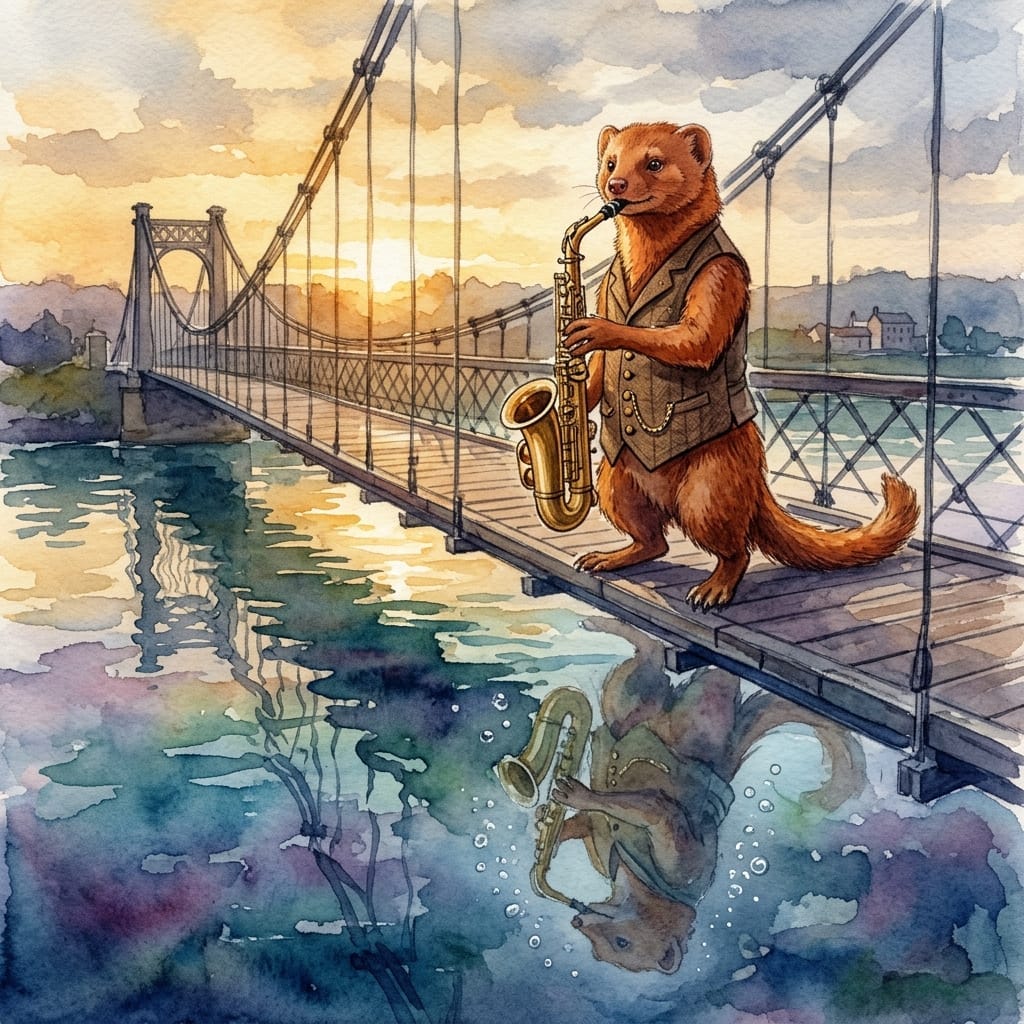
A young man blows a saxophone, and furious bubbles rise
He solos up a shoal of foam that drifts on watery skies
The current floats his hair aloft like moss upon a stone
As dancers clutch like drowning souls the song wails on alone.
Rollins played over the East River. My young man plays beneath a drowned city; the conceit of the song is that the saxophonist is playing underwater. In both cases the music is produced for nobody. In both cases the playing itself is the point. And in both cases there is something true happening that the official version of events has no room for.
"Heck of a job, Brownie." That was Frobisher's move. The man standing on the deck declaring the ore is gold while New Orleans went under.
Imagination is the pen and memory the ink
Drawing scenes from a darker page when we watched a city sink
Last Saturday it rained in Logan, Utah, and about a hundred protesters stood out in it.
They were there because a company owned, or at least fronted, by one of those Shark Tank types, wants to build a data center in Box Elder County. Not any old data center -- a processing behemoth that will require the energy input of a small nation. Forty thousand acres. Nine gigawatts, which is more electricity than the entire state of Utah currently uses.
The county commissioners approved it after retreating to a private room, broadcasting their vote on a livestream to a crowd that had come to be heard and was instead told to grow up.
The county rejected two referendum petitions. The developers filed for water rights, collected nearly four thousand protests from residents who paid fifteen dollars each to object, and then withdrew the application -- not because they were giving up, but because withdrawing resets the clock and erases the protests. You file again. The objections disappear. This is not a failure of process. This is process working exactly as someone designed it to.
One of the speakers at the rally described standing at a county meeting with a Save the Great Salt Lake activist on one side and a Charlie Kirk fan on the other, both yelling in the same direction.
I wanted to sit with that image for a moment. The Save the Lake guy and the Charlie Kirk guy, natural enemies in our local politics, but shoulder to shoulder. Both furious about the same thing. Not about ideology. Not about party. About being told to sit down. About a process designed to erase their voices and a project that treats their home as a resource to be extracted.
There's a line I heard once that I haven't been able to shake: They don't want to represent. They want to rule.
Frobisher loaded boats. The commissioners left the room. Brownie did a heck of a job. These are all the same gesture -- the performance of authority without the practice of care. The stage without the bridge. And ruling means you don't have to listen, and you don't have to check whether the ore is actually gold, and you certainly don't have to stand in the rain with the people who really live there.
The hundred people in Logan were on the bridge. They (we) were doing the unglamorous, unpaid, unrecorded work of showing up in unseasonable weather for a thing that mattered. Nobody was going to make them rich for it. Nobody was livestreaming it to a room where the decision had already been made. They stood there because the standing was the point, the way the playing was the point for Rollins on the Williamsburg Bridge, playing the same phrase forty times until it stopped being a phrase and started being true.
Imagination feeds the pain as memory makes the link
Truth submerged is rising, shaking off the muck and stink
Truth submerged is rising. Not truth announced, not truth performed, not truth loaded onto fifteen ships and hauled home in triumph. Truth that has been underwater. Truth that comes up on its own schedule, covered in muck, unglamorous and gasping, but rising.
Martin Frobisher never checked.
Sonny Rollins played until he was sure.
"We Watched a City Sink" was written in 2005. Sonny Rollins died this week at ninety-five. The data center in Box Elder County is still being built, as our so-called leaders refuse to listen.
The rain in Logan has stopped for the summer, but we the people are not willing to let the sharks take our lake without a fight.
Consider sharing this with someone who needs a bridge to the future today.
It was a good, wet saturday in northern utah. I keep saying Utah is changing.