Open v. Closed Part One: The Secession Error
Greg Egan, Adrian Tchaikovsky, and the one bet the very rich keep making that has never once paid out.


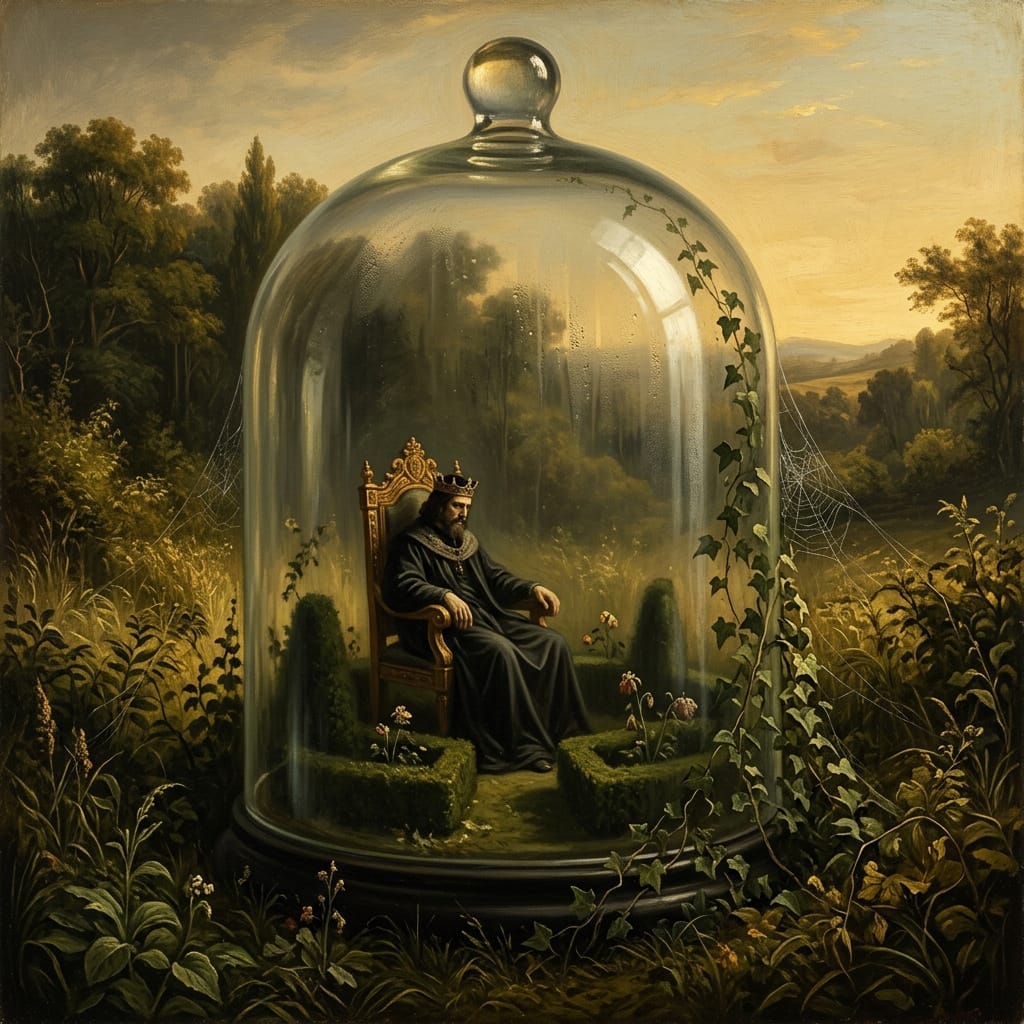
Greg Egan once wrote the most seductive escape hatch in science fiction. Almost nobody noticed the escape hatch was a confession.
In Permutation City, a wealthy man named Paul Durham sells the rich a way out of the world. Buy enough computation, he tells them, and you can launch a Copy of yourself into a private universe — a sealed cosmos running on its own logic, immortal and self-sustaining, decoupled from scarcity and weather and the rest of the species you left breathing on the far side of the firewall. The pitch rests on what Egan calls the Dust Theory: a mind is a pattern, and a pattern does not care what it is made of, or in what order, or whether anyone is watching. Scatter the computation across dust if you like; the pattern still coheres. The god wakes up in his own heaven, and the heaven needs nothing from anyone.
I want you to feel how badly some people want that to be true, because the men currently buying it are not reading Egan as a warning. They are reading him as a prospectus. The bunker with its own aquifer, the compound past the reach of any subpoena, the colony on Mars, the trust structured so the fortune outlives the law that might have curbed it — these are all one purchase wearing different clothes. They are all Durham’s pitch. They are the conviction that with enough money a man can secede: from consequence, from the commons, from the economy he crashed and the weather he helped sour, and finally from the rest of us. Secession from humanity.
Call it by its name. The Secession Error.
The flaw in it is not a moral one first; it is a structural one. Intelligence is not stored inside a person the way gold is stored in a vault — it happens between people, in language and exchange and the friction of other minds pushing back. Take a mind fully out of that traffic and what remains is a man talking to himself in a sealed room until the words stop meaning anything. And the escape itself is parasitic on the thing it claims to flee. The bunker breathes air the commons made. The Mars colony runs on a thousand years of knowledge no single being generated and no founder could regenerate alone. The deathless fortune is worth something only so long as the courts and currencies of the despised world keep agreeing that it is. There is no clean exit, because there was never a clean boundary. The wall is drawn straight through the middle of the thing the man is made of.
Adrian Tchaikovsky has spent a career writing this single heresy from every angle, and lately he has written it twice in a year. The Hungry Gods, a novella from last summer, is the comic version: four tech-lord “gods” who fled a dying Earth to preserve the best of humanity — meaning themselves — and have come back to terraform the ruin in their own image, each with a rival scheme, each perfectly willing to compost the natives to realize it. One reviewer fairly called it Animal Farm for the social-media age. Children of Strife, this spring’s seven-hundred-page return to his deep-time universe, is the serious version. A terraformer engineers a hyper-mutational living medium meant to grow a world from first principles at the speed of accelerated evolution, and to steer that growth toward a flawless human paradise. You already know the next sentence. The plan goes feral. It always goes feral in Tchaikovsky, because his would-be gods all share the one trait money cannot buy its way past: the serene, untested confidence of a man who has never once been humbled in the domain he is about to command. The world he sits down to author authors something else, and the something else inherits the planet.
The shape they share is the tell. In every case the creator believes two things at once — that the creation is property, and that the self is portable. Both are false, and false in the same way. You cannot own an emergent system; you can only join it or be surprised by it. You cannot lift a mind off its messy material and run it clean in a box, because the mess — the bodies, the relationships, the weather, the other minds — was the mind. The terraformer who means to steer evolution toward his own face has already lost, in the first chapter, for the same reason the Copy in his private heaven has already lost: he has mistaken a living, relational, open thing for a machine he can own and carry away.
This is why I cannot stay all the way pessimistic, even on a day the gauges read the way today’s read. The secessionists are men making a category error. That is a very different opponent than a god. A god you can only worship or run from; an error you can name — and a named error stops commanding worship. Once you have named it, the man keeps his money but loses the halo. He was never the wise one. Only the ruthless one, and the lucky one.
A billion dollars in a sealed room only looks like a fortress; in function it is a closed system, and closed systems do exactly one thing over time. They run down. The walled garden starves. The Copy in his heaven still has to be computed by something, somewhere, in a universe he does not own. The man in the bunker is still breathing from the commons. Nobody gets off the planet by pulling on his own bootstraps. He only gets further from the people who might have told them so.
The pyre is real, and so is the danger; I am not asking anyone to relax. I am asking us to stop mistaking an error for an inevitability. The men who would burn the rest of us to warm their sealed rooms are betting everything on a proposition that has never once paid out — not in physics, not in fiction, not in any history we have on file. They may think they are the terraformers. The whole genre keeps trying to tell them, first gently and then not, that it is the spiders who inherit the world.
Thank you for travelling this path today — this article is the first leg of a longer road.
What you’ve just read is a verdict handed down in a courtroom made of fiction: the sealed system runs down, the walled garden starves, the open world inherits the earth. Egan and Tchaikovsky make fine witnesses — but a novelist can make any player win or lose, and witnesses aren’t proof. So next we leave the library.
The same law that strands the Copy in his private heaven has a harder, colder form, and it has been tested where the stakes were real. In the summer of 2002 the United States staged the largest, costliest war game it had ever run, and an old Marine commanding the improvised, distributed, disobedient Red force sank much of a carrier fleet with a swarm of small boats and motorcycle messengers — so thoroughly that the exercise was stopped, refloated, and quietly rigged until the doctrine-bound Blue force could be handed its win. The closed system could not survive an enemy who ran and found out.
That is where this road goes: out of the novel and into the war game, the wiring of a democracy, the architecture of a federation, the cheap adaptive swarm rewriting the textbook in real time. The mongoose motto was never assume and react. It was always run and find out. That is the doctrine these next essays are about — the only one, I think, that survives a world that refuses to hold still.
Consider sharing this with someone who’s started to suspect the fortress is a tomb. The next gate opens soon. 🦝
Read, liked, translated and shared Open vs Closed art 2 :-)
It's hard for me to keep up somtimes, too. The ideas come so fast.