Not as Far to Fall
Or, Moving to Tatooine as the Empire Collapses

XII. Geopolitics: The Map is Not the Territory
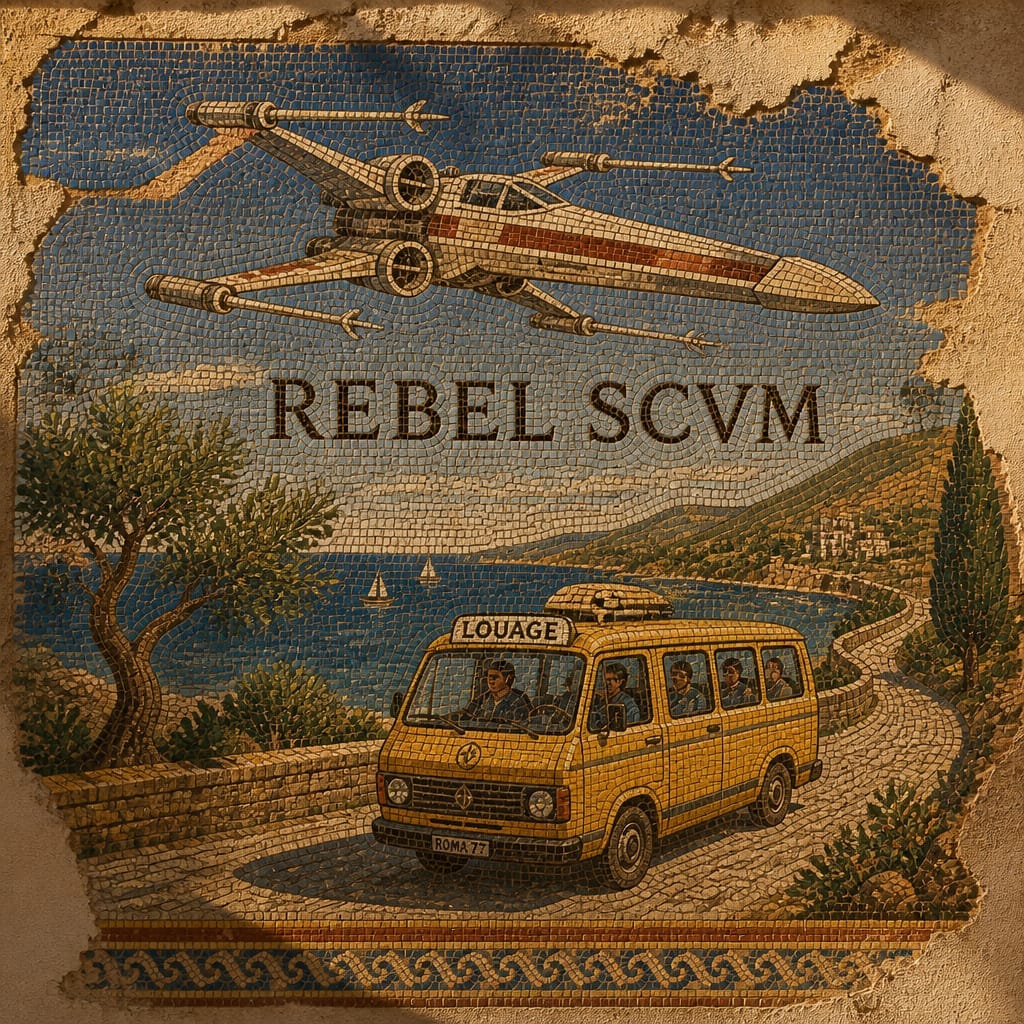
We had wine and charcuterie on a Friday afternoon with dear friends we don’t see often enough, because they live in Tunisia now.
Dan and Tammi — he writes the Project Archimedes Substack, she teaches English to teenagers in a fishing village on the Mediterranean — were back in the States for their daughter’s graduation. Summa cum laude from New Hampshire, in psychology. The daughter is in the Naval Reserves, a few years from military retirement and looking forward to her next act. They are quietly proud of this, the way good parents are when it’s obvious that the kid sticks the landing. We sat across a table from each other and caught up the way you do with people you love who live on the other side of an ocean: too fast, trying to fit everything in, the wine helping.

Dan is my brother from another mother, intellectually. I have good and dear friends in the Commune, people I trust with my life and my generator, but nobody else who can play a riff over the same chord progression. Dan and I can start a sentence about Heinlein and land it on federal workforce policy and neither of us needs a map for the route. Tammi is one of a kind — funnier and snarkier than Lady T, which is saying something, and the two of them on the other side of the table were having an entirely different conversation than we were. That’s the shape of a good afternoon with another couple: two conversations happening in parallel, occasionally intersecting, nobody bored.
They left the country about a year ago. Same reasons I moved my retirement savings offshore into the I-fund, same diagnostic, same reading of which way the wind was blowing. The difference is that Dan and Tammi packed their whole world into eight suitcases and got on a plane, and Lady T and I stayed in Utah. Same signals, opposite prescriptions. I’m fifty pay periods from a federal retirement, and that brass ring has its own gravity — you can’t walk away from a defined-benefit pension in a world where those barely exist, not without doing math that makes you nauseous. So we stayed. They went.
And now I wanted to know: what does it actually look like, on the other side of that decision?
Here is what daily life looks like in a small Tunisian fishing village, roughly sixty miles from Tunis, which is to say roughly sixty miles from the ruins of Carthage, and — Dan would want you to know this — next door to Tatooine.
Not metaphorically. Tataouine is a real town in southern Tunisia. Lucas filmed there. There’s the little hut where Luke watches the twin suns rise sits on a salt flat, and Dan and Tammi made the pilgrimage, and they have pictures. It is not, Dan reports, really a wretched hive of scum and villainy. They went into town to see Project Hail Mary after reading our review, on our assertion that it’s ‘a teacher movie,’ and picked the showing that was in English with French subtitles. Other options were Arabic and all-French. Three languages in one cinema, in a country most Americans couldn’t find on a map.
Tunisia is an Arabic-speaking, Islamic country. It is not the Saudi version of that description. This is the country that started the Arab Spring, the place where a fruit vendor named Mohamed Bouazizi set himself on fire in the very early days of 2011 and changed the entire region. It has a secular civic tradition, a French colonial layer that still shows up in the baguettes and the café culture, and a Mediterranean identity that runs deeper than either the Arabic or the French. The olive oil comes in fifty-liter drums, and you use it for a year. Five baguettes cost about a nickel in American money. The tea and coffee are ubiquitous and superb, although the tea is African style, served without milk.
There is no window shopping. You don’t browse. You know what you need, and you go to the specific place that has it, and you buy it. Much of the retail is what we might call a strip mall — five or six small shops together, each one doing one thing. Fruits and vegetables are seasonal in a way Americans have completely forgotten food can be. Bananas are imported from South America and they are expensive and occasional. Lady T’s breakfast banana habit would be a problem. Apples exist but they’re small and mealy, because the good ones get exported to someone who’ll pay more for them. That’s the developing-world relationship with global markets illustrated in one fruit: you can grow it, but you don’t get to eat the best of it.
The berry vendor is parked on the side of the road, close to traffic. They call them “danger berries,” because they are so close to the cars, but so good it’s worth the stop.
Dan brought a carbon steel pan in those eight suitcases. A really good one, because they love to cook. A few really good kitchen knives, including one made by his son-in-law, who is a skilled blacksmith. That knife is not just a kitchen tool. It’s a piece of family that fit in a suitcase. Woodcarving tools and other art supplies — Dan is a skilled artist, and the tools of his craft were non-negotiable. Good clothes. Very few books; those went to electronics, because he’s still living in the twenty-first century, just next door to Tatooine. He has his own iteration of Claude that he talks to back home, which is an image I can’t quite get over — an American expat in a Mediterranean fishing village, an hour from where Carthage used to be, talking to his AI about all of this.
And good British-style tea, because African tea is just different. It’s not designed to be served with milk, and when you’re used to English breakfast tea, that matters every single morning. The daily life of an expatriate is not defined by the big adjustments. It’s defined by the tea.
They live in a one-bedroom apartment in his sister’s house — his sister married a Tunisian man, and they’ve been there longer. Maybe a hundred square meters. Efficiency kitchen, en-suite bathroom, and a traditional Tunisian sitting area: a half-wall around a space with storage cabinets topped with cushions. Not a lot of room for accumulation. A thing has to have two or three uses to justify giving it part of their space. That’s not minimalism as an American lifestyle brand. That’s minimalism as physics, given respect because their rooms have walls.
If you need something from the Western world — a plumbing fixture to fit a broken sink, a good drill, a specific part — you take a ferry across the Mediterranean to Germany and buy the thing, and then you bring it back. Bring one. If you’re buying ten, Tunisian customs assumes you’re planning to sell them and charges a hefty import tax. The border doesn’t distinguish between “my friends also need a good drill” and “I’m running an import business.”
There is no Amazon. You cannot click twice on your phone and have a shovel show up the next day. The good shovels are at specialty stores in the big cities, if they’re anywhere. The local farmer either has a good one he’s had for thirty years, or the cheap Chinese one because that’s all he can afford. Cheap, fast, or good — pick one, and turn it up to eleven.
No permits required, either. There’s no OSHA. You want to sell food on the side of the road, you sell some food. You want to zip-tie some planks to the posts and stand on them with a brush and a can of paint, you do you. The same absence of institutional infrastructure that means you can’t get a good drill also means nobody’s standing between you and the work. America solved the safety problem and created the permission problem. Tunisia has the danger and the agency, bundled together, take it or leave it.
And this is where Dan said the thing that I think is the key to all of it.
Africa, he said, doesn’t have as far to fall.
We are looking at a reduction of roughly ten percent in global oil production. Five years minimum, maybe permanent. That’s the Hormuz conversation, and it’s the conversation underneath every other conversation Dan and I have. The global supply chain is a single system, and it has chokepoints, and the question is not whether it will be disrupted but when and how badly.
America built the most optimized, most interdependent, most frictionless supply-chain civilization in history. Click a button, a shovel appears. The corollary of that optimization is fragility. Every efficiency is a dependency. Every next-day delivery is a system that fails catastrophically when it fails at all.
Tunisia never built that infrastructure. Which means Tunisia never became dependent on it. The old cars run because they can be fixed, by a person, with basic tools and hands, without a software update. The motorcycles don’t run on computer chips. It’s a little like Cuba keeping the old American cars running since the fifties — not because they’re sentimental, but because they had to, and the skills and machine shops and parts distribution networks that grew up around that necessity became their own kind of wealth.
And here’s the part that matters: the guys who run little shops all day and then get together for coffee every evening — that’s not just social. That’s a business meeting. Who has what, where it is, what came in, what’s needed. Distributed inventory management, running on caffeine and social trust instead of enterprise software. Knowing a guy isn’t inefficiency. It’s the operating system.
Dan is right that Tunisia doesn’t have the same cushion we do. There’s less fat on the system — most of the stuff is already in use or has been repurposed until it’s used up. You don’t find Tunisian storage units full of table saws somebody used once. Here, we have fifty thousand storage facilities full of tools and furniture and appliances, all just sitting there in the dark — America’s accidental strategic reserve, filed under “hoarding” rather than “inventory.” If the supply chain seizes, that junk becomes a savings account we forgot we had.
But Tunisia also doesn’t have as far to fall. They’re closer to the bone, but they already know how to live there. The evening coffee meeting, the seasonal food, the thirty-year shovel, the danger berries on the side of the road. It’s a system that runs on less, because it always has.
Both systems have fatal dependencies. Theirs is diesel — local farms can't run without it, and there aren't enough donkeys in the country to replace what tractors move, even though there are still donkey carts in the streets. Ours is the expectation that a replacement is always on the way — that the flow never stops, that the next click always delivers. Tunisia depends on a commodity. America depends on a miracle of logistics that we've mistaken for a law of physics.
Here’s what I keep coming back to, a few hours after the lunch.
There’s a ruin near where they live. Mosaic tile floors, somebody’s little beach house, about fourteen hundred years old. There’s garbage in there because a shepherd was herding his flock nearby and stopped for lunch. No ticket booth. No tourists. No plaque explaining what you’re looking at. Just a mosaic floor, open to the sky, with a sandwich wrapper where the Romans — or whoever came after the Romans — used to sit.
That’s what a place looks like when it has so much history that it can’t afford to curate all of it. America puts everything behind glass because we don’t have enough. Tunisia leaves mosaic floors open to the weather because there are too many to fence.
I don’t know which country is making the smarter bet about the future. But I know which one has a longer memory. And I know that when my friends leave again — their Lufthansa flight was cancelled, so we get one more week, delivered via German bureaucratic incompetence or lack of jet fuel — the chairs across the table will be empty in a way that makes this whole contretemps feel personal. Because the system doesn’t just break institutions and norms. It scatters the people you love. And the evening coffee meeting where you talk about what matters is a little bit quieter without the guy who finishes your sentences.
Dan and Tammi, if you’re reading this later from the roof where you can see the ocean: we’ll keep the light on.
Consider sharing this with someone who’s weighing their own version of the same bet.
🐸🦝🦄
(Postscript: As it happened, Dan and Tammi made it as far as the auto shop where Stepson Jake is currently working. They are driving in an older car borrowed from their daughter and son-in-law, and the brakes were making a bad sound. So Lady T picked them up at the shop, and they came back and sat with us and the core group of the Commune, drinking good whisky and telling each other more stories until the work was done. It was a good day, and it made my heart happy to see them.)
You must read HCR as this column is such a necessary antidote.
“Here, we have fifty thousand storage facilities full of tools and furniture and appliances, all just sitting there in the dark — America’s accidental strategic reserve, filed under “hoarding” rather than “inventory.” If the supply chain seizes, that junk becomes a savings account we forgot we had”. Ah. Such a science fictional remark en passant !🙂 “America's accidental strategic reserve”. Love this.