Defying Gravity in 2025
Or: What did L. Frank Baum Know About Red Hats?

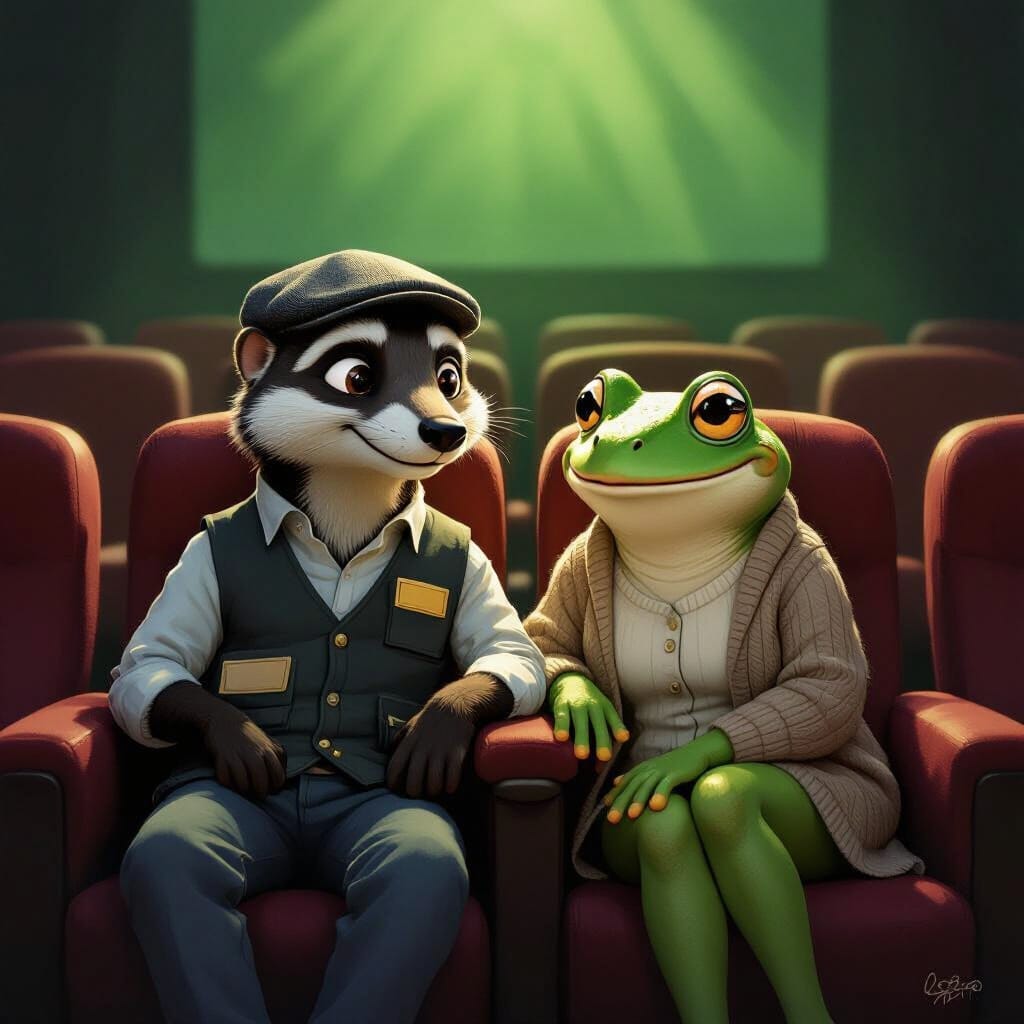
I’m trying to take a day of leave almost every week now. Sixty-six pay periods until retirement, and I don’t really care about the cash payout that would come with me if I had days left at the end. I’d rather lose the money and leave with my sanity intact. It’s my own personal response to the Use it or Lose it policy.
So there we were today, Lady T and me, settled into the dark of the weekday theater with overpriced popcorn, watching Wicked: For Good.
If you haven’t seen it: it’s spectacular. Visually stunning, emotionally rich, with performances that deserve every award they’ll inevitably win. Cynthia Erivo and Ariana Grande have chemistry that makes you believe in a friendship strong enough to survive political apocalypse.
But about halfway through, Lady T leaned over and whispered two words that reframed everything:
“Red hats. They might as well be wearing red hats.”
She was right.
The Scene
Jeff Goldblum’s Wizard has just discovered that Elphaba - the green girl, the outcast, the one who’s been mocked her whole life for being visibly different - has genuine power. Real magic. And he wants her.
Not in a sinister, cackling way. That’s not how seduction works.
No, he’s charming. He sees her potential. He tells her she’s special, that she’s been overlooked, that the system failed to recognize her gifts - but he sees her. She could be part of something big. She could belong.
Ariana Grande’s Glinda is already there, dazzling in the spotlight, living proof that the path works. Join us. Be celebrated. Be seen.
It’s the most effective recruiting pitch in history, and it works on the same principle whether you’re in the Emerald City or at a rally in Ohio: You’ve been forgotten, but we remember you. You’ve been mocked, but we respect you. Come be on the winning team.
Here’s your red hat.
Elphaba almost takes it. She wants to belong. So badly. Who doesn’t?
And then she sees behind the curtain.
The Curtain
I left the theater curious. The parallels felt too precise to be accidental - but the stage musical opened in 2003, Gregory Maguire’s novel came out in 1995, and the screenplay adapts that earlier material. They weren’t written about Trump.
And yet, here we are. The Fascist Authoritarian playbook has its bootprints all over this movie.
So I went down the rabbit hole. Or, I suppose, the yellow brick road.
L. Frank Baum published The Wonderful Wizard of Oz in 1900. Not the Dust Bowl era - the 1939 film moved Dorothy’s Kansas forward visually. Baum was writing from an earlier American crisis.
He’d lived in Aberdeen, South Dakota in the late 1880s, running a store and editing a newspaper, watching drought-ravaged farmers struggle against forces they couldn’t control. He was in Chicago for the 1896 Democratic convention when William Jennings Bryan delivered the famous “Cross of Gold” speech and captured the Populist imagination.
And then he wrote a children’s story.
In 1964, a historian named Henry Littlefield proposed that Baum’s fairy tale was actually a political allegory - and once you see it, you can’t unsee it.
The Yellow Brick Road is the gold standard. Dorothy’s slippers - silver in the book, not ruby - represent the free coinage of silver that Populists championed. The Scarecrow is the American farmer, dismissed as ignorant and muddle-headed. The Tin Man is the industrial worker, dehumanized into a machine. The Cowardly Lion may be three-time Presidential candidate William Jennings Bryan himself - all roar, no follow-through.
The Wicked Witch of the East represents the crushing forces of Eastern capital - banks, railroads, the whole machinery of Gilded Age exploitation. The Munchkins are common people, freed when that weight is lifted.
And the Wizard?
The Wizard is a humbug. A little man behind a curtain, projecting a terrifying image through noise and fire and spectacle. He rules through bluster. He has no real magic at all.
Sound familiar?
The Pattern
Here’s what I’ve come to understand: Baum wasn’t predicting Trump. He was capturing a pattern.
The specific faces change. McKinley’s sound-money Republicans. The Gilded Age robber barons. The culture warriors of the 1990s that Maguire was responding to. The regime we’re living under now.
But the shape stays the same:
A charismatic figure who rules through image and spectacle. An apparatus designed to intimidate. The revelation that there’s nothing behind the curtain but a small man working levers. Institutional enforcers who keep the system running. Scapegoats who get labeled “wicked” to justify the cruelty. And common people who had the power all along but didn’t know it.
That’s what good allegory does. It doesn’t just capture a moment - it captures the fractal geometry of how power works. Zoom in, zoom out, the pattern repeats.
So when Lady T whispered “red hats” in that dark theater, she wasn’t wrong. She was recognizing a shape that’s been recurring for at least 125 years.
The Cost of Seeing
The heart of Wicked isn’t the spectacle, though. It’s what happens after Elphaba sees behind the curtain.
She has to choose.
She can stay. She can have everything she ever wanted - belonging, recognition, power. All she has to do is not look too closely at what the Wizard is actually doing. At who gets hurt. At what the machine requires.
Or she can refuse. And lose everything.
“Defying Gravity” isn’t just a showstopper about a woman learning to fly. It’s about the moment of moral clarity that costs you your place in the world. I’m through accepting limits ‘cause someone says they’re so. She sees, and she can’t unsee, and that changes everything.
The system responds the way systems always respond. She becomes the Wicked Witch - not because she’s evil, but because the propaganda machine needs a villain. The same gifts that made her valuable become proof of her threat. The narrative gets written around her.
And here’s the part that lands hardest in 2025: Elphaba leaves, but Glinda stays.
Glinda sees what Elphaba sees. She knows. But she’s not ready to pay the price. So she smiles and performs and tries to do what good she can from inside the system, and her best friend becomes a wanted fugitive.
The film doesn’t judge her for this, exactly. It understands. Not everyone can burn their life down for principle, and the people who stay aren’t always cowards - sometimes they’re just not ready yet.
But it’s clear about the cost. When Glinda finally stands in the wreckage at the end, she’s been changed by what she witnessed and what she accepted. She’s not the same person who wanted to be popular.
For Good
I won’t lay out every beat, but the ending matters. If you haven’t seen the movie yet … spoilers follow.
Dorothy is barely in this film. We see silver slippers, a flash of blue gingham, the back of a head as the farm girl runs away. She’s not the story. Oh, sure, she’s the official story - the narrative the Wizard’s machine will tell. Wholesome girl defeats the Wicked Witch, order restored, nothing to see here.
But we’ve seen behind the curtain. We know what actually happened.
And in the final moments, when the Scarecrow opens a hidden door and we discover that Elphaba survived - that her death was a trick, that she and Fiyero escape together into the unknown - something unlocks.
The people we think we’ve lost to the machine aren’t always gone. Sometimes they’re working from the inside. Sometimes they’re waiting. Sometimes the story isn’t over just because the propaganda says it is.
The song that closes the film is “For Good.” Two friends, separated by impossible circumstances, acknowledging what they’ve meant to each other:
I do believe I have been changed for the better... Because I knew you, I have been changed for good.
It’s a pun, and it’s earned. “For good” as in permanently. “For good” as in toward goodness. Changed by fighting alongside someone. Changed by seeing clearly, even when it costs you.
You can’t go back to who you were before. You’ve seen behind the curtain. And once you know, you know.
The Whisper in the Dark
We’re all sitting in the dark right now, in a sense. Watching a spectacle, trying to figure out what’s real and what’s projection.
Some people see the Wizard and believe the fire and the smoke. Some people see behind the curtain and have to decide what to do about it.
Lady T and I have been married over twenty years now. We’ve built a life together - the little homestead, our friends in the Commune, the weekly Costco runs with the $1.50 hot dogs. We’re not heroes. We’re not leading any revolutions.
But we’re sitting in the dark together, and when one of us sees the pattern, the other one recognizes it too.
That’s not nothing.
Maybe that’s everything.
I really enjoyed the movie. I wonder and hope others will see the powerful symbolism.