Crafting a Revolution:
The Making Is the Point


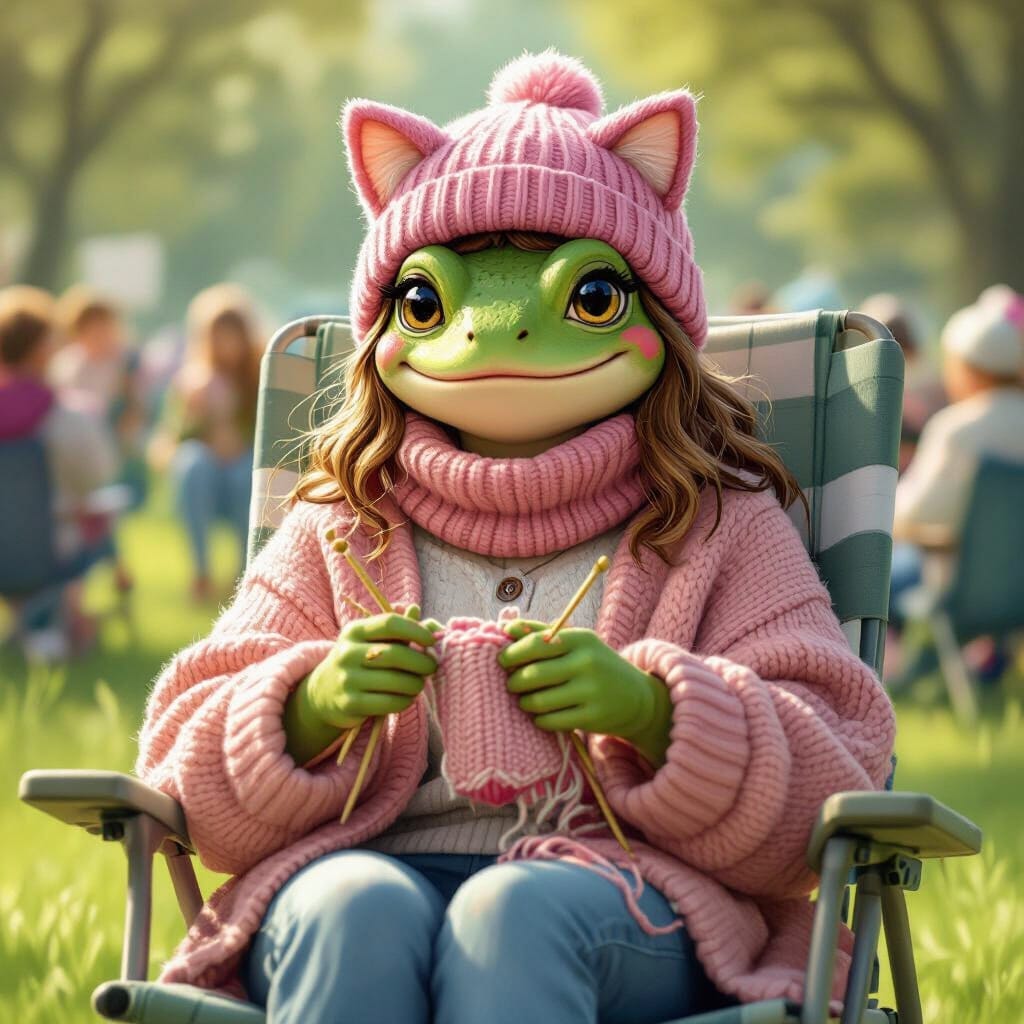
In March, my wife Lady T and I joined the No Kings rallies wearing matching frog hats. She made them herself - green yarn, crochet hook, the whole thing. We could have ordered something online. We didn’t.
At the time, I wrote about the frog as a symbol of joyous resistance - the tactical value of frivolity, of refusing to let the bastards set the emotional tenor of the fight. That piece was about what the hat meant. This one is about what it meant that she made it.
There’s a video making the rounds from Parkrose Permaculture about “craftivism” - the use of handwork as a tool for political organizing. The host makes a point that stuck with me: during World War II, we had machine knitting. We had the industrial capacity to mass-produce socks for soldiers. But both here and in the UK, communities organized around hand-knitting those socks anyway.
Why? Because the point wasn’t socks. The point was investment. Connection. Giving people a way to use their skills, to feel like they were contributing, to be part of something.
She tells a story about sharing a pattern for 3D-printed whistles for community watch groups, and someone asking why bother - you can order whistles cheap from Alibaba. And she says: No, you’re missing it. Think about all those nerds out there with 3D printers, itching for a way to contribute. Now they can. Now they’re in.
Stitching a Movement Together
There’s a political scientist at Johns Hopkins named Hara Han who studies movement building. She makes an observation that cuts to the heart of this: at a certain point in the history of every social movement that has ever changed the world, things get hard. The moment of crisis comes. And in those moments, what holds people together isn’t their commitment to the issue itself - it’s their relational commitments to each other.
The relationships are the infrastructure. The cause is what brings people in; the community is what keeps them when it gets costly.
Or as the saying goes: if we give the white ladies arts and crafts, they’ll finally show up for the resistance.
I’m being a little glib, but only a little. The craftivism framework isn’t about whether knitting a frog hat is the most efficient form of political action. It’s about understanding that movements are made of people, and people need entry points. They need ways to contribute that match their skills. They need to feel useful, connected, valued.
Once someone shows up to your knit-in, once they start 3D-printing whistles, once they’re baking for your mutual aid fundraiser - they’re in. They’ll level up. They’ll take on more. But first you have to get them through the door.
Following the Pattern
This isn’t new. The history of craft as resistance infrastructure is long, and better documented than people realize.
During both World Wars, knitting wasn’t just about producing goods - though it did that too. In occupied Belgium, resistance members used knitting to encode and transmit information about German troop movements. Knit and purl stitches form a binary system. An old woman sitting by a window with her needles, watching trains go by? She might be counting. She might be recording. Who would suspect her?
Under Pinochet’s Chile, women created arpilleras - textile scenes stitched onto burlap, documenting disappearances, torture, human rights abuses the regime denied. They were small enough to smuggle, innocent-looking enough to survive checkpoints, and they were carried out through church networks to tell the world what was happening. Fabric as witness. Thread as testimony.
The tricoteuses of the French Revolution are the iconic image - knitting women at the foot of the guillotine, needles clicking while the blade fell. But they’re a complicated symbol. By the time they were sitting in those squares, the revolution had already won. They weren’t resistance; they were victory lap. The same energy that had fueled the uprising had curdled into the Terror, and the craft that once built solidarity was now performed as spectacle at executions.
They’re worth remembering not as a model but as a warning: movements can win and still lose themselves. The relational bonds that hold people together in crisis can be redirected toward revenge as easily as toward justice. The making is the point - but it matters what you’re making for.
And then there’s Betsy Ross.
Ask any American third-grader who made the first flag. Legend says it was a seamstress in Philadelphia, approached by General Washington himself, who turned her upholstery skills toward revolution. The historical evidence is thin - the story comes from her grandson, almost a century later - but that’s not really the point. The story stuck because it captures something Americans want to believe about themselves: that the revolution was stitched together by ordinary people using ordinary skills, that a woman with a needle and thread could be as essential to independence as any soldier with a musket.
Whether or not Betsy Ross actually made that flag, the story of Betsy Ross has been doing political work for two hundred years.
Picking Up the Thread
Which brings us back to Portland, 2025.
When Trump sent National Guard troops to “protect” ICE facilities from what he called domestic terrorists, a group of women who called themselves Knitters Against Fascism showed up with lawn chairs and knitting needles. They weren’t there to riot. They weren’t there to burn anything down. They were there to sit calmly and knit, week after week, providing a visual counter-narrative to the lie that their city was “war-ravaged.”
They were also there to be friendly faces for immigrants arriving at the facility for appointments. To witness. To be present.
A knitwear designer named Michelle Lee Bernstein posted a frog hat pattern on her website. A month later, a church group had raised $550 for a local food bank selling hats they’d knitted from that pattern. One hat she made herself sold for $100, donated to the Northeast Emergency Food Program.
Small acts. Real money. Real food. Real community.
Tying the Knots
In March, Lady T sat down with her crochet hook and made two frog hats out of green yarn. We wore them to the No Kings rally and stood in a crowd of people who had made the same choice - not to order something, but to make something. To show up wearing proof of investment.
The hats were silly. That was the point. Joy as resistance, frivolity as a tactical choice. I wrote about that already.
But here’s the other thing: she made them. Hours with the hook, shaping the eyes, choosing the yarn. And in the making, she was part of something larger than the two of us walking down the street. She was connected to every other person who’d made a frog hat, or a protest sign, or a batch of cookies for a mutual aid bake sale, or a 3D-printed whistle for a community watch group.
The making is the point. Not because it’s efficient - it isn’t. But because movements aren’t made of causes. They’re made of people. And people need to feel useful. They need entry points. They need to contribute something with their own hands.
When things get hard - and they will get hard - what holds us together won’t be our commitment to abstract principles. It will be our commitment to each other. The relationships we built while making things together.
So if you’ve got a craft, bring it. If you knit, knit. If you crochet, crochet. If you’ve got a 3D printer gathering dust, find out what your local organizers need and print it. Show up to the meetings with your sketchbook, your knitting needles, your embroidery hoop.
Give the white ladies arts and crafts. They’ll finally show up for the resistance.
And once they’re in, they’ll stay.
Today feels like frog hat weather.
🐸 🐸 🐸 🐸