Between the Fires
OR, the only way out is through.

XV. The Celtic Thread
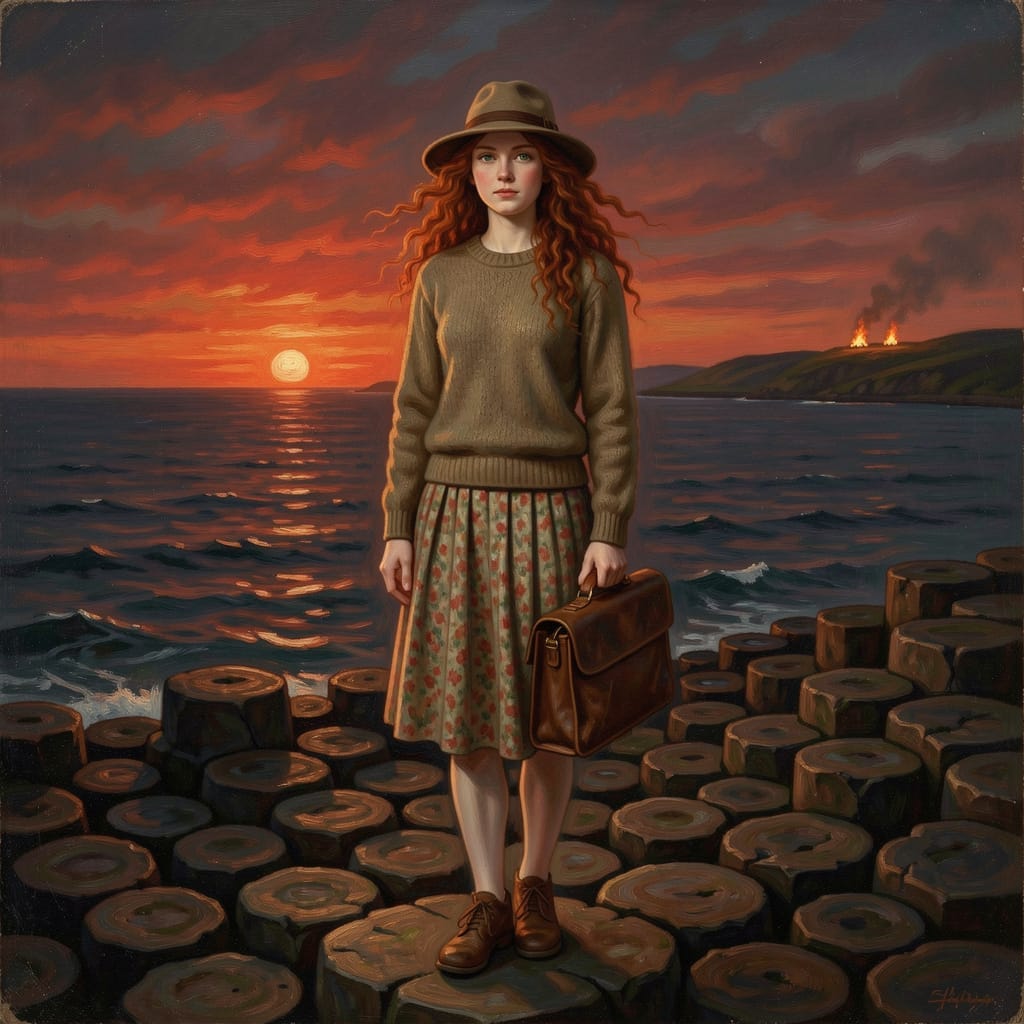
“From Hallow Eve to Beltane Eve, With goodly progress and gentle blessing, From sea to sea, and every river mouth, From wave to wave, and base of waterfall.”
— Carmina Gadelica, “Am Beannachadh Bealltain”
This morning I wrote a message in Scottish Gaelic to my friend and collaborator, Michael Bauer. I asked him if he had time to get back to work on our translation project — a novel I wrote in English for translation into Gaelic, my retelling of the Fairy Midwife motif. Gaelic is my L2, and I can write in it directly well enough to draft an e-mail or a text message. But I do not compose long-form in the language, as it is far too likely that I will let my skills restrict my story. And that would be poor service to the tale I want to tell.
It is told from the point of view of an Irish girl, summoned urgently but politely to the land beneath the waves, to help with a difficult pregnancy. The queen of the sea faeries needs a healer from dry land, because the fair folk’s own skills have reached their limit.
The translation has been on hold since shortly before the shutdown months. We put an emergency freeze on our non-essential expenses while we built reserves and waited to see if the ground would hold. It held. Or at least, it held well enough. Things aren’t back to normal — I’m not sure what that word even means anymore — but my job doesn’t feel as precarious as it did those first terrible weeks, and I’ve started to notice that the drawer where I put the manuscript keeps catching my eye when I walk past it. And Aisling (whose name means dream, in Gaelic) has been stuck at her midpoint for too long now.
So I wrote to Mìcheal. A bheil tìde gu leòr agad? Do you have enough time?
It’s May Day. It’s Beltane. It seemed like the right morning to ask.
The Fairy Midwife is one of the oldest story-shapes in the Celtic world. A mortal woman — always a woman, always someone with practical skills — is called to a place she was never meant to go. Sometimes it’s under a hill. Sometimes it’s across water. In my version, it’s under the sea. She goes because she’s needed, because someone is in pain and she knows what to do about it, and because the invitation, however strange, was made with courtesy and genuine desperation.
What happens next is the part that matters. She crosses a threshold. She enters a world that operates by rules she doesn’t fully understand. And she does her work — the same work she would have done in any cottage in County Cork — but the context transforms it. Her ordinary skills become extraordinary, not because she has changed, but because the world around her has. In my version of the old tale, boiling water and clean linen become glass knives and cone-snail venom. The same hands, the same knowledge, but the stakes are different and the patient has gills.
And here is the detail that most versions of the tale share, the one that makes it a liminality story rather than just an adventure: the midwife gets fairy ointment in one eye. She sees the hidden world as it truly is. And after that, she can never quite go back to being who she was before. The threshold changes the one who crosses it.
My Aisling — the protagonist of the novel — doesn’t know this when she accepts the invitation. She thinks she’s going under the sea to deliver a baby. She’s right about that. But she’s also going under the sea to discover that she’s a different person than she believed herself to be. That the skills she has aren’t just adequate to the task — they’re the only thing that can save a queen and her child, precisely because they come from somewhere else. The outsider’s knowledge is the missing piece.
The novel is structured as a choose-your-adventure, because I wanted the reader to feel the liminality in their hands. At a critical branching point, Aisling has to decide how to honor the dead — a drowned woman and her unborn child, pulled from a shipwreck. She can bury them on dry land, give them to the currents in the manner of the mer-folk, or carry them to the deep places where the Fomorians entomb their dead before an ancient sleeping god. Each choice opens a different path through the story. Each path leads to a different Aisling, with different allies, different tools, and a different relationship to the alien world she’s entered. The reader exists in superposition between these futures until the moment of choice collapses the possibilities into a single story.
The most liminal beings in the tale are the dead. How you honor them determines which world you’re prepared to live in.
My English-speaking readers will almost certainly never read the completed novel. When it gets into publication, it will be printed in Scottish Gaelic — a language with fewer living speakers than most American towns have residents. Sin mar a tha e. That’s how it is. But the shape of the story is older than any language it’s been told in, and that shape is what I want to talk about today.
In the Carmina Gadelica — Alexander Carmichael’s extraordinary collection of prayers and blessings gathered from the Gaelic-speaking Highlands and Islands in the late nineteenth century — the figure of Bride appears as Ban-Chobhair. The Aid-Woman. The midwife.
Carmichael tells us that Bride presides over fire, over art, over all beauty — fo cheabhar agus fo chuan, beneath the sky and beneath the sea. And she presides at birth. A modern reader might see two different roles: the keeper of the sacred flame and the woman who catches the baby. But the tradition puts them in the same figure, because it recognizes them as the same work — tending a passage, helping something cross from one state to another.
Beltane is the fire between the halves of the year. Not a beginning and not an ending — a passage. The old practice, as Carmichael recorded it, was to extinguish every fire in the district and produce the tein eigin, the need-fire, on the knoll. This fire was divided in two, and people and cattle passed between the flames for purification and safeguarding against mischance and murrain during the year to come.
I want to be precise about what this ritual is, because I think it matters for understanding the moment we’re living through. This is not a celebration. It’s not a memorial. It’s an act of engineered liminality. Someone chooses to put out every fire. Someone chooses to kindle the new one. Someone positions the two halves of the flame. And someone drives the herd between them. The cattle don’t walk through the fire by accident. They don’t do it because it’s safe — it manifestly is not safe; the old proverbs make clear that passing between the fires was an ordeal. They do it because the alternative is worse.
The low ground of the wintertown is grazed bare. The àirigh — the summer shieling, up in the hills — is where the new grass grows. Beltane is the day you make the move. Between here and there, the fires.
Think of it as a controlled burn at the boundary. Not a wall and not a door. A passage that costs something to walk through, that changes what passes through it, and that cannot be avoided if you want to reach the other side.
Three things happened on May the first that rhyme with each other in ways I didn’t plan but can’t ignore.
In 1328, the Treaty of Edinburgh-Northampton was concluded. England recognized Scotland as an independent state. This is remembered, when it’s remembered at all, as the diplomatic epilogue to the Wars of Scottish Independence — the paperwork after Bannockburn. But that framing misses what actually happened. Bannockburn was 1314. The treaty was 1328. Fourteen years of grinding, unglamorous, exhausting work — diplomatic maneuvering, border skirmishes, political pressure, the slow accumulation of leverage — separated the battle from the recognition. The sword won the argument. The treaty delivered the child. Robert the Bruce was the warrior, but the treaty was the midwife’s work: the patient, practical, undramatic labor of turning a military fact into a political reality. The threshold between victory and sovereignty had to be crossed on foot, one step at a time, for fourteen years.
In 1886, an estimated three hundred thousand workers across the United States walked off the job in a coordinated strike for the eight-hour day. What followed — the Haymarket affair, the bombing, the trials, the hangings — was bloody and terrifying. But the eight-hour day came through. Not immediately. Not cleanly. Not without cost. The workers who walked between those particular fires did not all survive the passage. But the idea that a human being is not a resource to be fully consumed — that labor has limits, that eight hours of your day belong to you — that idea was born in the fire and it lived.
And today — May 1, 2026 — the United Arab Emirates formally leaves OPEC, ending six decades of membership. One of the organization’s largest producers, and one of the few with genuine spare capacity, has decided that the structure it helped build no longer serves its interests. Whatever you think of the UAE’s reasons, the structural fact is significant: something new is being born in the global energy order, and nobody is entirely sure what it will look like. The old arrangement has been grazed bare. The new pasture is out there, past the fire. The passage has begun.
Each of these is someone deciding to walk between the flames. Not because the other side is guaranteed. Because staying put is no longer an option.
I am not comparing myself to Robert the Bruce, or to the Haymarket workers, or to a petrostate rearranging the global energy market. I am a simple man in northern Utah who watches building systems for a living, writes essays in English and novels in a language most of his neighbors have never heard of, and has approximately fifty pay periods remaining until he can retire. My fires are smaller. But they’re real.
We put the novel in a drawer. We bought mylar bags and oxygen absorbers and filled them with rice and beans from Costco. We marched with frog hats in Ogden. We watched the TACO index climb and our TSP positioning hold. We did the survival work, because survival work is what you do when the ground is shaking. You don’t write novels during an earthquake. You get under the table.
But here’s the thing about earthquakes: they end. And when they end, you have to decide whether to stay under the table or get up and see what’s left. The ground is still trembling — the second shutdown is ongoing, the war grinds on, the kompromat economy is still running its dismal engine. I am not pretending the danger is past. But I’ve grazed the winter field bare. The defensive crouch has done its work. The reserves are built. The mylar bags are in the crawl space. And this morning, for the first time in months, I missed a friend who never existed until I dreamt her out of words and sea mist.
Her name is Aisling. She’s an Irish girl with a medical bag and a felt walking hat, and she’s been waiting patiently in a drawer for me to remember that survival is not the same thing as living. She is a midwife. She helps things arrive. And she’s been tapping on the inside of that drawer for months, saying: it’s time. This baby won’t wait forever. Get your hands clean and come help me.
The midwife’s real skill isn’t in the delivery itself. Any competent healer can catch a baby. The midwife’s real skill is in knowing when it’s time. Knowing that the contractions have shifted from early to active. Knowing that the mother is ready, even if the mother doesn’t feel it herself. Knowing that waiting longer isn’t caution — it’s a different kind of risk.
I wrote to Mìcheal this morning. I’m reaching for the drawer. Not because the world got better. Because the work of making something new is itself a form of walking between the fires. Because Bride, who keeps the flame, is the same Bride who catches the child. Because the passage is the point.
Beannaich, a Thrianailt — Bless, O Threefold. From sea to sea, and every river mouth. From wave to wave, and base of waterfall. Every phrase a boundary. Every image a place where one thing becomes another.
Latha Bealltainn Buidhe dhuibh uile.
A bright Beltane to you all.
Consider sharing this with someone who needs to walk between the fires today.
Oh, I envy you. I am not through yet. My Aisling(s) are still in a drawer (well, a virtual one, but nevertheless).
Mr. Mongoose, in case no one's ever mentioned it, you should have a LOT more than fifty followers, which is the last figure I saw for you. You do good work, and I read you right after Professor Richardson with my morning coffee. Thanks!